
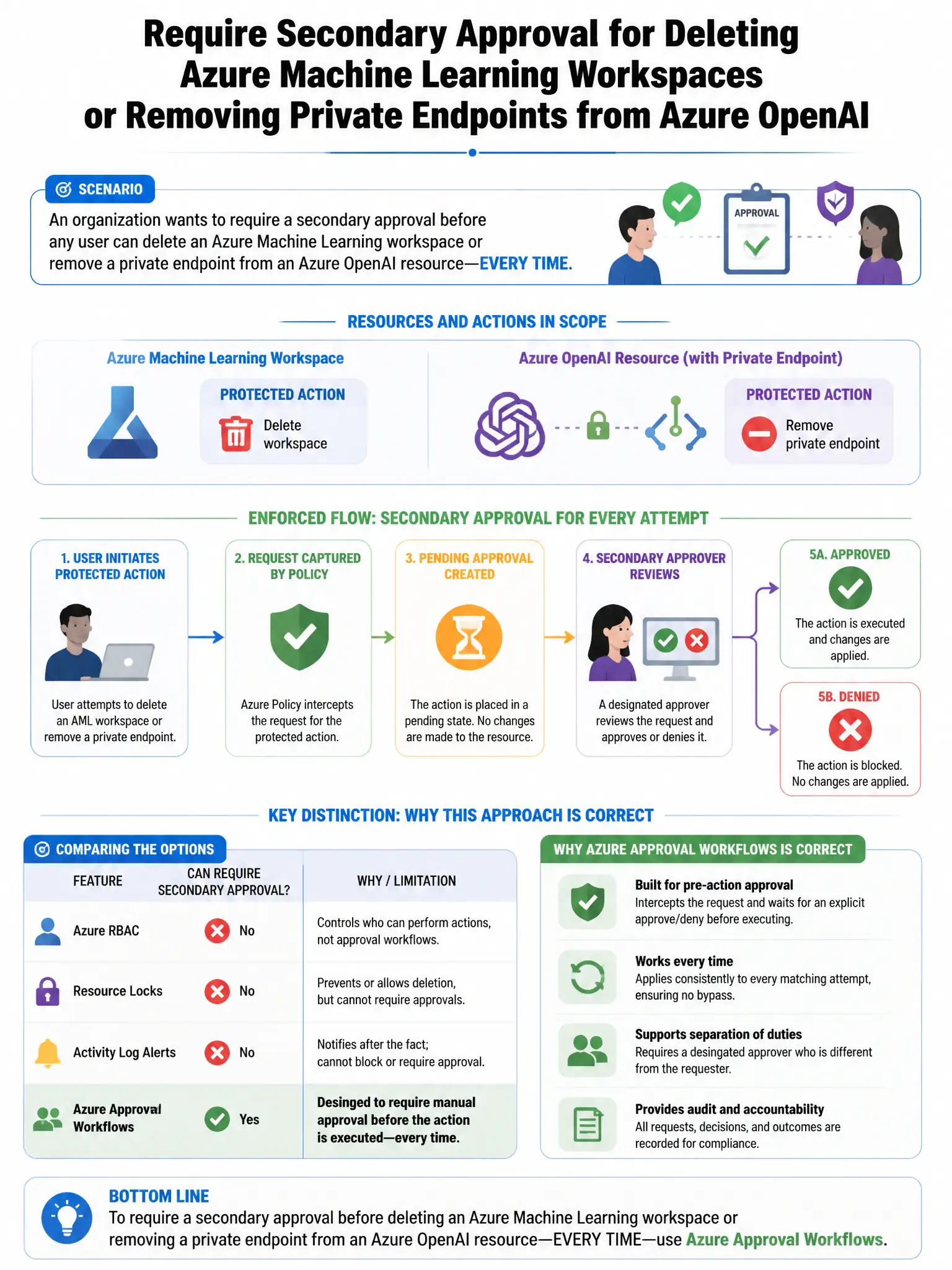
An organization wants to require a secondary approval before any user can delete an Azure Machine Learning workspace or remove a private endpoint from an Azure OpenAI resource—even if that user has Owner or Contributor permissions. Which Microsoft Entra ID feature enables this approval gate for specific sensitive Azure management operations?
Select an answer to reveal the explanation.
Short Explanation
Here's the deal — you need the Microsoft Entra ID Protected Actions approach with a Conditional Access policy requiring approval MFA for delete operations. It forces a step-up approval before sensitive management actions, even for Owner or Contributor users.
Full Explanation
The Microsoft Entra ID Protected Actions approach with a Conditional Access policy requiring approval MFA for delete operations is correct because Microsoft Entra ID Protected Actions allows administrators to designate specific Microsoft Entra ID permissions, including management plane operations, as protected. When a user attempts a protected action, such as deleting an Azure Machine Learning workspace or removing a private endpoint from an Azure OpenAI resource, they must satisfy a Conditional Access authentication context—typically stepping up to phishing-resistant MFA or getting manager approval through an authentication flow—before the action is permitted. This adds a mandatory approval gate beyond what RBAC alone provides. The Azure Resource Lock (CanNotDelete) approach is wrong because Azure Resource Locks prevent deletion by anyone until the lock is manually removed by a user with appropriate permissions, but removing the lock itself does not require additional approval—any user with the required lock management permission can remove it. The Azure Policy DeployIfNotExists effect approach is wrong because Azure Policy DeployIfNotExists targets resource deployment configuration, not management plane delete operations. The Entra ID PIM role assignment expiration approach is wrong because Entra ID PIM role expiration limits how long a role is active but does not add an approval gate for specific operations while the role is active.