
Permits call an external language-model REST endpoint from SQL and must authenticate securely. What should they use?
Select an answer to reveal the explanation.
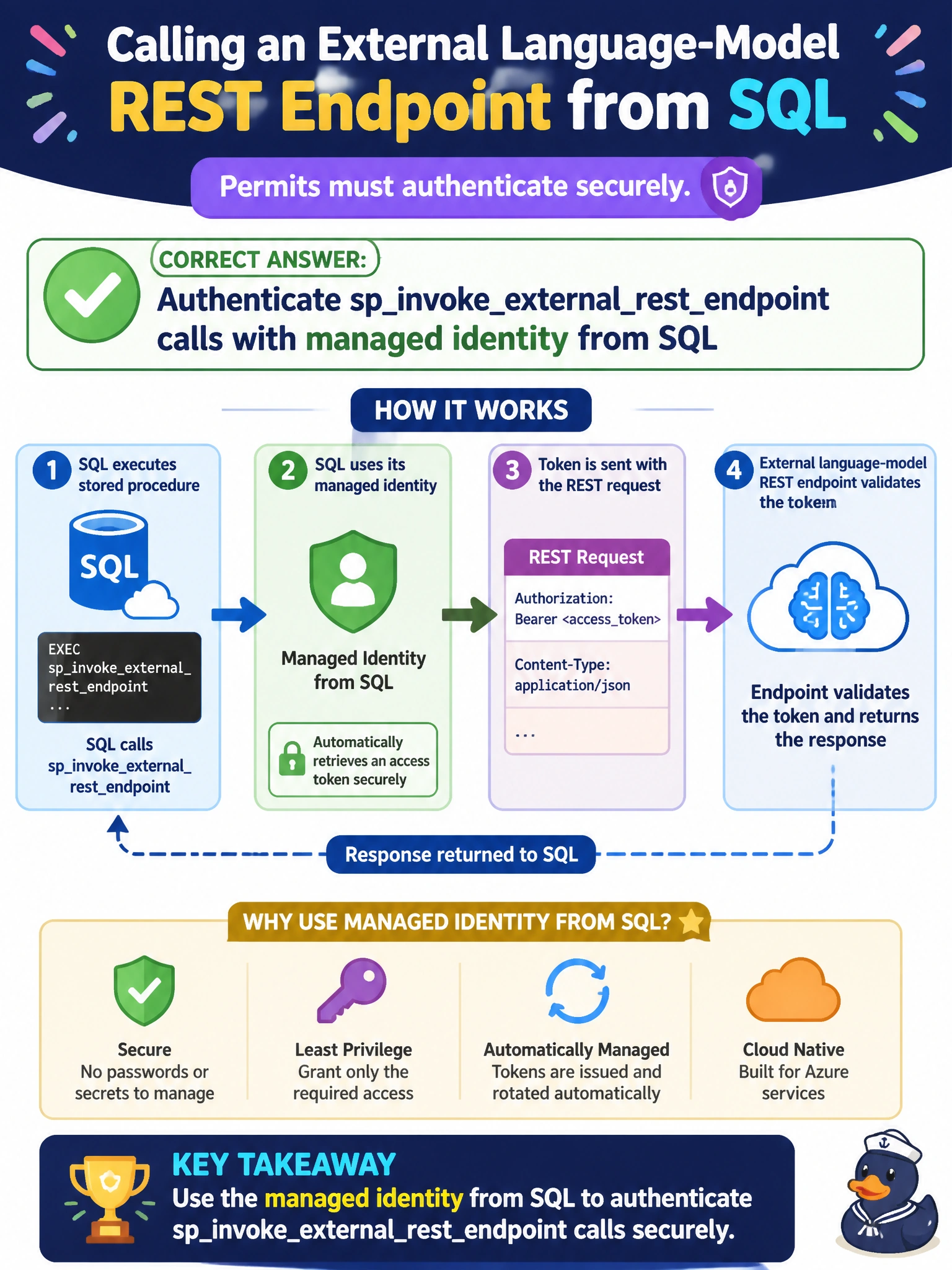
Short Explanation
Managed identity is the permits desk badge for SQL-to-model calls—no sticky-note passwords taped to the procedure.
Full Explanation
Permits should authenticate sp_invoke_external_rest_endpoint calls with managed identity from SQL when calling an external language-model REST endpoint. Managed identity avoids embedding long-lived secrets in T-SQL and aligns municipal SQL-to-model calls with Azure AD–backed authentication practices expected in secure DP-800-style designs. Embedding long-lived personal access tokens in every public stored procedure body fails by concept because secrets in procedure text are broadly readable through definitions, hard to rotate, and frequently leaked in source control or admin scripts. Disabling authentication so anyone can invoke the model endpoint anonymously fails by removing access control and exposing a billable, potentially sensitive civic AI endpoint to abuse. Passing database sa passwords in query string parameters to the model URL fails by misusing database credentials as API authentication, leaking them into logs and proxy URLs, and violating least privilege. Exam caveat: managed identity must be granted to the correct endpoint audience or resource and allowed through egress controls—identity configuration alone does not succeed if RBAC or networking is incomplete. Operationally, enable a managed identity for the SQL host, grant it rights to the model endpoint, configure sp_invoke_external_rest_endpoint without inline PATs, rotate away any historic secrets, and audit successful versus denied invoke attempts for the permits workload.