
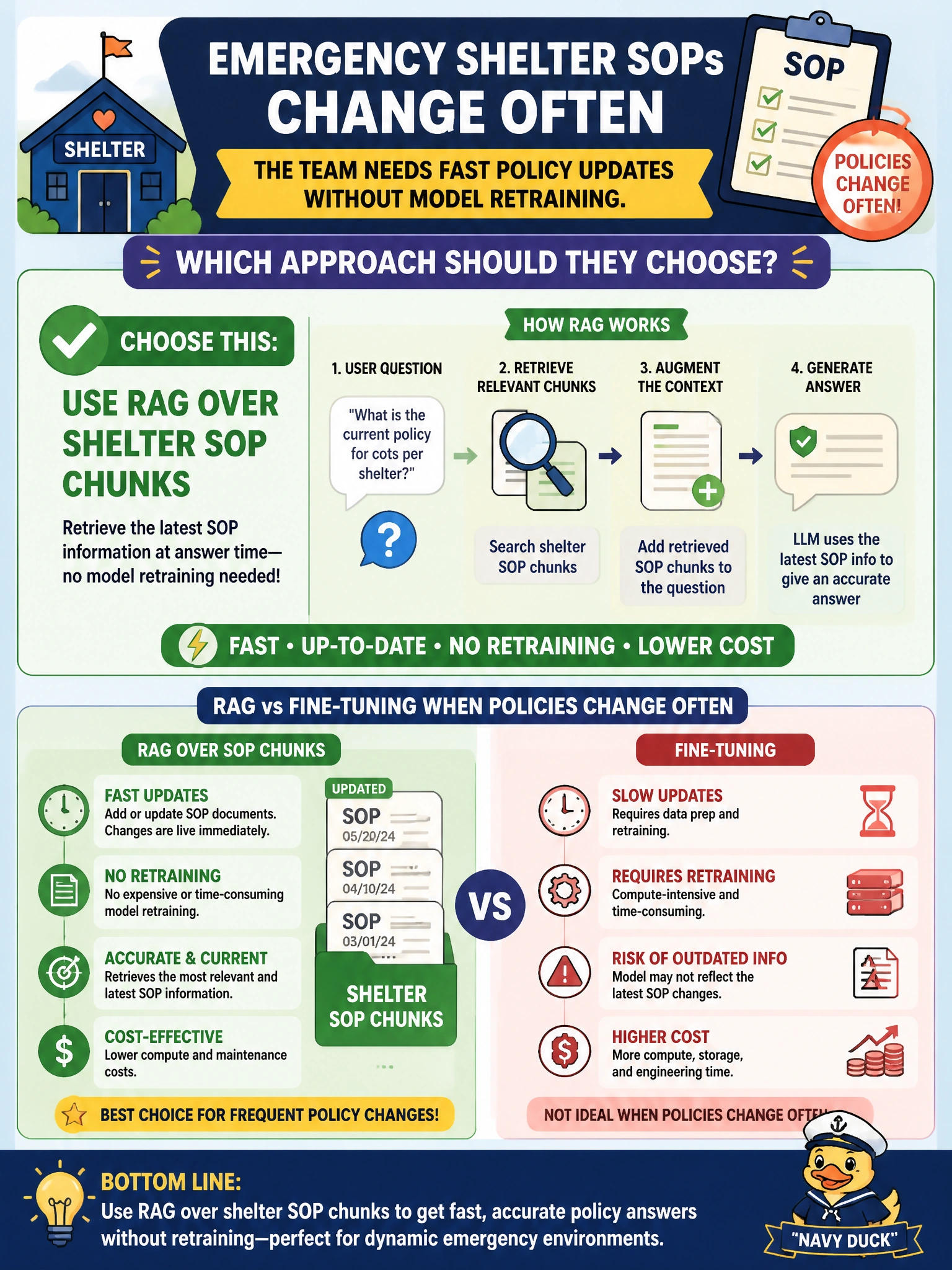
Emergency shelter SOPs change often and the team needs fast policy updates without model retraining. Which approach should they choose?
Select an answer to reveal the explanation.
Short Explanation
When shelter SOPs change weekly, RAG is the sticky-note update on the binder—swap the chunks, skip the expensive retrain.
Full Explanation
Emergency shelter teams should use RAG over shelter SOP chunks rather than fine-tuning when policies change quickly and answers must track the latest text without model retraining. RAG updates by refreshing or re-indexing retrieved municipal SOP chunks, which fits emergency content that can change daily during activations. Fine-tuning a new model for every SOP edit before any assistant can answer fails by concept because fine-tuning is slow, costly, and operationally heavy relative to publishing changed chunks into the retrieval store. Ignoring SOP changes and keeping answers from outdated model weights only fails because parametric memory lags policy and can give obsolete shelter instructions when minutes matter. Deleting all SOP chunks so neither RAG nor fine-tuning has source text fails by removing the authoritative content both approaches need and leaving the assistant without a source of truth. Exam caveat: RAG still requires disciplined chunk publishing and cache invalidation—leaving stale SOP chunks in the index recreates the outdated-answer problem without any fine-tune cycle. Operationally, store versioned shelter SOP chunks, re-index on publish, answer via retrieval-grounded prompts, measure time-to-update after an SOP edit, and reserve fine-tuning for stable style or domain behaviors that do not encode fast-changing emergency procedures.