
Water ops want sensor anomaly rows included in a RAG prompt’s context window for the language model. How should those rows be packaged?
Select an answer to reveal the explanation.
Short Explanation
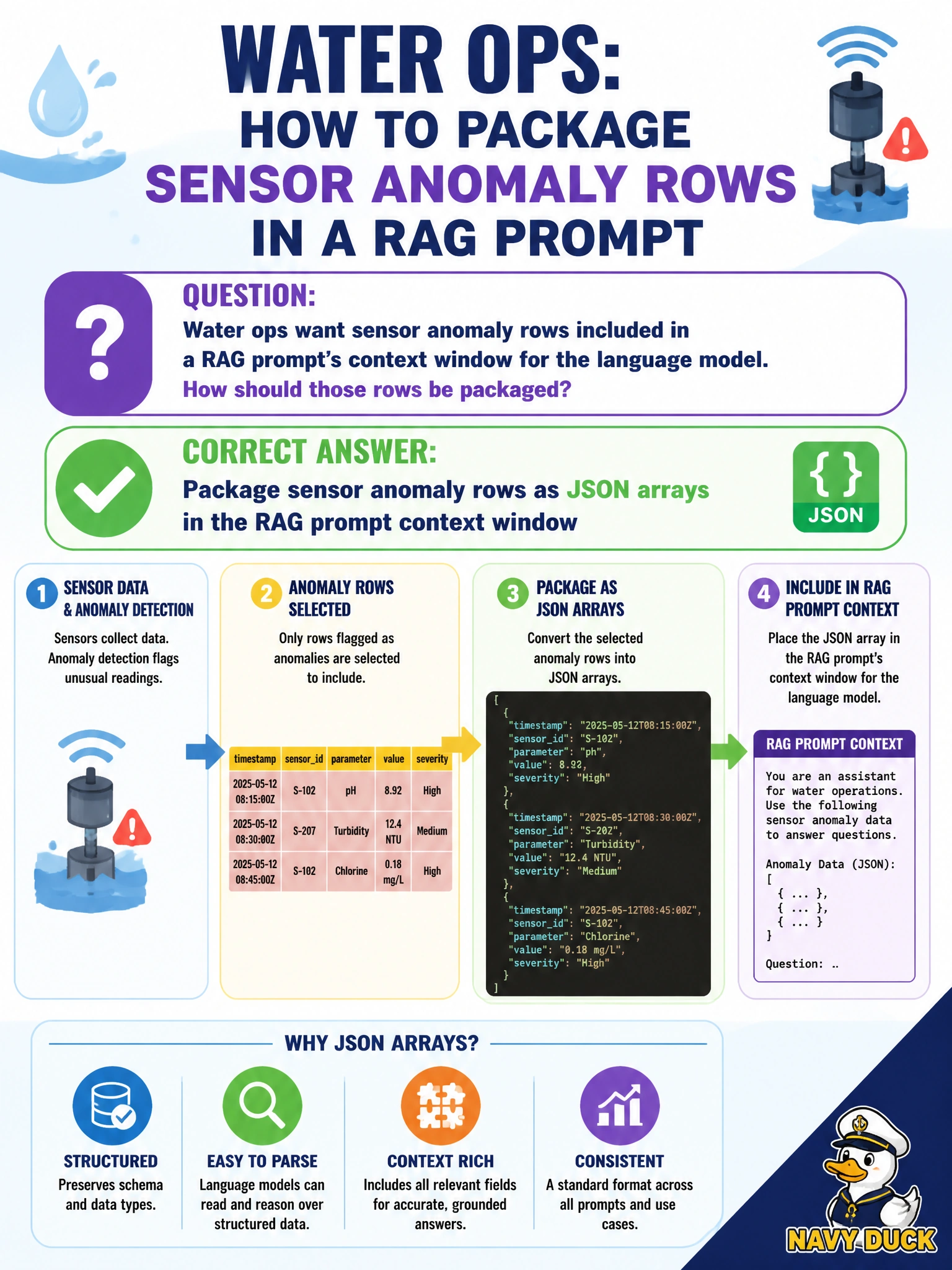
JSON arrays are how water ops pack anomaly rows into the prompt lunchbox—structured, readable, ready for the model.
Full Explanation
Water ops should package sensor anomaly rows as JSON arrays in the RAG prompt context window so the language model receives structured, parseable civic telemetry rather than opaque artifacts. JSON arrays preserve field names and values for anomaly timestamps, tag names, severities, and readings, which models can cite when summarizing operational issues for operators. Leaving anomaly rows as unreadable binary blobs outside the prompt fails by concept because binaries do not provide usable structured context inside the context window for RAG. Omitting anomalies entirely so the model has no structured sensor context fails by asking for anomaly-aware answers without supplying the rows that constitute the evidence. Pasting anomaly rows as unsorted screenshots that the model cannot parse as data fails because image pastes are a weak substitute for explicit JSON fields in this packaging pattern and hinder reliable field-level grounding. Exam caveat: respect context-window limits—send the highest-priority anomaly subset, aggregates, or recent windows rather than unbounded history that truncates mid-array. Operationally, serialize selected anomaly rows to JSON arrays, include them beside the operator question in the RAG prompt, verify the model references actual tag names and values, and monitor prompt size against model context quotas during incident spikes.