
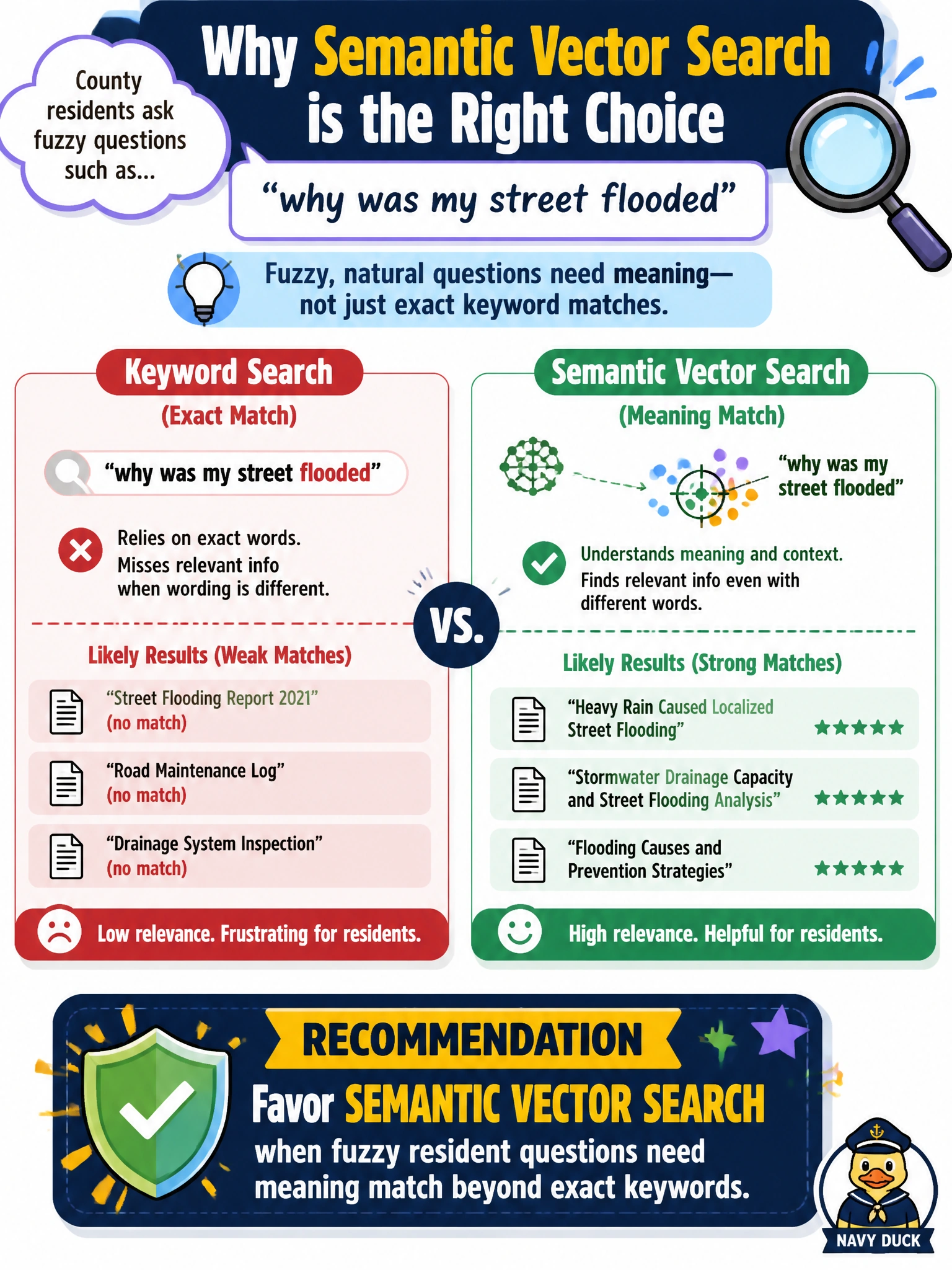
County residents ask fuzzy questions such as “why was my street flooded” where exact keyword matches are weak. Which search approach should the team favor?
Select an answer to reveal the explanation.
Short Explanation
When you hear “why was my street flooded,” exact keyword matches can miss what the resident means. Semantic vector search helps you find relevant information even when the wording differs.
Full Explanation
When county residents ask fuzzy questions such as “why was my street flooded,” favor semantic vector search because matching meaning matters more than matching exact keywords. Embeddings can retrieve flood-related knowledge or case notes even when residents describe causes, locations, or impacts in everyday language that does not mirror catalog terms. Strict full-text token matching alone fails for fuzzy intake: if a paraphrase shares few exact tokens with relevant content, results may be weak or absent. Refusing all flood-related questions and providing no search path fails by denying service rather than choosing a suitable way to retrieve information. Matching only a utility account number and ignoring question meaning also fails: account identity may help authorize access, but it does not interpret the intent of a free-text question. Exam caveat: semantic similarity is not proof; use grounding and source filters, and do not present a match as an official flood-cause determination without authoritative records. As a practical check, embed the flood knowledge corpus with a documented model, test retrieval with real resident phrasings, and route questions requiring transactional answers to authoritative work-order or sensor records.