
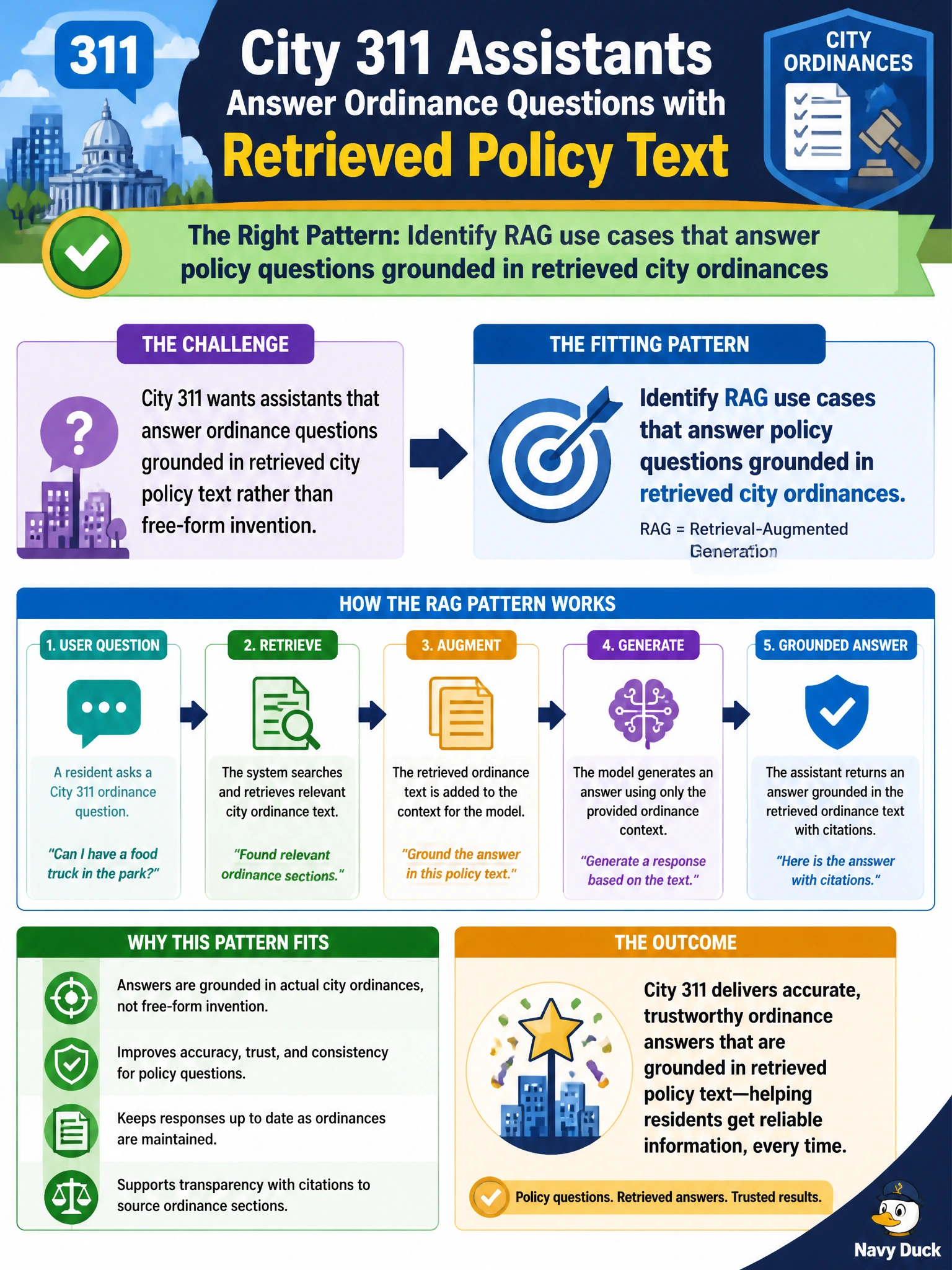
City 311 wants assistants that answer ordinance questions grounded in retrieved city policy text rather than free-form invention. Which pattern fits?
Select an answer to reveal the explanation.
Short Explanation
You want RAG for 311 policy questions: it is like answering with the ordinance binder open on your desk, not inventing rules from memory. Grounding answers in retrieved city policy text keeps them tied to the ordinances.
Full Explanation
City 311 should identify RAG use cases that answer ordinance questions grounded in retrieved city policy text rather than free-form model invention. Retrieval-augmented generation fetches relevant ordinance chunks first, then conditions the language model on that civic context so answers stay tied to published policy. Answering ordinance questions from pretrained model knowledge without retrieving city policy text fails because parametric memory can hallucinate or drift from the current municipal code. Disabling assistants entirely and never grounding answers in ordinances abandons the goal of a grounded assistant instead of implementing RAG. Retrieving only unrelated parking-lot camera IDs fails because those identifiers are not ordinance text and cannot ground policy answers. Exam caveat: RAG grounding quality depends on chunking, retrieval relevance, and prompt instructions that constrain answers to the provided context; merely enabling a model endpoint is not RAG. Operationally, index ordinance chunks for retrieval, require the assistant to insert retrieved text into the prompt, evaluate answers against current code citations, and refresh the chunk store whenever ordinances are amended.