
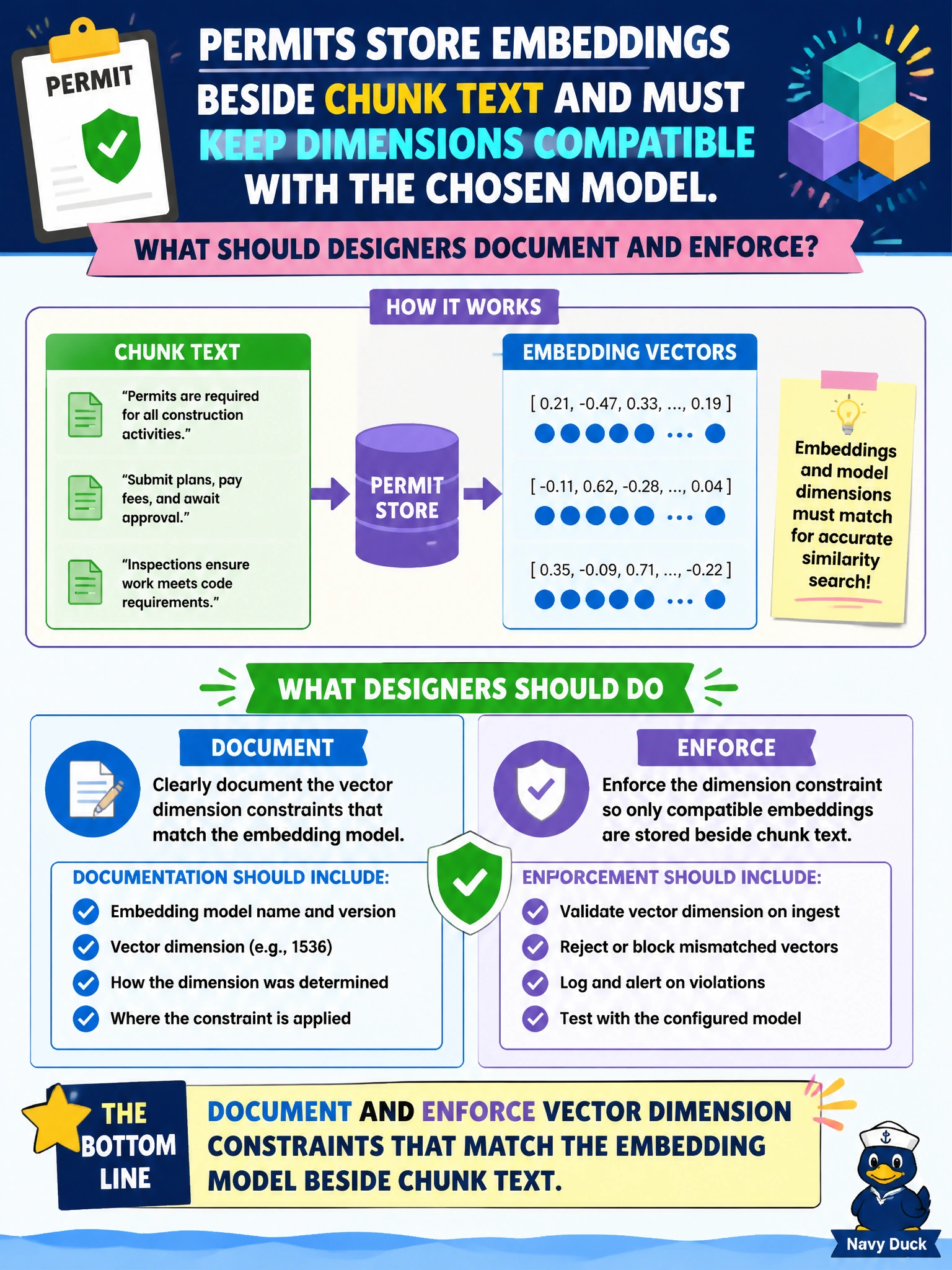
Permits store embedding vectors beside chunk text and must keep dimensions compatible with the chosen model. What should designers document and enforce?
Select an answer to reveal the explanation.
Short Explanation
You’ll want to document and enforce dimension constraints that match your embedding model beside the chunk text. That keeps your schema reliable as you store and retrieve permit embeddings.
Full Explanation
Designers should document and enforce vector dimension constraints that match the embedding model when storing vectors beside chunk text. Dimension alignment is a schema correctness requirement: VECTOR_SEARCH and index builds assume a consistent vector size, and municipal RAG chunk tables can break when mixed models write incompatible widths into one column. Letting each model store vectors of its own size in a shared column fails because heterogeneous widths corrupt similarity comparisons and typically cause insert or index operations to fail. Storing embeddings as free-form prose paragraphs fails because prose is not a fixed-dimension vector type that an engine can index for nearest-neighbor search. Omitting dimension documentation fails because support staff cannot verify schema fit when models or vendors change. Exam caveat: dimension enforcement must stay tied to model identity; rotating to a new embedding model usually requires a new column or controlled migration, not silent overwrites into the old width. As a practical check, record the model name and dimension in the chunk table contract, validate inserts with constraints or application checks, reject mismatched batches in CI, and re-embed historical permit chunks if the model dimension changes.