
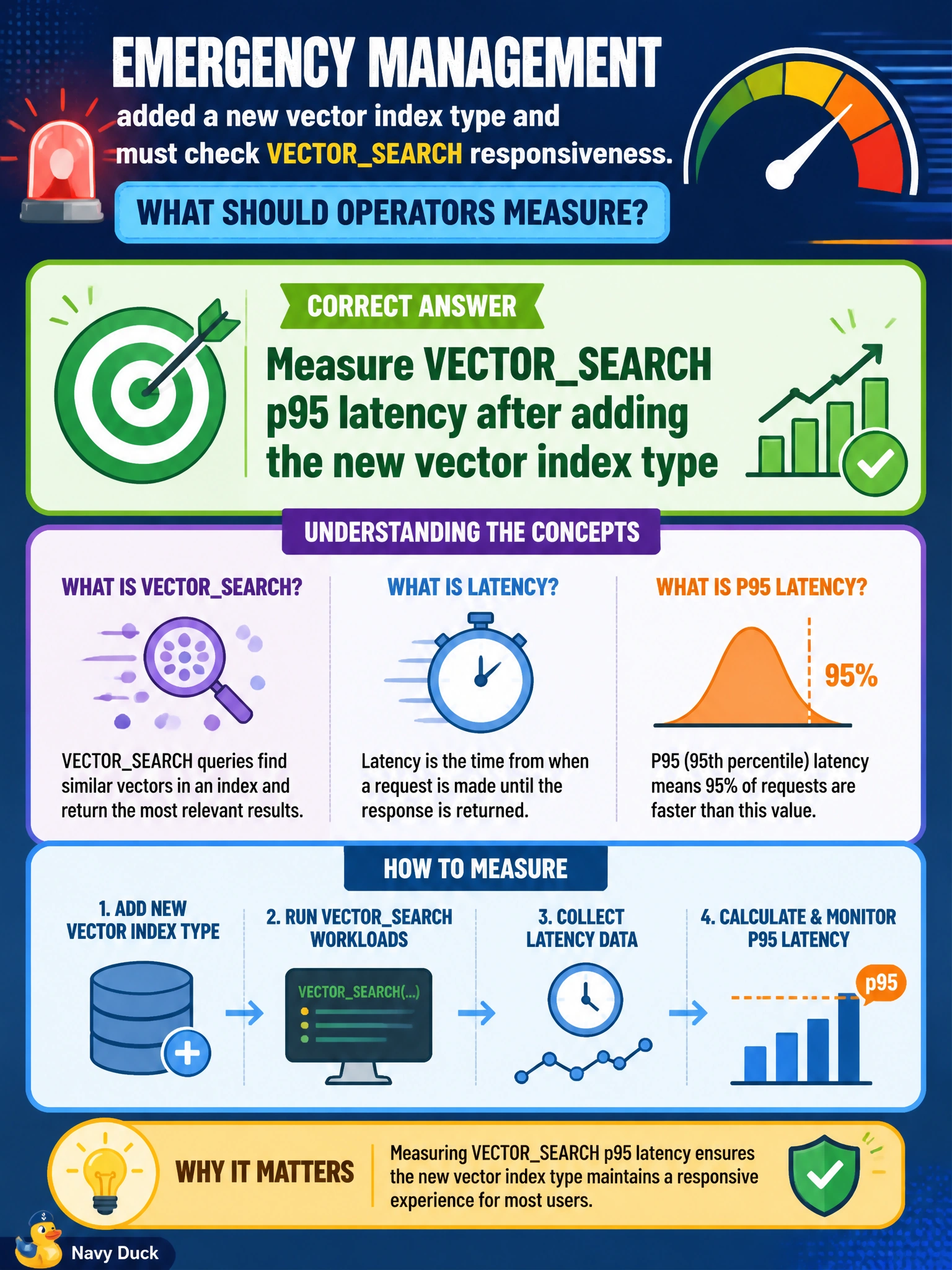
Emergency management added a new vector index type and must check VECTOR_SEARCH responsiveness. What should operators measure?
Select an answer to reveal the explanation.
Short Explanation
After a new vector index, ops times the slow-ish end of the pack—p95 latency—to see if VECTOR_SEARCH still feels snappy.
Full Explanation
After adding a new vector index type, emergency management operators should measure VECTOR_SEARCH p95 latency to validate responsiveness under realistic tail conditions. p95 (and similar percentiles) reveal whether the new index keeps municipal search snappy for most queries, not just the lucky average case. Measuring only the length of the emergency siren tone and ignoring search latency fails by concept because siren acoustics are unrelated to vector query performance. Avoiding timing queries so index changes cannot be evaluated fails by removing the measurement needed to accept or roll back the index change. Deleting the vector index immediately without collecting latency data fails by discarding both the index investment and any evidence about whether it helped or hurt VECTOR_SEARCH. Exam caveat: latency alone is insufficient—pair p95 with recall or relevance checks so a faster index is not accepted if neighbor quality collapses for emergency SOP retrieval. Operationally, capture baseline p50/p95 VECTOR_SEARCH latency before the change, deploy the new index type, remeasure under representative concurrency, compare against emergency SLOs, and keep a rollback path if tail latency regresses.