
A water utility needs hybrid search that still elevates exact chemical-name keyword hits while using vectors for narrative lab notes. How should they design it?
Select an answer to reveal the explanation.
Short Explanation
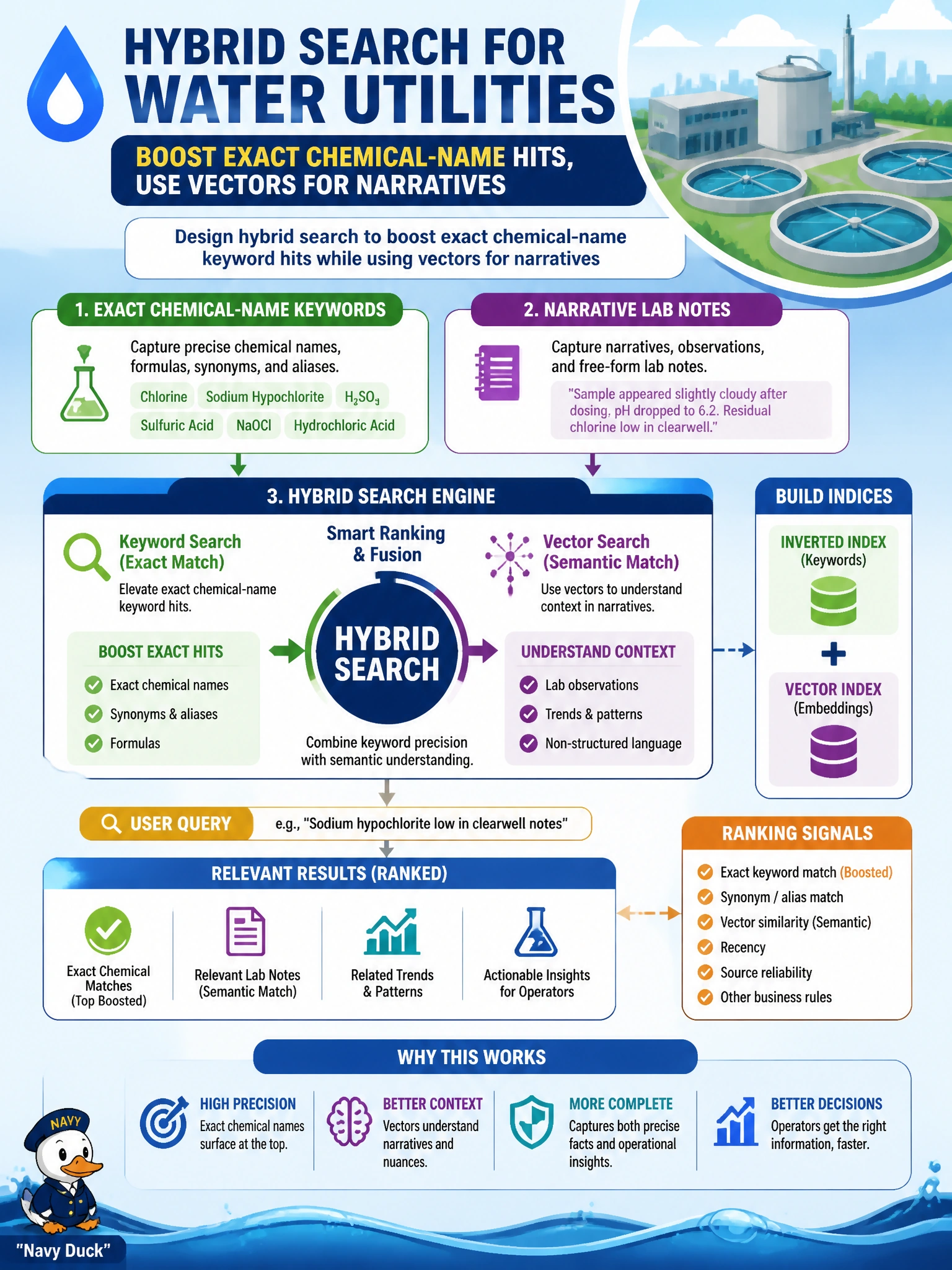
Hybrid with a keyword boost is like putting the exact chemical name on a loudspeaker while vectors still hunt through the narrative notes.
Full Explanation
Water utilities should design hybrid search to boost exact chemical-name keyword hits while still using vector similarity for narrative lab notes. Regulated chemical identifiers often require precise lexical elevation, whereas lab narratives are paraphrased and benefit from embeddings; hybrid design with keyword boost satisfies both municipal needs in one retrieval path. Dropping keyword matching so chemical names never boost exact hits fails by concept because exact chemical strings are high-precision signals that should not be diluted into pure vector ranking alone. Searching only the plant street address and ignoring chemical and narrative text fails because address fields do not encode chemical identity or lab-note meaning. Storing chemical names as images that cannot participate in keyword or vector search fails by making the critical tokens unscannable to both retrieval modes. Exam caveat: boost weights must be validated so chemical exact matches rise without drowning relevant narrative context the operator still needs beside the hit. Operationally, maintain a controlled chemical-name dictionary for full-text, embed narrative lab notes separately, configure hybrid fusion with an explicit keyword boost, and test queries that mix exact CAS-style or chemical tokens with free-text symptom language.