
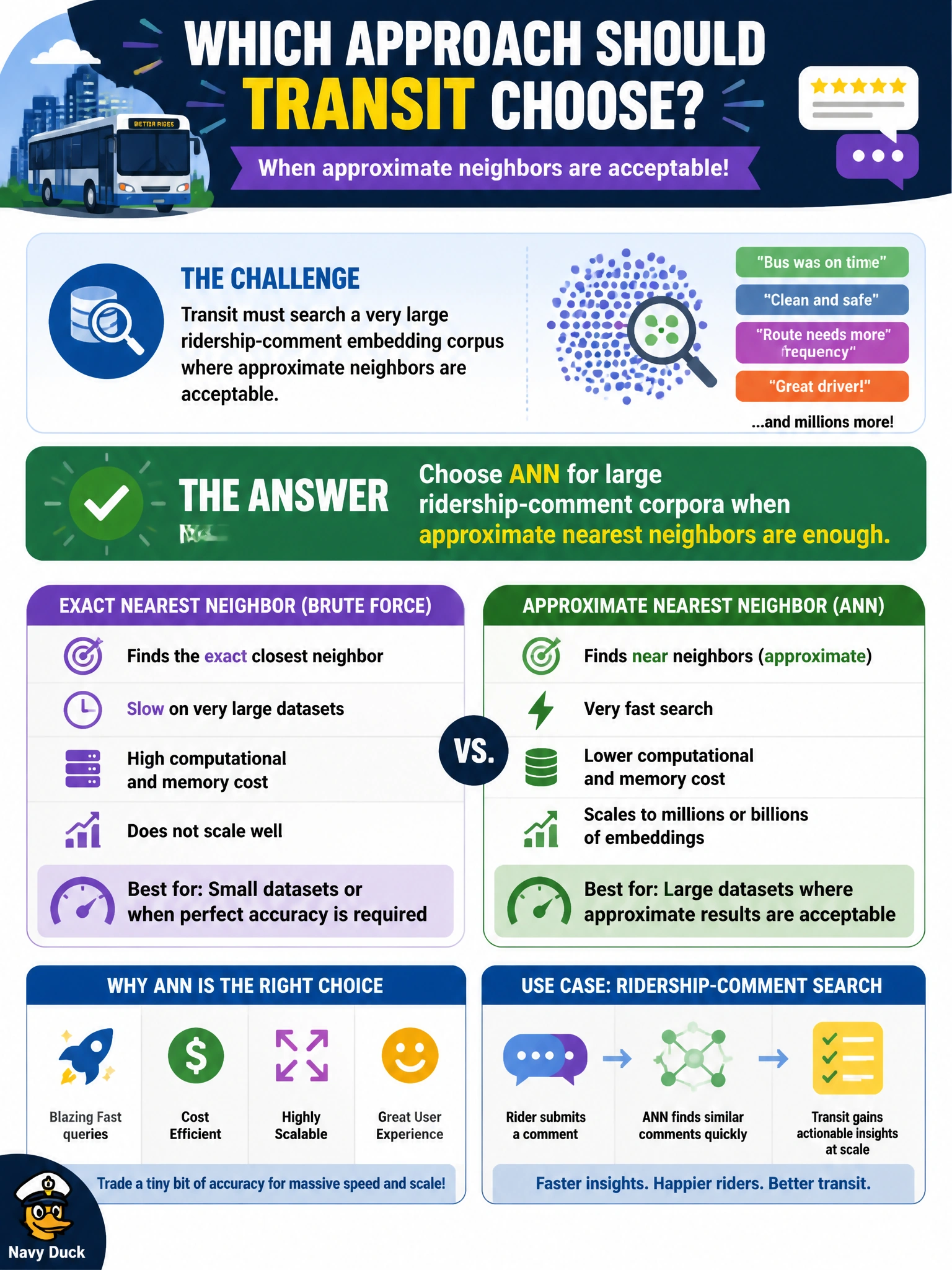
Transit must search a very large ridership-comment embedding corpus where approximate neighbors are acceptable. Which approach should they choose?
Select an answer to reveal the explanation.
Short Explanation
On a giant pile of ridership comments, ANN is like asking for “close enough” neighbors fast instead of exact-matching every seat on the train.
Full Explanation
Approximate nearest neighbor (ANN) search is the right choice when transit must query a very large ridership-comment embedding corpus and approximate neighbors are acceptable for planning insight. ANN trades a controlled amount of recall exactness for far better latency and resource use at scale, which is the operational tradeoff DP-800 expects candidates to recognize for large municipal vector corpora. Always forcing exact nearest-neighbor (ENN) scans fails by concept when the corpus is huge and approximate quality is already good enough: exact scans can become prohibitively expensive and slow without improving decision usefulness for ridership themes. Disabling vector search and emailing every comment to planners fails because it abandons automated similarity retrieval for an unscalable manual review workflow that cannot keep pace with large comment volumes. Storing comments as BIT flags fails by collapsing natural-language meaning into boolean markers so no neighbor search over embeddings remains possible at all. Exam caveat: ANN is not universally preferred—when regulatory or legal workflows demand exact neighbors on a small set, ENN is the correct mode; the stem here explicitly allows approximate quality on a large corpus. Operationally, choose an ANN index type suited to the embedding dimension, measure recall@k against a labeled ridership-comment sample, track p95 VECTOR_SEARCH latency under peak load, and document the acceptable similarity threshold for transit planners.