
An open-data portal needs nearest-neighbor retrieval over dataset description embeddings in SQL. Which function should developers call?
Select an answer to reveal the explanation.
Short Explanation
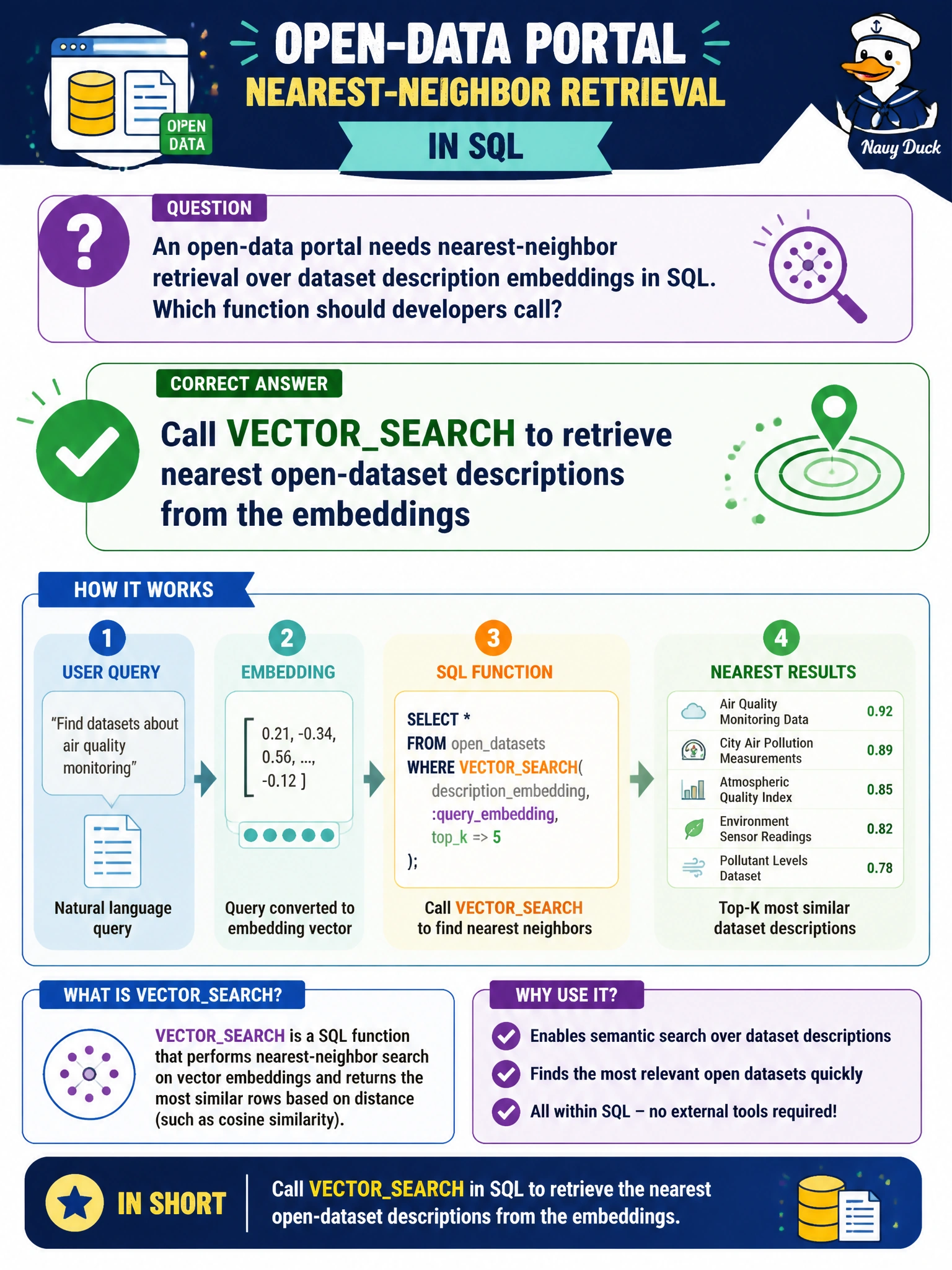
VECTOR_SEARCH is the open-data catalog’s “find similar shelves” button—you hand it an embedding and it brings back the nearest dataset descriptions.
Full Explanation
VECTOR_SEARCH is the T-SQL function that performs nearest-neighbor retrieval over vector columns, so an open-data portal can hand SQL an embedding of a dataset description and receive the closest matching catalog rows without leaving the database engine. That pattern keeps municipal semantic search close to the authoritative description table, lets developers filter and join like any other SQL result set, and matches how DP-800 frames AI-enabled retrieval inside database solutions. Calling only GETDATE fails by concept because a timestamp function returns calendar time and has no distance semantics over embeddings, so it cannot rank similar open-dataset descriptions. Replacing embeddings with PRINT statements that dump every catalog title fails because PRINT is a client message path, not a ranked similarity operator, and flooding titles does not compute nearest neighbors. Dropping the description table and forcing analysts to guess matching datasets fails by destroying the corpus that retrieval depends on and substituting unauditable human guesswork for measurable semantic search. Exam caveat: VECTOR_SEARCH still requires a properly typed vector column, compatible dimensions, and an appropriate distance metric or index strategy—invoking the function name alone does not fix a mismatched embedding schema. Operationally, validate that description embeddings are present and dimension-aligned, run VECTOR_SEARCH with a known query embedding against a golden set of open-dataset neighbors, confirm TOP-k results and scores look sensible, and monitor latency as the civic catalog grows.