
A courts clerk must evaluate vector index types and distance metrics before opinion semantic search goes live. What should the team do?
Select an answer to reveal the explanation.
Short Explanation
Index type and distance metric are the clerk’s measuring sticks—try them against real opinion-search quality before the courtroom goes live.
Full Explanation
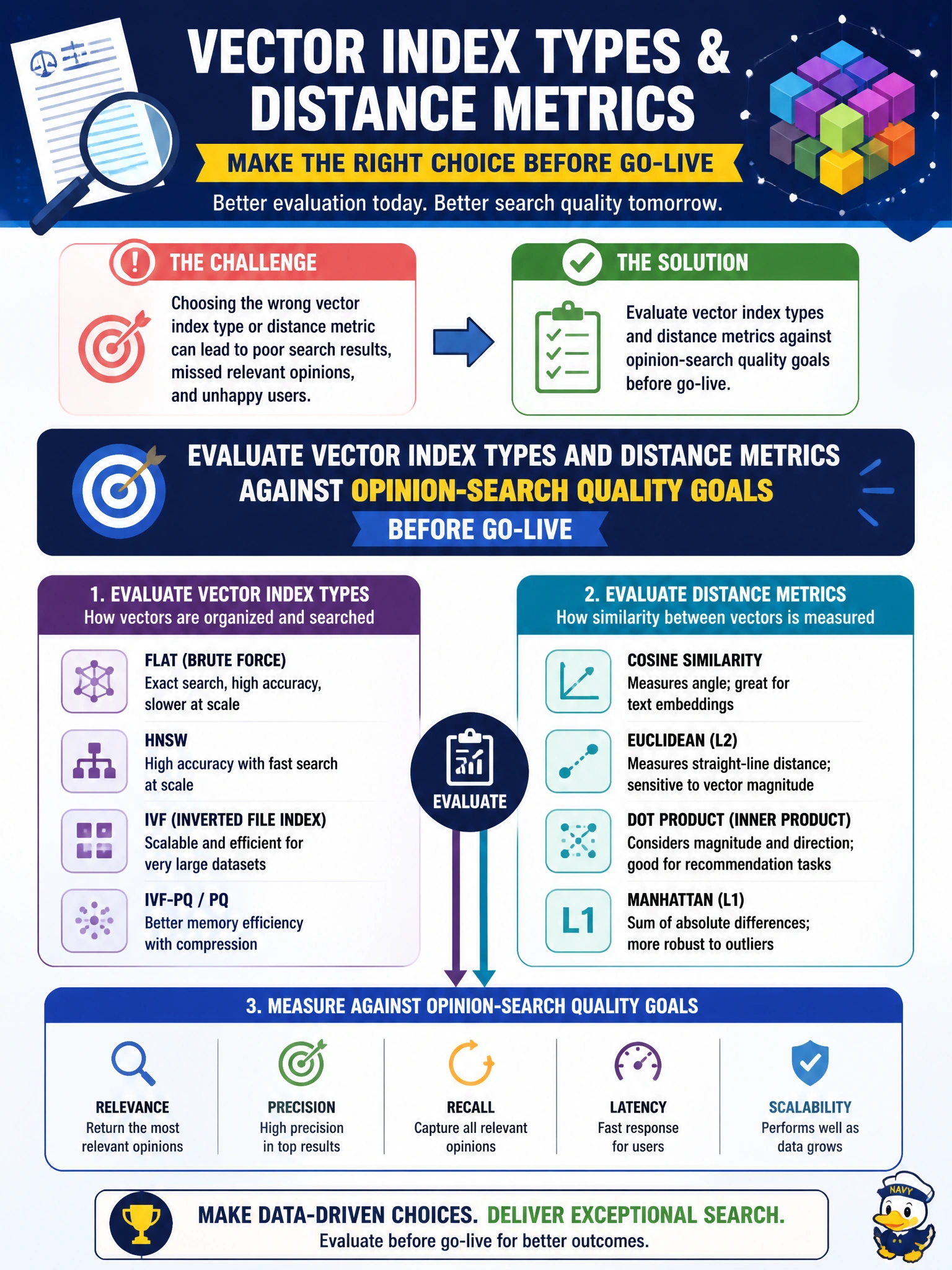
Before opinion semantic search goes live, the courts team must evaluate vector index types and distance metrics against measurable opinion-search quality goals. Index family and metric choice (for example cosine versus Euclidean-style distances, depending on how embeddings were produced) directly affect neighbor ranking, latency, and recall for municipal legal text, so deliberate evaluation is the DP-800 prep step—not a cosmetic configuration detail. Picking a random index type without measuring distance-metric fit fails by concept because index and metric interact with the embedding space; a random pick can silently degrade opinion relevance even if queries still return something. Ignoring metrics and indexing only the filing-fee amount column fails because fee amounts are scalar financial attributes, not semantic opinion embeddings, so that index does not support opinion nearest-neighbor search. Deleting all opinion embeddings so quality cannot be measured fails by removing the corpus and eliminating any ability to validate search quality before go-live. Exam caveat: evaluation must use representative clerk queries and labeled relevant opinions; optimizing only for raw throughput without relevance checks can pass latency gates while failing courtroom usefulness. Operationally, build a small golden set of opinion queries, compare candidate index types and metrics on recall@k and p95 latency, record the winning configuration beside the embedding model and dimension, and re-check after significant docket corpus growth.