
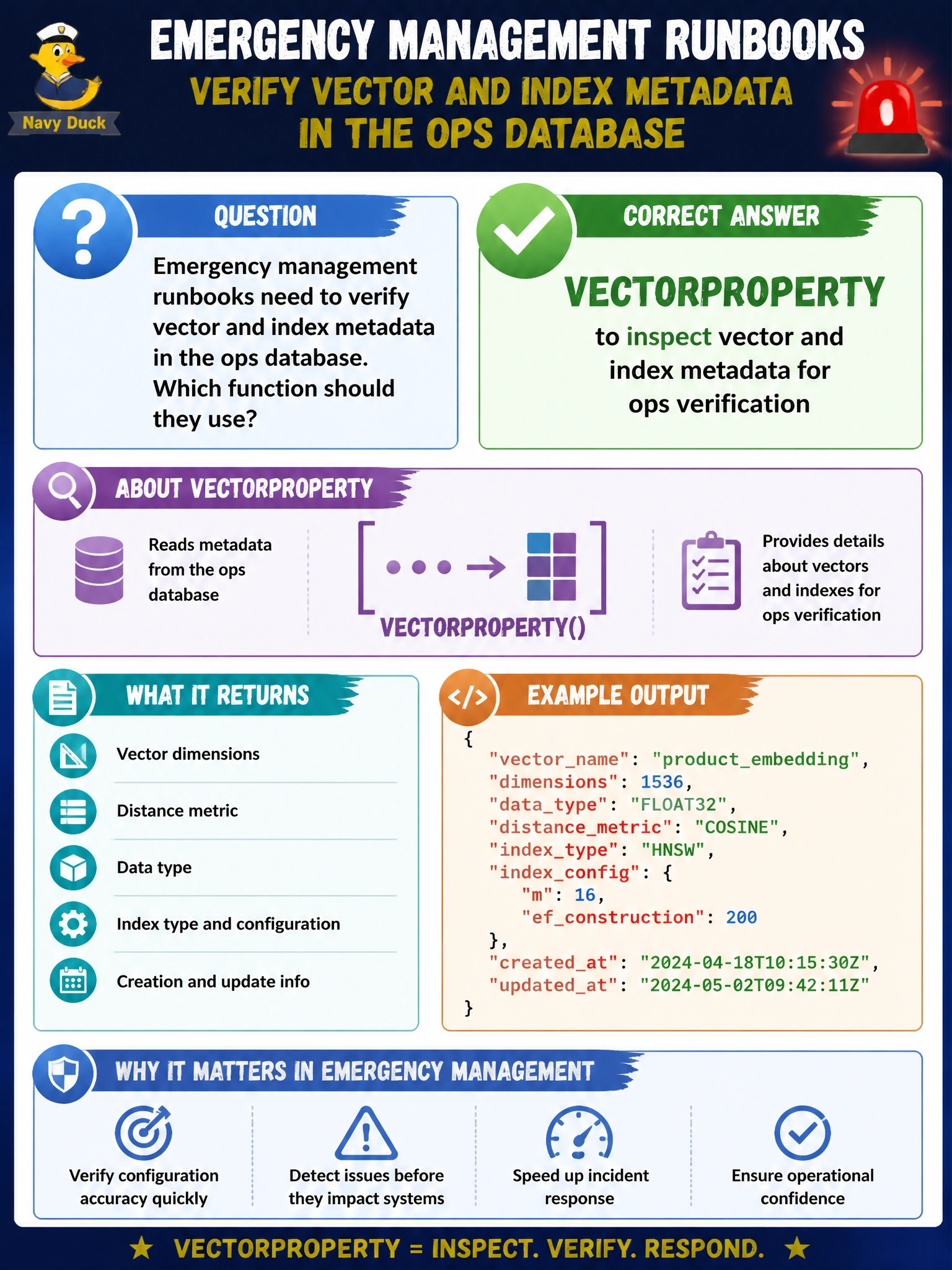
Emergency management runbooks need to verify vector and index metadata in the ops database. Which function should they use?
Select an answer to reveal the explanation.
Short Explanation
VECTORPROPERTY is the equipment tag on your vectors and indexes—ops runbooks read it to confirm what’s actually deployed.
Full Explanation
Emergency management runbooks that must verify vector and index metadata in the ops database should use VECTORPROPERTY to inspect that metadata. DP-800 exposes VECTORPROPERTY for operational verification of vector columns and related index characteristics so municipal operators can confirm what is actually deployed. That function is the correct equipment tag for embeddings and vector indexes during drills and change review. DBCC CHECKIDENT alone inspects identity counter state and does not report vector dimensions or vector index metadata. OBJECT_DEFINITION on unrelated stored procedures only returns module text and does not describe vector properties. HOST_NAME returns the client workstation name and cannot inspect embedding dimensions or index metadata. Exam caveat: VECTORPROPERTY answers differ by property name and object; runbooks should call out the exact properties operators must capture (for example dimension or index-related attributes) rather than a vague “check vectors.” Operational check: in a staging ops database, run VECTORPROPERTY against the incident embedding column and its vector index, record expected values in the emergency runbook, and re-validate those values after embedding model or index changes before declaring the environment ready.