
A library needs faster similarity search over catalog blurb embeddings. What should they create?
Select an answer to reveal the explanation.
Short Explanation
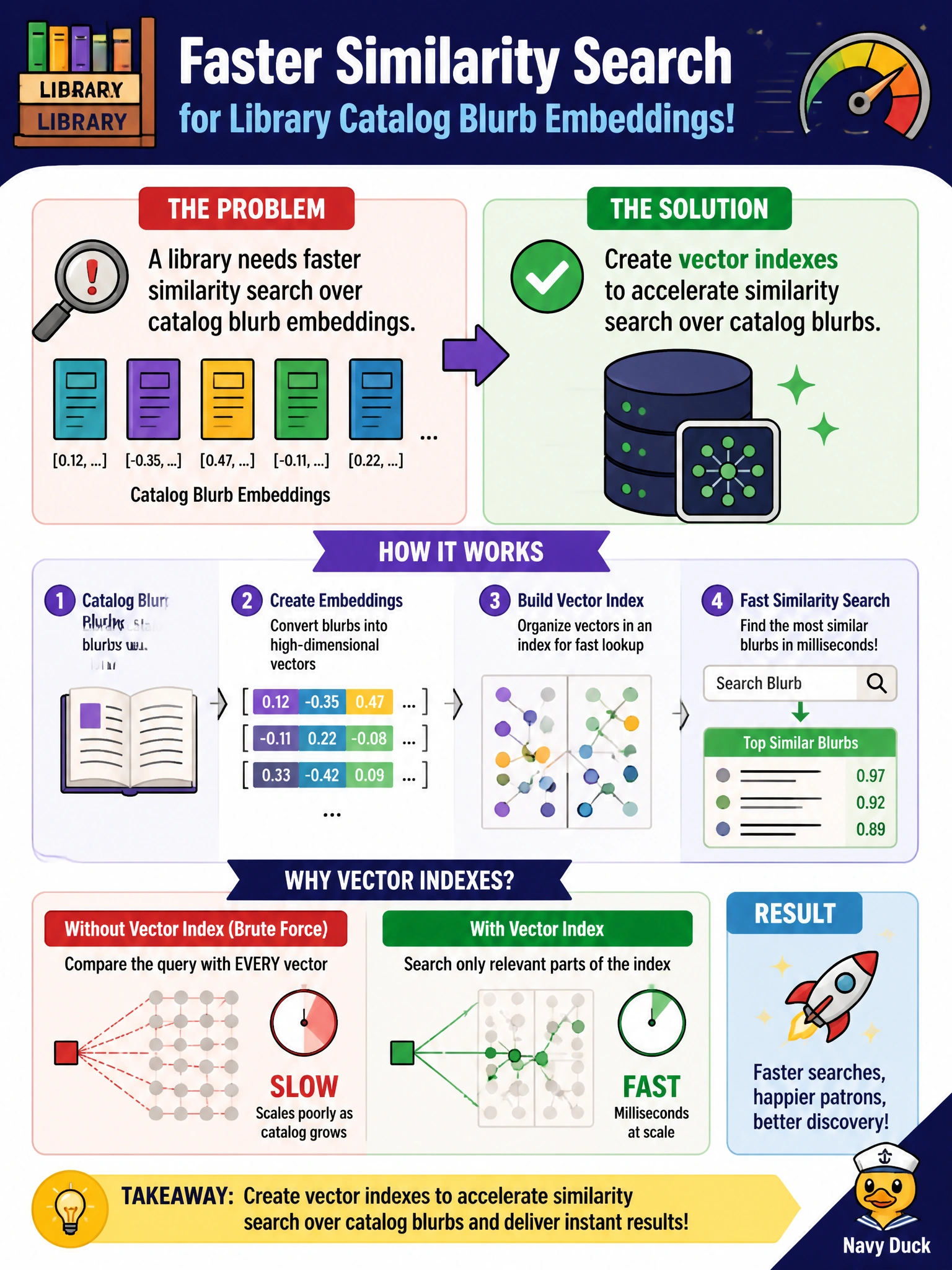
A vector index is the express lane for “find similar blurbs”—without it, the library takes the scenic full-scan route every time.
Full Explanation
A library that needs faster similarity search over catalog blurb embeddings should create vector indexes to accelerate those searches. DP-800 performance guidance for vector workloads treats vector indexes as the accelerator for nearest-neighbor style retrieval over municipal embedding columns. Without them, similarity queries degrade toward expensive scans as catalog volume grows. Dropping all indexes and always scanning every embedding with a nested loop fails by maximizing latency and CPU for every blurb similarity request. Indexing only the print date and never the vector column helps chronological filters but does not accelerate vector distance search over blurbs. Replacing vector search with exact ISBN equality checks only abandons similarity entirely—useful for known-item lookup, not for “find similar blurbs” semantic scenarios. Exam caveat: vector index build time, memory, and recall/latency tradeoffs vary by index type and library catalog size; indexes must be maintained as blurbs and embeddings refresh or search quality and speed drift. Operational check: run the same similarity query with and without a vector index on a representative catalog subset, compare elapsed time and top-k stability, and include vector index rebuild or update steps in the catalog embedding maintenance runbook.