
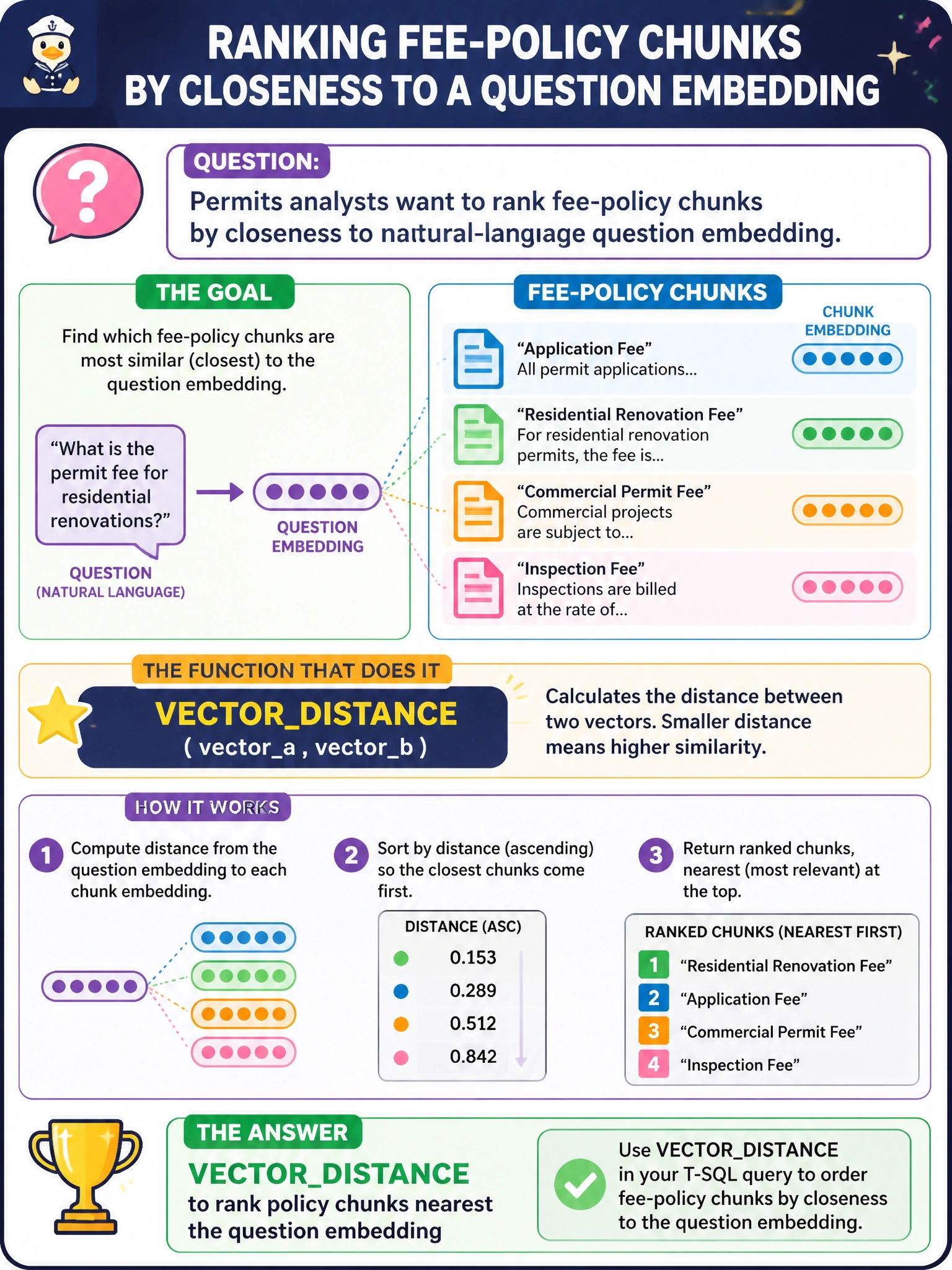
Permits analysts want to rank fee-policy chunks by closeness to a natural-language question embedding. Which T-SQL function supports that ranking?
Select an answer to reveal the explanation.
Short Explanation
VECTOR_DISTANCE is the measuring tape between the question and each policy chunk—shortest distance wins the ranking.
Full Explanation
Permits analysts ranking fee-policy chunks by closeness to a natural-language question embedding should use VECTOR_DISTANCE to compare the question vector with each policy chunk vector. DP-800 T-SQL vector functions center on VECTOR_DISTANCE for similarity ranking in SQL. That function provides the distance measure that lets municipal fee-policy RAG-style ranking order chunks from nearest to farthest relative to the analyst’s question embedding. GETDATE alone with no vector comparison returns a timestamp and cannot rank embeddings by semantic closeness. NEWID randomly shuffles identifiers and is the opposite of deterministic similarity ranking for fee-policy retrieval. CHECKSUM on the question text without using vector distance hashes text for other purposes and does not compute embedding distance to policy chunks. Exam caveat: distance metrics and normalization interact—teams should use a consistent metric with how embeddings were trained or normalized, or rankings become unstable across query batches. Operational check: embed a sample permits question, compute VECTOR_DISTANCE to known relevant and irrelevant fee-policy chunks, confirm relevant chunks rank nearer, and wire that ordering into the analyst retrieval query before exposing it in production.