
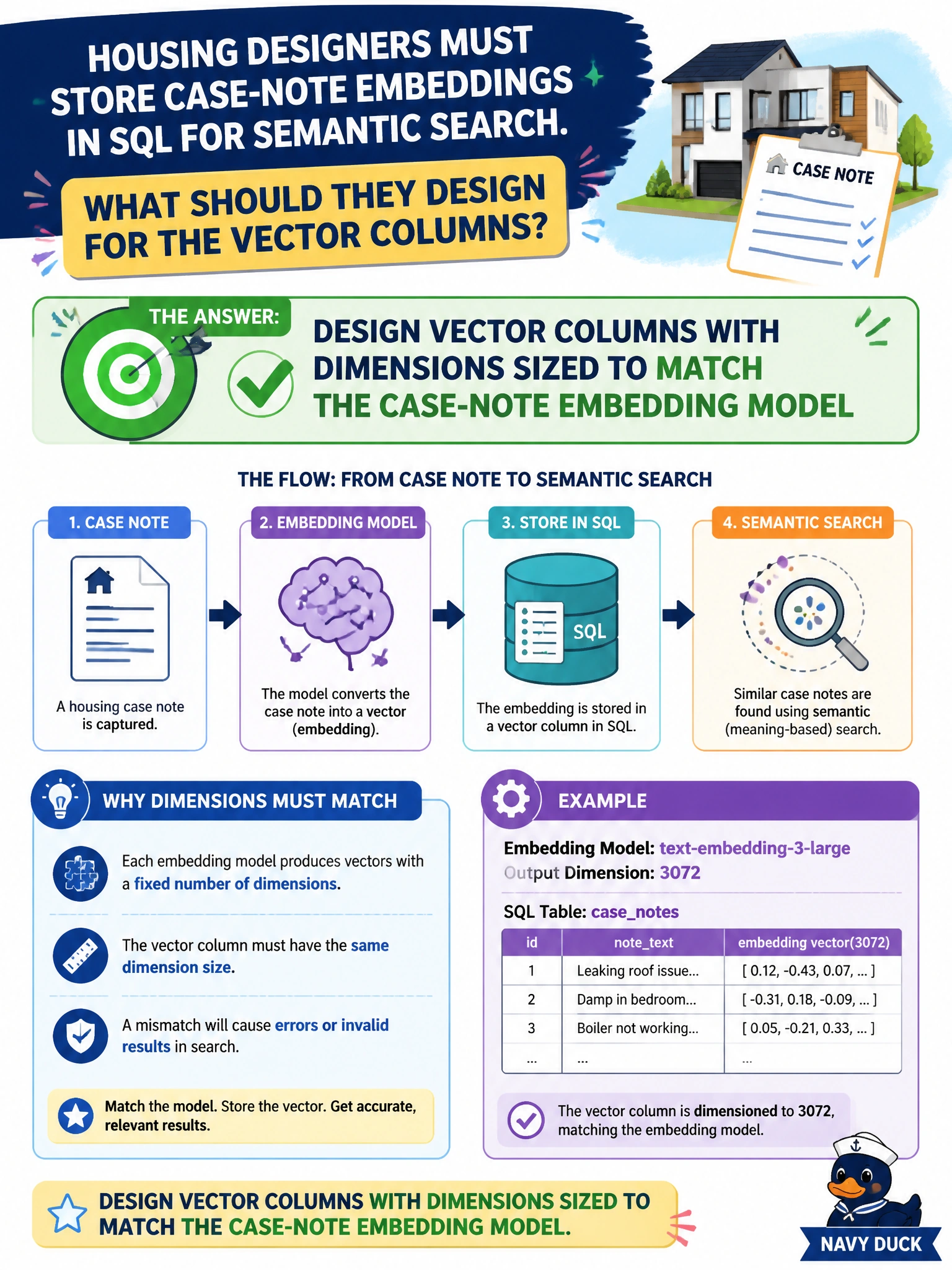
Housing designers must store case-note embeddings in SQL for semantic search. What should they design for the vector columns?
Select an answer to reveal the explanation.
Short Explanation
Vector columns need the right shoe size—match dimensions to the case-note embedding model or the feet won’t fit.
Full Explanation
Housing designers storing case-note embeddings in SQL for semantic search must design vector columns with dimensions sized to match the case-note embedding model. DP-800 vector storage is dimension-sensitive: the column’s vector type specification must agree with the model’s output length or inserts and indexes fail or become inconsistent. Correct dimension design is what makes municipal case-note vectors usable for later distance and search operations. Storing embeddings as unbounded VARCHAR paragraphs with no vector type fails by abandoning the vector data type contract SQL AI features expect for efficient similarity operations. Using a single BIT column to represent an entire embedding cannot encode a multi-dimensional vector and destroys semantic information. Ignoring dimension requirements and letting every model write mismatched sizes into one column produces runtime errors or silent incompatibility across models and breaks index assumptions. Exam caveat: changing embedding models often changes dimensions; housing teams must plan migration of vector columns and indexes rather than appending mismatched vectors into the old column. Operational check: confirm the registered case-note model’s dimension, create the vector column with that size, insert a generated embedding, and verify VECTORPROPERTY or catalog metadata reports the expected dimension before building similarity indexes.