
County SQL AI developers must register an external model so T-SQL can call it. What configuration is required?
Select an answer to reveal the explanation.
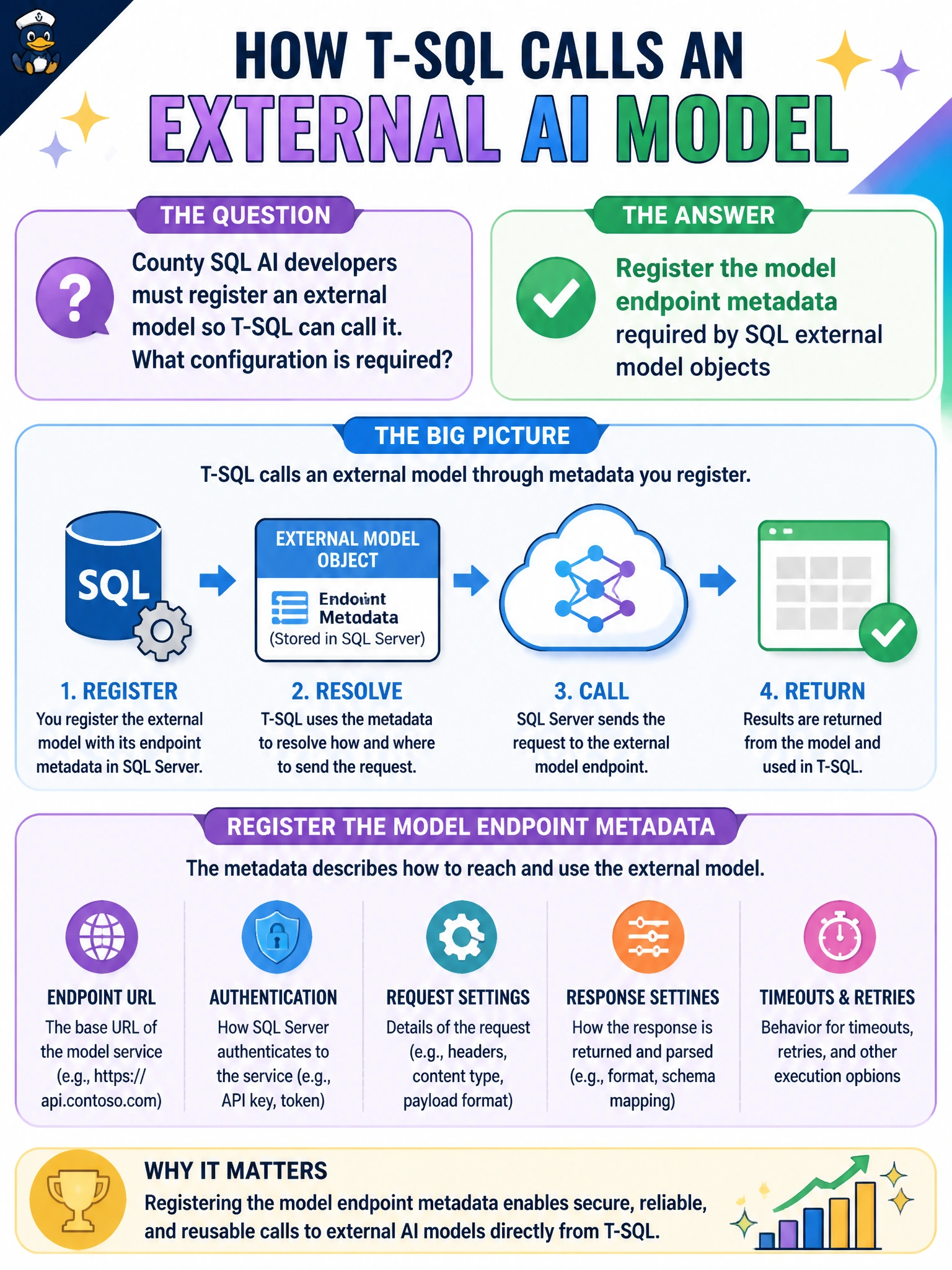
Short Explanation
External models need a real address—register the endpoint metadata SQL expects or the call has nowhere to go.
Full Explanation
County SQL AI developers must register the model endpoint metadata required by SQL external model objects so T-SQL can reach the model. DP-800 configuration for external models is concrete: without correct endpoint metadata, the database object has no reliable address to call. Registering that metadata is the required configuration for municipal T-SQL invocation paths. Omitting endpoint metadata and hoping SQL invents a reachable URL fails because registration is incomplete—the call has nowhere to go. Storing the model’s marketing brochure in a TEXT column instead of endpoint metadata confuses documentation with connectivity and does not satisfy external model object requirements. Pointing the external model object at an unreachable localhost path on a laptop may look configured in a developer environment but fails for county server-side execution and breaks shared environments. Exam caveat: endpoint metadata includes more than a URL—authentication, protocol expectations, and model identity must remain valid after secret rotation and network policy changes, or registrations fail at runtime despite looking present in catalog views. Operational check: after registration, invoke a simple T-SQL call through the external model object from the county SQL environment (not only from a laptop), confirm the endpoint resolves, and record a runbook step to revalidate metadata whenever the model host or credentials change.