
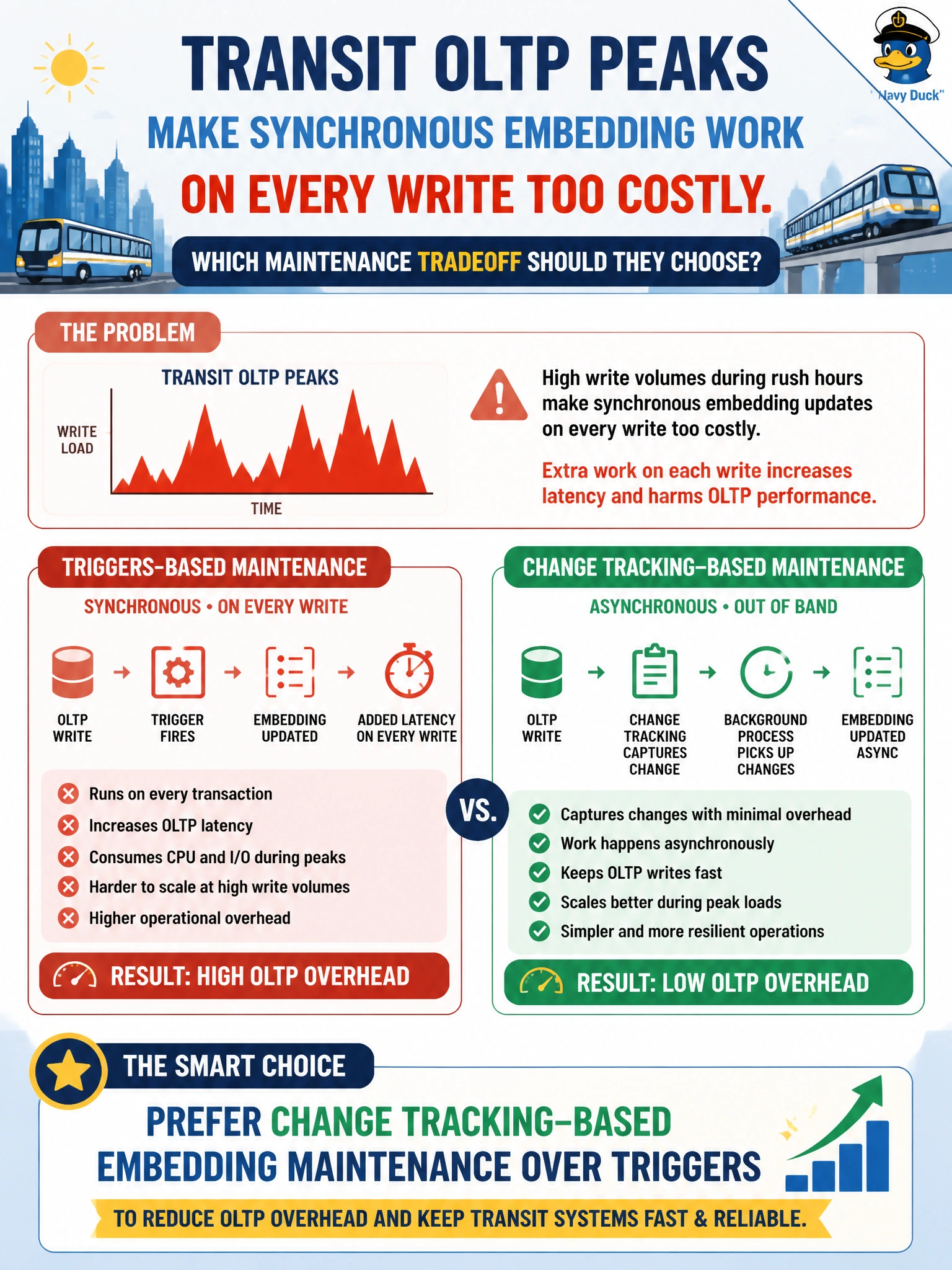
Transit OLTP peaks make synchronous embedding work on every write too costly. Which maintenance tradeoff should they choose?
Select an answer to reveal the explanation.
Short Explanation
Triggers on a hot transit write path are like stopping every bus to repaint the map—Change Tracking moves embedding upkeep off the OLTP critical path.
Full Explanation
Transit OLTP peaks make synchronous embedding on every write too costly, so teams should prefer Change Tracking–based embedding maintenance over heavy triggers to reduce OLTP overhead. DP-800 maintenance tradeoffs weigh freshness mechanisms against write-path cost: Change Tracking moves embedding upkeep off the critical path while still identifying which ridership or route-related text changed. That is the right tradeoff when peak transit writes cannot absorb model latency. Keeping heavy trigger-based embedding work on every hot write path regardless of OLTP cost preserves immediacy at the expense of throughput and can stall route updates during peaks. Disabling route updates so embeddings never need maintenance freezes operations to protect vectors—the wrong civic priority. Recomputing the entire ridership comment corpus inside each INSERT trigger maximizes lock time and compute on the worst possible path and does not scale. Exam caveat: Change Tracking refresh is near-real-time only as often as the maintenance job runs; if the stem had demanded immediate refresh, triggers might still be indicated—but here the explicit goal is reducing OLTP overhead under peaks. Operational check: compare write latency and lock duration for a route update with trigger-embedded work versus Change Tracking plus asynchronous maintenance, confirm changed rows are still captured, and set job frequency so transit semantic search meets an agreed staleness budget without burdening peak OLTP.