
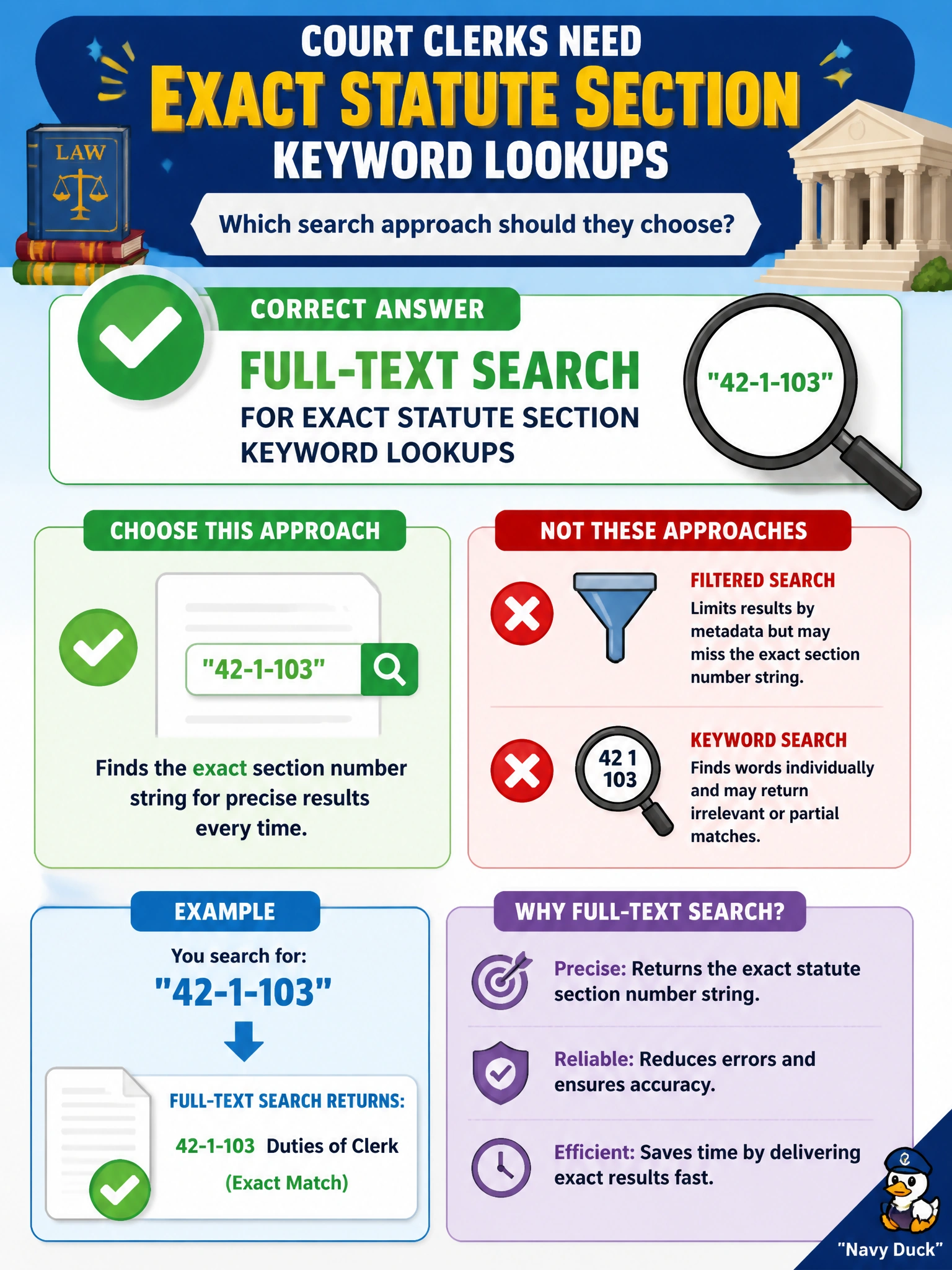
Court clerks need exact statute section keyword lookups such as a precise section number string. Which search approach should they choose?
Select an answer to reveal the explanation.
Short Explanation
Exact statute section strings are a card catalog problem—full-text nails the keyword; pure vector search is for “find me something like this.”
Full Explanation
Court clerks who need exact statute section keyword lookups—such as a precise section number string—should use full-text search, not vector-only semantic search. DP-800 intelligent-search questions distinguish exact keyword scenarios from semantic similarity scenarios. Full-text catalogs excel when the query is a known token or phrase that must match literally, which is how clerks hunt statute section strings. Vector-only semantic search with no keyword matching optimizes for “find something like this,” not for exact section identifiers, and can return nearby-but-wrong sections. Choosing hybrid search only, even when the need is purely exact keyword match, adds unnecessary vector machinery when full-text alone satisfies the clerk workflow. Disabling search and requiring clerks to open every opinion PDF manually abandons database search and does not scale. Exam caveat: full-text still needs appropriate indexes, word breakers, and catalog maintenance; exact-string needs can also involve precision choices (stopwords, punctuation in section numbers) that must be tested against real statute citation formats. Operational check: index statute text with full-text, query a known section number string, confirm the correct opinions return, and compare against a vector-only query to demonstrate why semantic neighbors are the wrong tool for exact citation lookup.