
311 receives English and Spanish resident notes and needs embeddings that respect language differences. How should external models be managed?
Select an answer to reveal the explanation.
Short Explanation
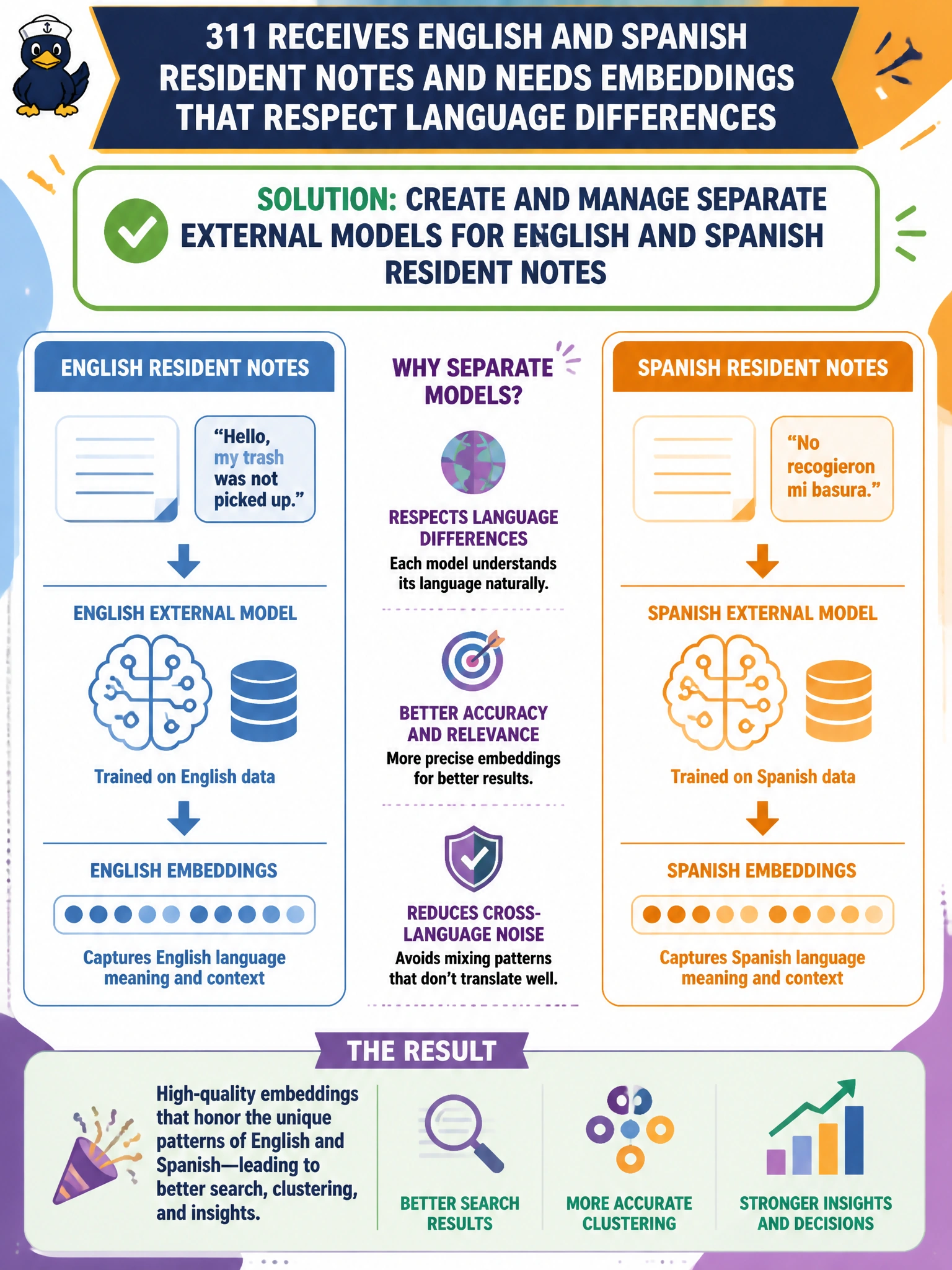
English and Spanish 311 notes deserve models that speak their language—manage separate external models rather than forcing one tongue on everyone.
Full Explanation
When 311 receives English and Spanish resident notes, external models should be created and managed separately so embeddings respect language differences rather than collapsing everything into one undifferentiated model object. DP-800 multilingual guidance for municipal embedding emphasizes language-aware model management when resident input is bilingual. Separate English and Spanish external models let the city route notes to the model that matches language metadata and preserve embedding quality for each corpus. Forcing every Spanish note through an English-only model with no language review fails by mismatch: the model’s tokenization and semantic space are not optimized for the Spanish notes residents actually submit. Creating one shared model object that ignores language metadata entirely may be workable for some multilingual models, but in this stem it specifically rejects the language-aware management the question asks for and invites silent quality skew. Translating notes by hand on paper and never calling an external model abandons the SQL external-model path and cannot keep pace with live 311 volume. Exam caveat: routing depends on accurate language detection or resident language flags—misrouted notes produce the same quality problems as an English-only mandate. Operational check: classify a mixed English/Spanish sample, invoke the corresponding registered external models, compare retrieval quality within each language cohort, and alert when notes lack language metadata so they are not blindly sent to the wrong model.