
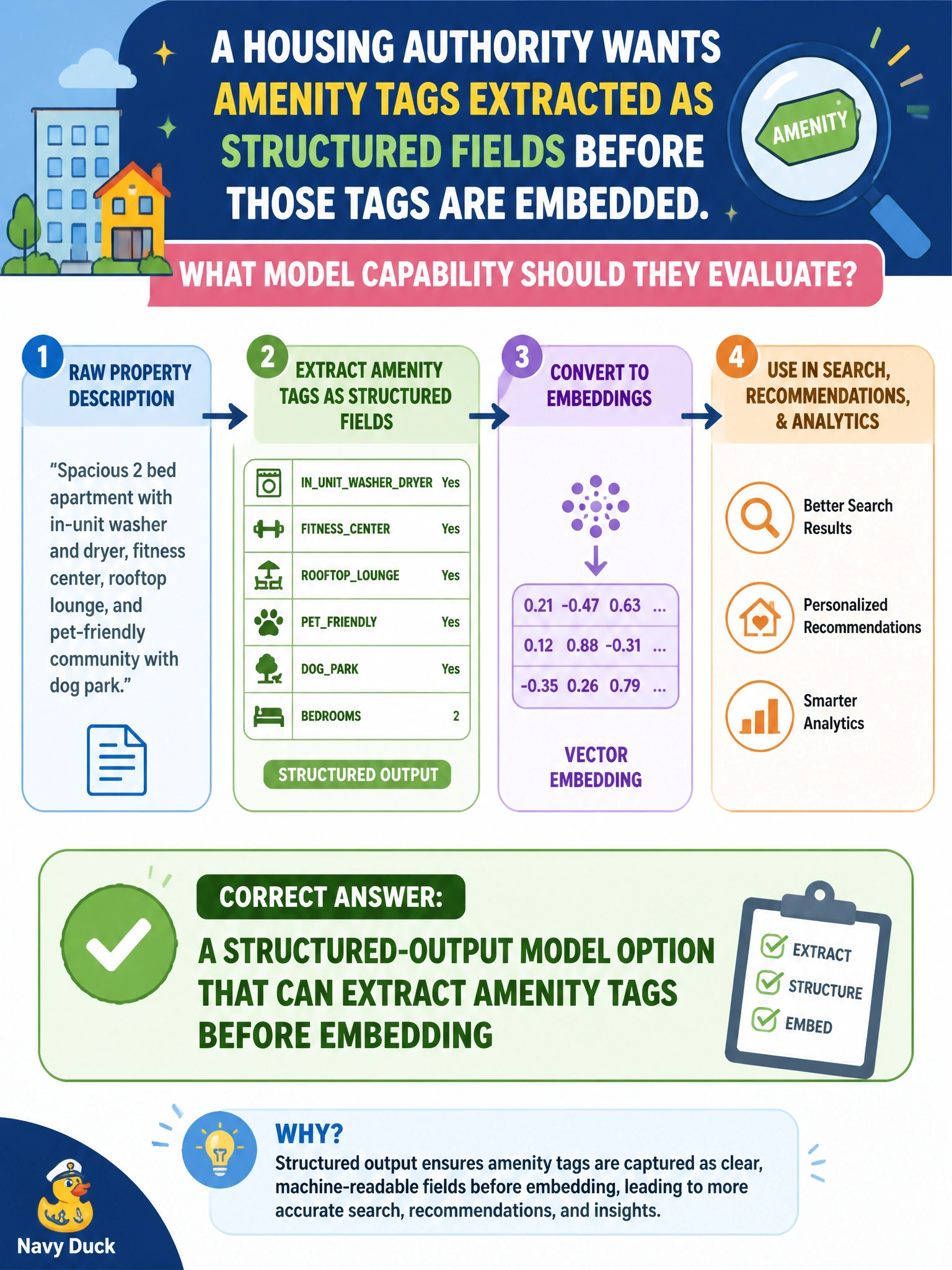
A housing authority wants amenity tags extracted as structured fields before those tags are embedded. What model capability should they evaluate?
Select an answer to reveal the explanation.
Short Explanation
You’ll want a structured-output model option that extracts amenity tags into parseable fields before embedding them. That gives you cleaner, more consistent signals for housing search than relying on fluent prose.
Full Explanation
A housing authority seeking amenity tags as structured fields before embedding should evaluate a structured-output model option that extracts parseable amenity fields first. DP-800 connects structured-output capability to reliable downstream embedding of discrete municipal attributes, rather than relying on free prose. Extracting tags into fields, then embedding those fields or normalized tag strings, produces cleaner similarity signals for housing search. A model that describes amenities in fluent narrative text but provides no parseable fields fails the extraction prerequisite: the authority still lacks structured tags to embed consistently. A model that refuses all housing text and returns empty arrays provides no usable extraction and blocks the pipeline. Skipping extraction and embedding random integers as fake amenity tags invents false structure and pollutes semantic search with meaningless vectors. Exam caveat: the schema must match the housing amenity vocabulary and be versioned; returning JSON is insufficient if required keys are missing or types vary across properties. Practical check: run listing narratives through the structured-output path, validate amenity fields against a schema, embed only validated tags, and compare amenity-focused retrieval with a prose-only baseline to confirm improved precision.