
Parks policy documents have overlapping sections that must not lose context at chunk boundaries. What chunking strategy should they use?
Select an answer to reveal the explanation.
Short Explanation
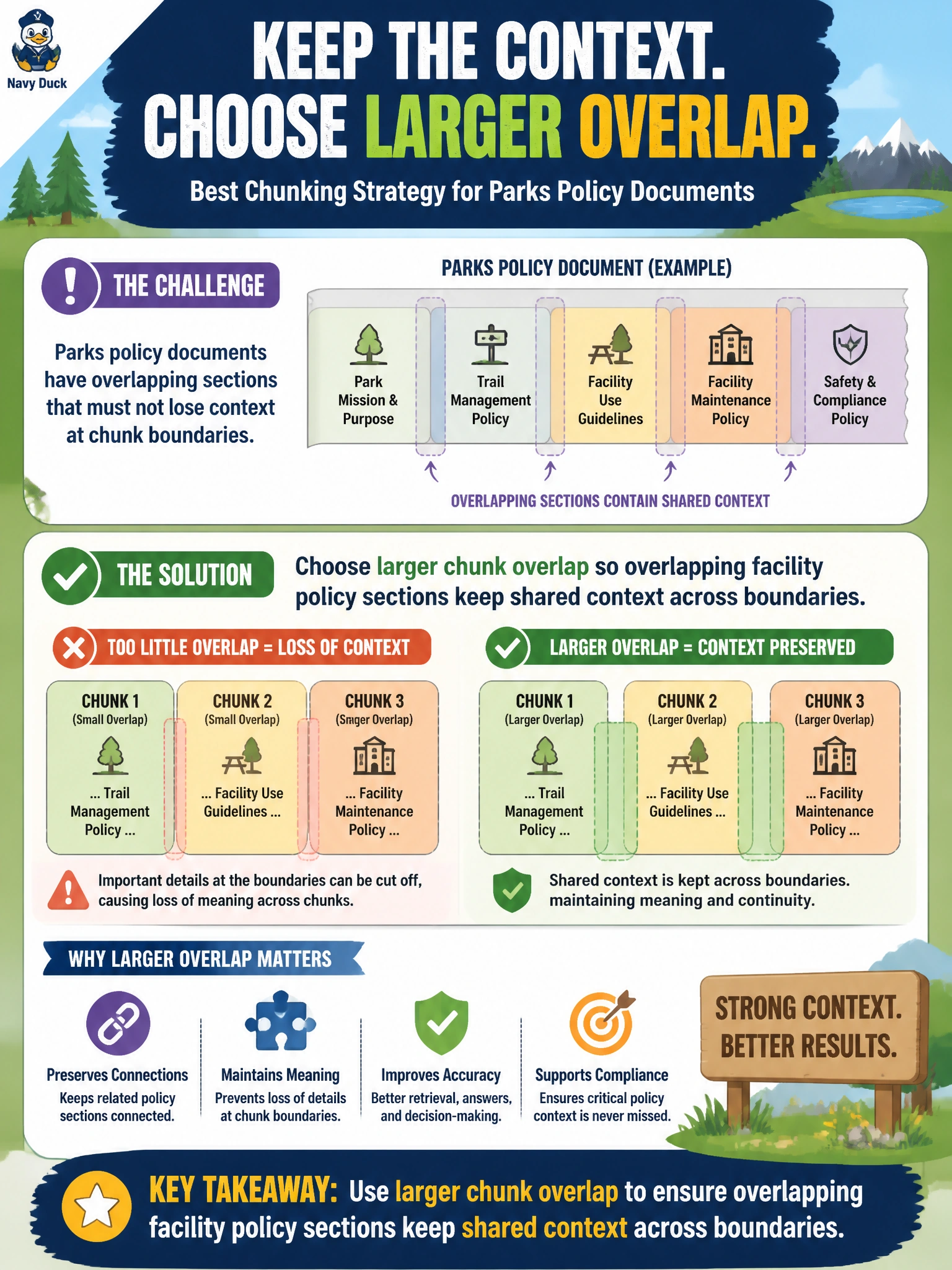
Overlap is the shared hallway between policy rooms—give chunks enough overlap so a rule that straddles sections doesn’t get cut in half.
Full Explanation
Parks policy documents with overlapping sections need larger chunk overlap so shared context survives chunk boundaries when facility rules straddle adjacent sections. DP-800 chunking guidance is not only about fitting token limits; overlap is how municipal policy language that crosses headings remains coherent for embedding and retrieval. Larger overlap keeps the connecting sentences that explain how two facility rules interact instead of isolating each chunk into a context-free fragment. Using zero overlap and hard cuts that discard sentences spanning section borders fails by concept: boundary sentences are exactly where overlapping policy meaning lives, and hard cuts drop them. Chunking only by file size in bytes with no regard for policy section structure optimizes for storage arithmetic rather than semantic units and can split mid-rule or mid-table. Putting each policy binder into one gigantic chunk regardless of token limits reintroduces model limit failures and makes similarity ranking coarse because an entire binder becomes a single vector. Exam caveat: overlap increases storage and embedding cost roughly with the duplicated tokens, so parks teams should tune overlap against both retrieval quality on boundary questions and budget—not maximize overlap blindly. Operational check: take a policy passage that spans two sections, chunk with the chosen overlap, confirm both adjacent chunks contain the shared bridging language, embed them, and verify a natural-language question about that bridging rule retrieves the correct chunks.