
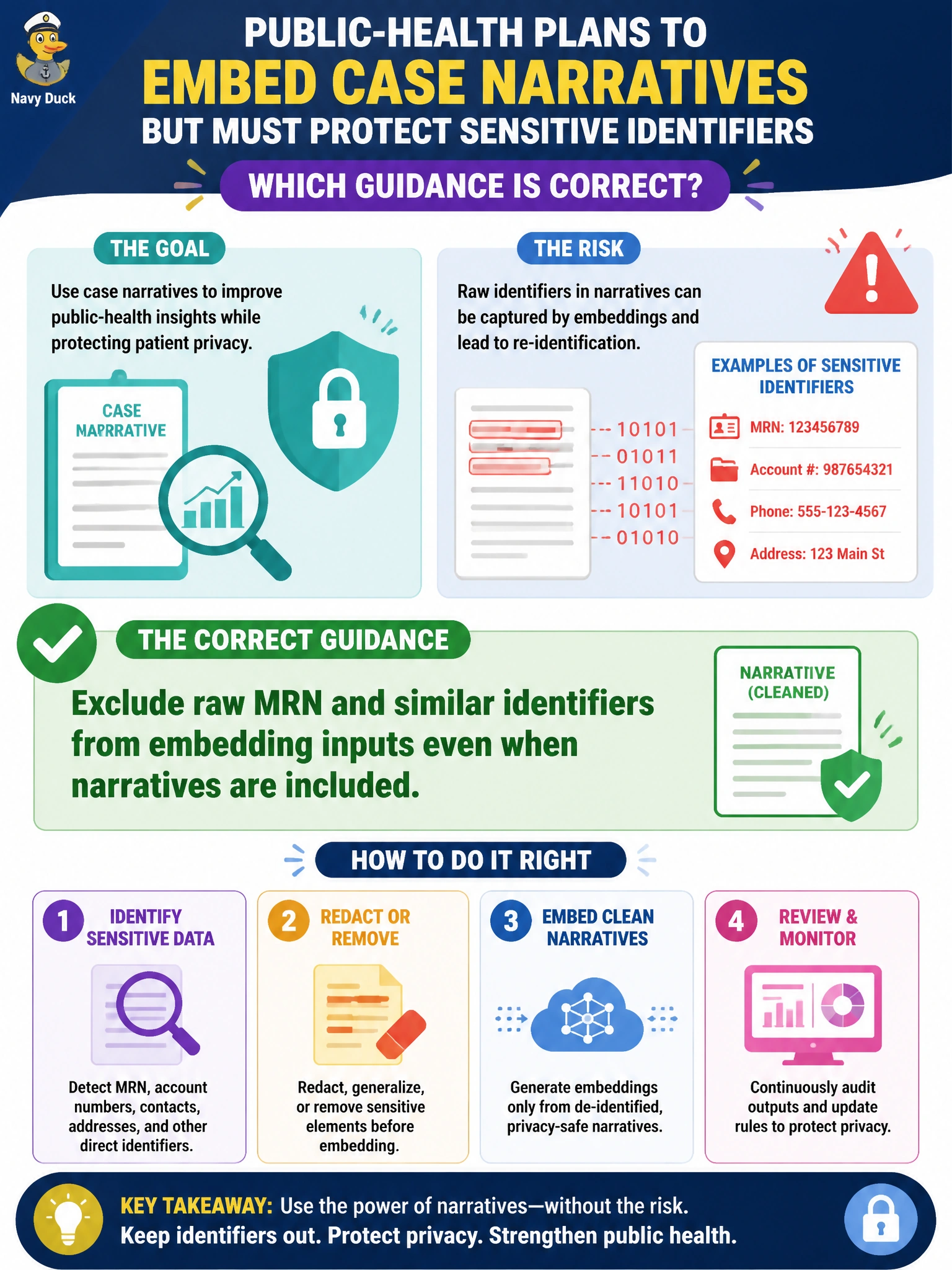
Public-health plans to embed case narratives but must protect sensitive identifiers. Which guidance is correct?
Select an answer to reveal the explanation.
Short Explanation
Narratives can go into the blender; raw MRNs should not—leave those identifiers out of embedding inputs even when the story text is included.
Full Explanation
Public-health case narratives may be embedded for search, but raw medical record numbers and similar identifiers must be excluded from embedding inputs even when the narrative text itself is included. DP-800 privacy guidance for AI-in-database scenarios separates useful clinical language from direct identifiers that should not be vectorized into searchable indexes. Excluding raw MRNs reduces the chance that semantic or neighboring retrieval surfaces or reconstructs sensitive identifiers from embedding space. Always concatenating MRN and SSN into every narrative before embedding maximizes identifier leakage into vectors and is the opposite of least-privilege input design. Preferring to embed raw medical record numbers even when narratives are optional elevates identifiers over the optional narrative content and creates an unnecessary sensitive index. Publishing MRN columns to a public vector index for cross-clinic search exposes protected identifiers beyond the authorized clinic boundary. Exam caveat: exclusion must be enforced in the embedding projection, not only in UI masking—downstream jobs that concatenate “helpful” identifiers back into text will reintroduce the risk the stem is testing. Operational check: review the embedding input query or view for case narratives, confirm MRN/SSN-like columns are omitted, generate embeddings from a redacted sample, and verify retrieval demos cannot be used as an MRN lookup path across clinics.