
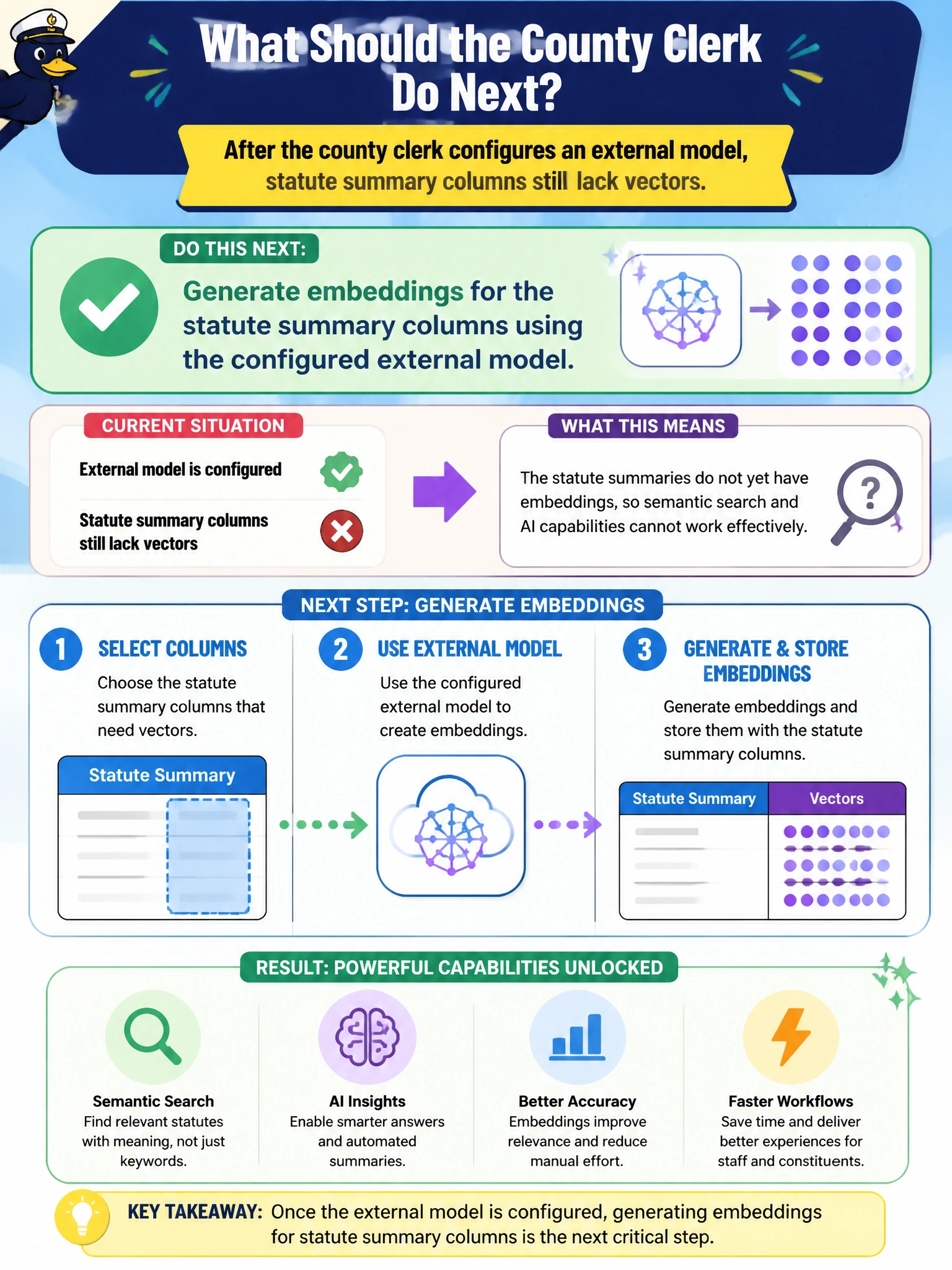
After the county clerk configures an external model, statute summary columns still lack vectors. What should they do next?
Select an answer to reveal the explanation.
Short Explanation
Configuring the model is hanging the doorbell; generating embeddings is actually pressing it—statute summaries still need that generate step.
Full Explanation
After the county clerk configures an external model, statute summary columns still lack vectors until embeddings are explicitly generated with that model. Configuration registers how SQL will call the endpoint; generation is the separate step that writes vectors into the statute summary embedding columns. DP-800 expects candidates to distinguish model setup from the generate-embeddings operation that actually populates municipal vector data. Assuming the model registration alone fills every vector column automatically forever confuses plumbing with data movement—registration does not backfill historical statute summaries. Deleting the statute summaries so no embeddings are needed abandons the clerk’s search requirement rather than completing the pipeline. Storing statute text only in email drafts outside SQL moves content out of the database where external model objects and vector columns cannot maintain it. Exam caveat: after model version or dimension changes, previously generated embeddings may be incompatible with new columns or indexes, so regeneration is not a one-time ceremony but a repeatable controlled job. Operational check: pick a statute summary row with a null vector, invoke the generate-embeddings path against the configured external model, confirm the column receives a vector of the expected dimension, and validate a sample semantic query returns that statute among relevant neighbors.