
An open-data team is choosing a managed path to keep published dataset blurb embeddings current. Which option should they evaluate for that maintenance workflow?
Select an answer to reveal the explanation.
Short Explanation
You can evaluate Microsoft Foundry as a managed way to keep published dataset blurb embeddings current. It avoids tying every text edit to a service redeployment, while keeping the blurbs available for discovery.
Full Explanation
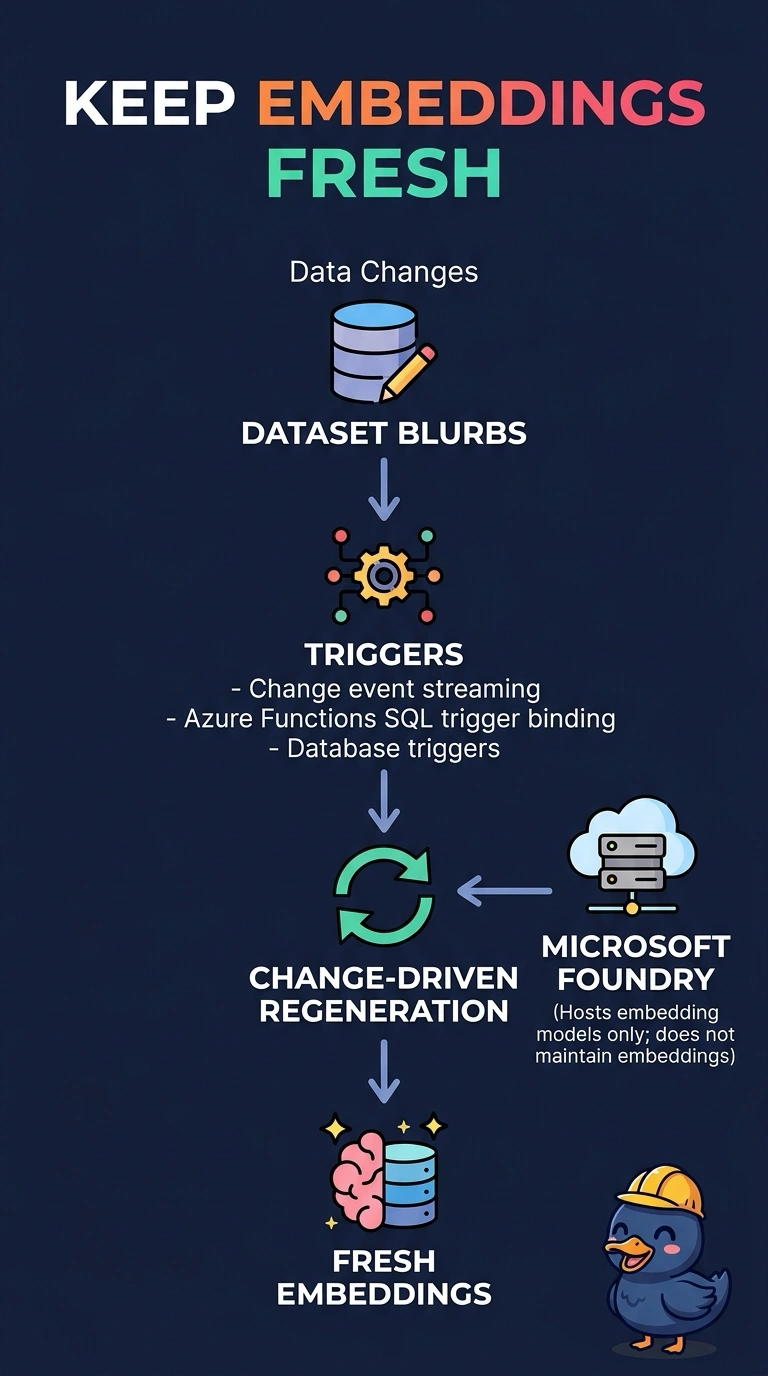
An open-data team keeping published dataset blurb embeddings current should evaluate Microsoft Foundry embedding models, called from Azure SQL (for example with AI_GENERATE_EMBEDDINGS) and paired with a change-driven refresh such as change event streaming or the Azure Functions SQL trigger binding, as the maintenance path. Foundry supplies and governs the models; change detection must be wired separately. DP-800 expects candidates to recognize managed AI platform options when civic teams need ongoing embedding upkeep. Foundry models give a governed lane to regenerate blurb embeddings when catalog text changes, fitting published open-data maintenance. Printing blurbs to PDF and filing them without an embedding pipeline creates an archival artifact, not a vector maintenance workflow, and does nothing for semantic search freshness. Keeping blurb vectors as constants in the application repository and redeploying whenever an editor changes text couples content edits to release engineering, scales poorly for catalog editors, and risks stale vectors between deployments. Removing blurbs from the open-data catalog entirely avoids maintenance by deleting content residents and analysts use to discover datasets. Exam caveat: evaluating Foundry does not mean skipping model registration, dimension contracts, or refresh SLAs; managed platforms still require municipal ownership of which blurbs are embedded and how often. Operational check: pilot one published dataset blurb through the Foundry maintenance path, change its text, confirm the embedding refreshes on the intended schedule, and compare operational effort with the prior hard-coded or manual process before wider catalog adoption.