
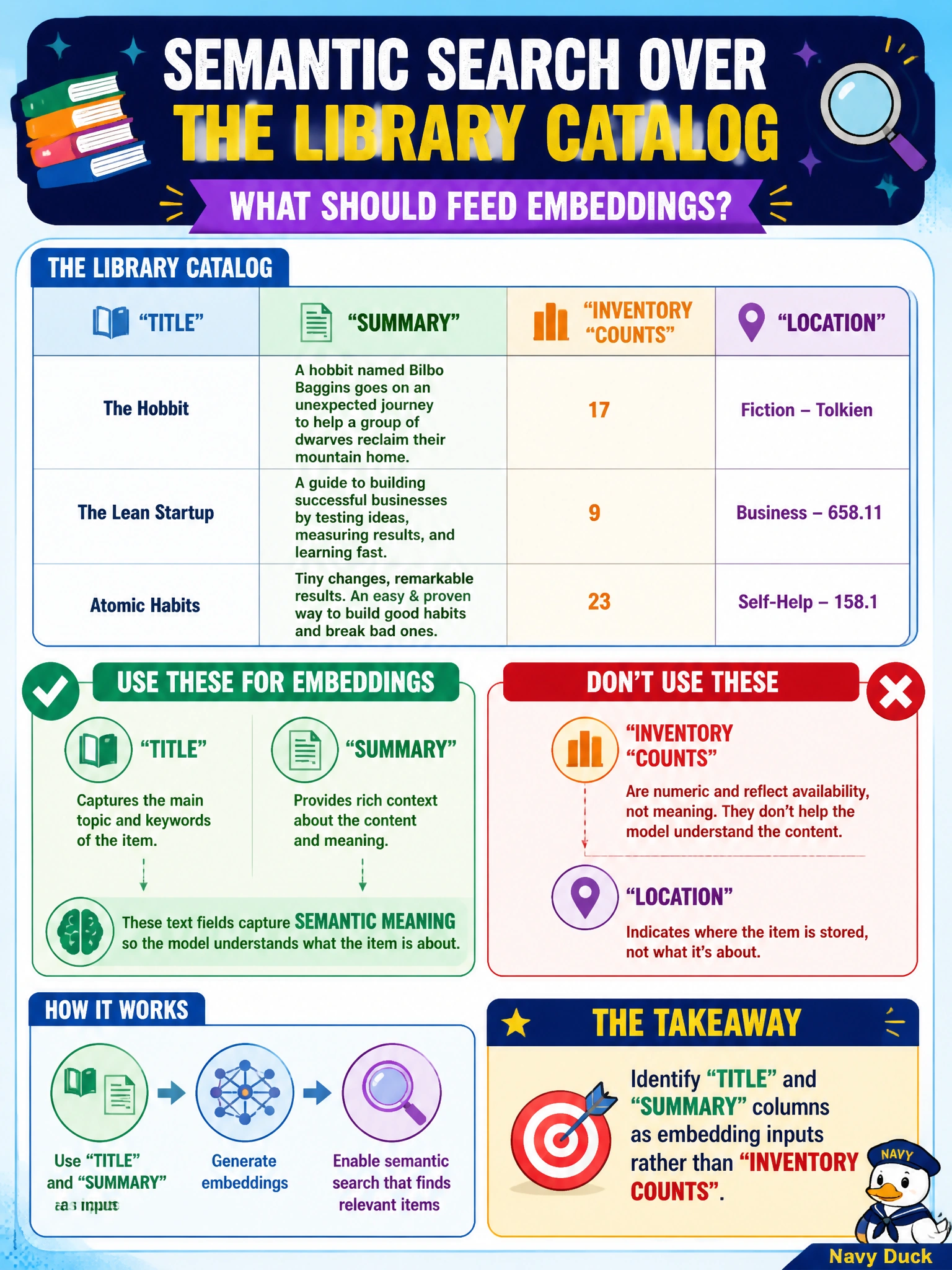
A library plans semantic search over the catalog and must pick which columns feed embeddings. What should they identify as inputs?
Select an answer to reveal the explanation.
Short Explanation
Titles and summaries carry meaning; shelf counts are just tally marks—embed the words patrons search with, not the inventory abacus.
Full Explanation
Semantic search over a library catalog depends on embedding columns that carry meaning for patrons—titles and summaries—not inventory tallies. Identifying title and summary columns as embedding inputs is the correct design step because those fields encode what a work is about, which is what semantic similarity should compare. DP-800 repeatedly tests whether candidates can separate semantic source columns from numeric or secret columns that should never drive embeddings. Embedding only shelf count and barcode numbers while ignoring title and summary fails by concept: counts and barcodes are identifiers or quantities, not topical language, so nearest-neighbor results will not resemble subject similarity. Embedding the library’s Wi-Fi password column for patron search is both semantically useless and a security failure that leaks sensitive configuration into vector indexes. Refusing to choose columns and embedding every integer metric in the inventory schema amplifies noise, wastes tokens and storage, and still ignores the textual fields patrons actually query against. Exam caveat: when summaries are null or boilerplate, retrieval quality drops even with correct column choice, so libraries should define fallbacks (for example title-only embeddings) and quality checks for sparse summary text. Operational check: embed a sample of title and summary pairs, run representative patron natural-language queries, confirm top results align by subject rather than by shelf count, and verify password or pure inventory metrics are excluded from the embedding input projection.