
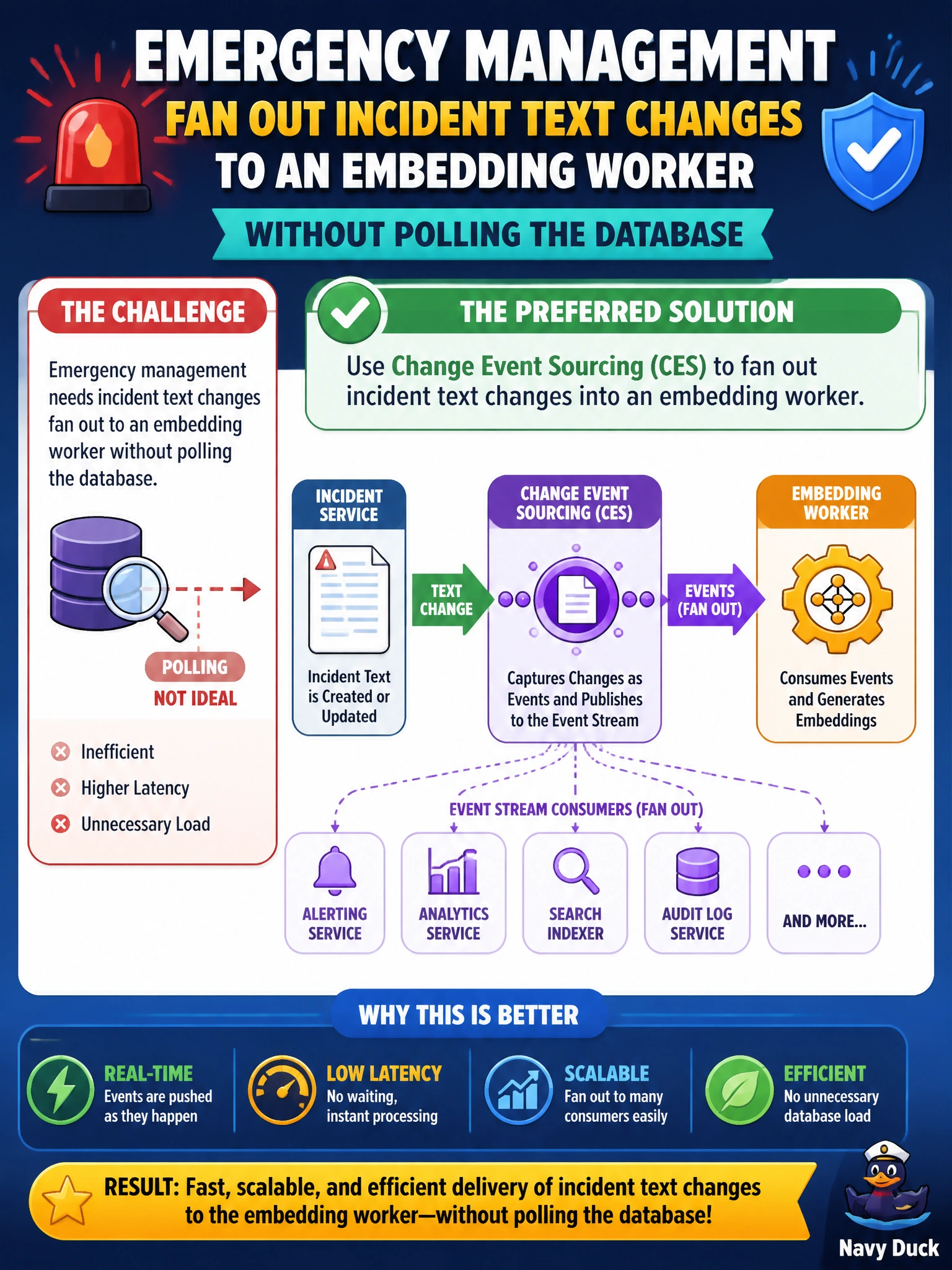
Emergency management needs incident text changes fan out to an embedding worker without polling the database. What should they prefer?
Select an answer to reveal the explanation.
Short Explanation
CES is the loudspeaker: incident text changes fan out to the embedding worker so emergency systems don’t sit around polling for news.
Full Explanation
Emergency management needs incident text changes to reach an embedding worker without polling the database, which is what Change Event Sourcing (CES) provides by fanning those changes out as events. DP-800 positions CES as the push-oriented pattern when municipal systems cannot afford chatty polling loops during incidents. The embedding worker reacts to emitted change events instead of repeatedly querying for diffs, improving responsiveness under surge conditions. Manual email of every incident update to a volunteer who regenerates vectors fails on latency, auditability, and human availability—the opposite of emergency-grade automation. Disabling incident text edits during emergencies so embeddings stay frozen protects vector stability by blocking the operational truth that responders need to record. Replacing incident text with a single shared default vector for all events collapses distinct incidents into one meaningless embedding and destroys retrieval differentiation. Exam caveat: CES consumers must handle duplicate or out-of-order events so embedding workers remain correct when emergency message buses retry; at-least-once delivery is common and must not produce divergent vectors without reconciliation. Operational check: update incident text in a drill scenario, confirm a CES event is emitted to the embedding worker without a polling query against the incident table, and verify the worker updates the correct incident embedding while leaving unrelated incidents unchanged.