
Courts IT wants nightly embedding rebuilds only for opinions that actually changed. How should they combine change capture with orchestration?
Select an answer to reveal the explanation.
Short Explanation
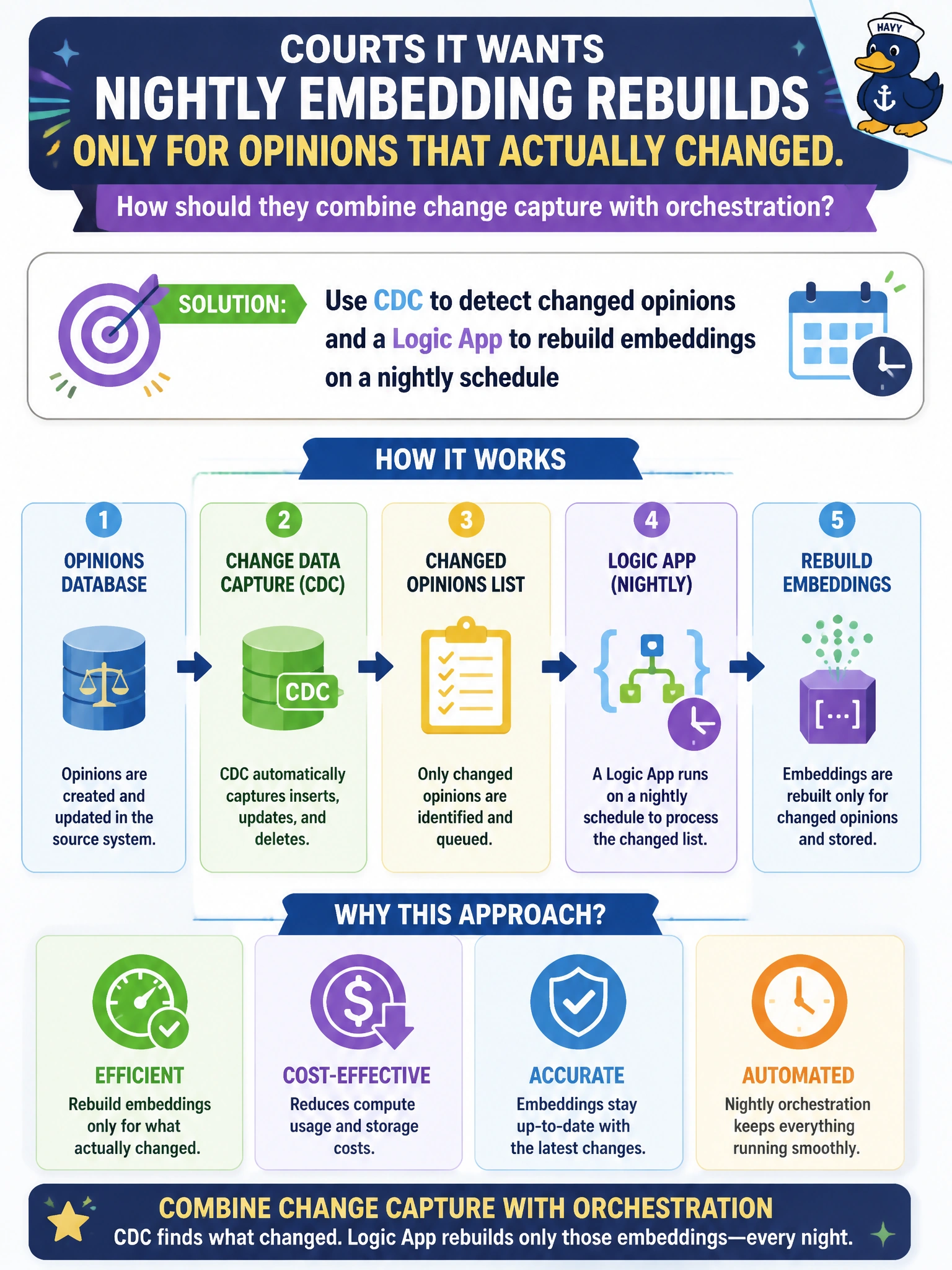
CDC spots which opinions moved; a Logic App runs the nightly rebuild—courts get fresh vectors without boiling the ocean every hour.
Full Explanation
Courts IT that wants nightly embedding rebuilds only for opinions that actually changed should combine CDC to detect those opinion changes with a Logic App that orchestrates the rebuild on a nightly schedule. DP-800 treats change capture and orchestration as complementary: CDC answers which rows moved; Logic Apps answer when and how the batch embedding job runs. That pairing avoids boiling the ocean every hour while still giving clerks fresher vectors by morning. Rebuilding every opinion embedding every minute regardless of change burns compute and can thrash model endpoints without improving correctness for unchanged opinions. Turning off CDC and never refreshing opinion vectors again freezes semantic search on historical text even as clerks amend opinions. Storing opinions only as images so embeddings are impossible abandons the text embedding scenario the stem requires and is not a maintenance strategy. Exam caveat: CDC retention, capture instance health, and Logic App schedule windows must be monitored together—healthy CDC with a disabled Logic App, or a healthy schedule reading expired CDC data, both produce the same symptom of stale court embeddings. Operational check: amend one opinion in a test database, confirm CDC records the change, allow the nightly Logic App to run, and verify only changed opinion embeddings regenerate while unchanged opinions keep their prior vectors.