
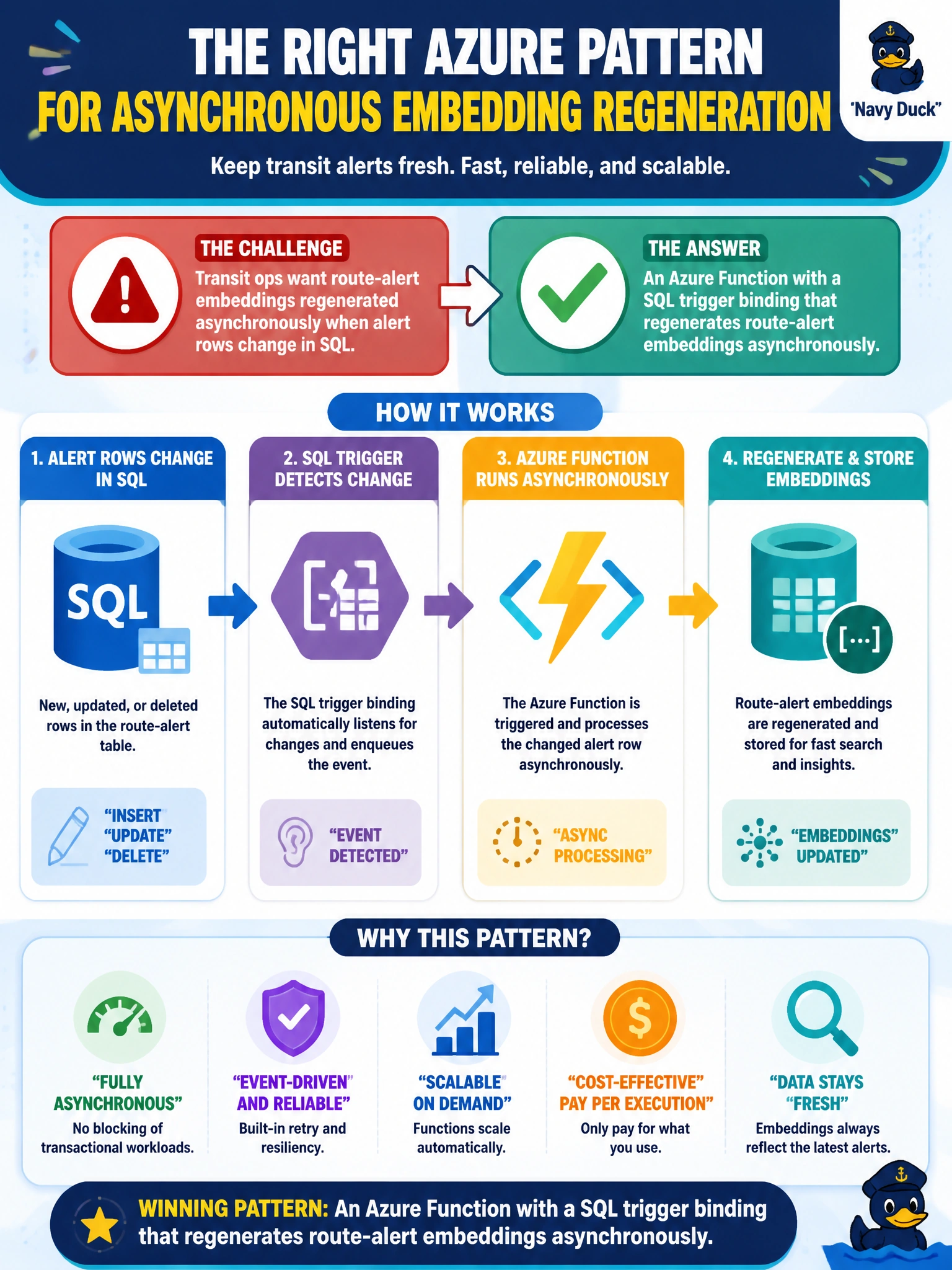
Transit ops want route-alert embeddings regenerated asynchronously when alert rows change in SQL. Which Azure pattern should they use?
Select an answer to reveal the explanation.
Short Explanation
Let an Azure Function with a SQL trigger chew on route-alert embeddings in the background—like a night crew fixing signs while daytime ops keep rolling.
Full Explanation
Transit operations need route-alert embeddings regenerated when alert rows change, but they should not pay synchronous embedding cost inside the OLTP transaction. An Azure Function with a SQL trigger binding regenerates those embeddings asynchronously as SQL changes arrive, which matches the DP-800 pattern of event-driven offload for municipal embedding maintenance. Alerts keep flowing for dispatchers while the function owns the slower model call. A synchronous cursor that locks the alert table until every embedding finishes in the same transaction fails by coupling model latency to transit write availability—locks and long transactions amplify outages during storm-related alert storms. Manual copy-paste of alert text into a chat UI with no automation is not an Azure pattern and cannot scale to continuous route-alert churn. Deleting alert rows instead of refreshing their embeddings removes operational history rather than maintaining vectors and breaks any search or analytics that still need the alert text. Exam caveat: the Function must be idempotent and ordered carefully for rapid successive updates to the same alert, or embeddings can land on an intermediate text version. Operational check: update a route-alert row in a lower environment, confirm the SQL trigger binding invokes the Function, verify the embedding regenerates without prolonging the original SQL transaction lock time, and alert on Function failures so transit does not silently accumulate stale vectors.