
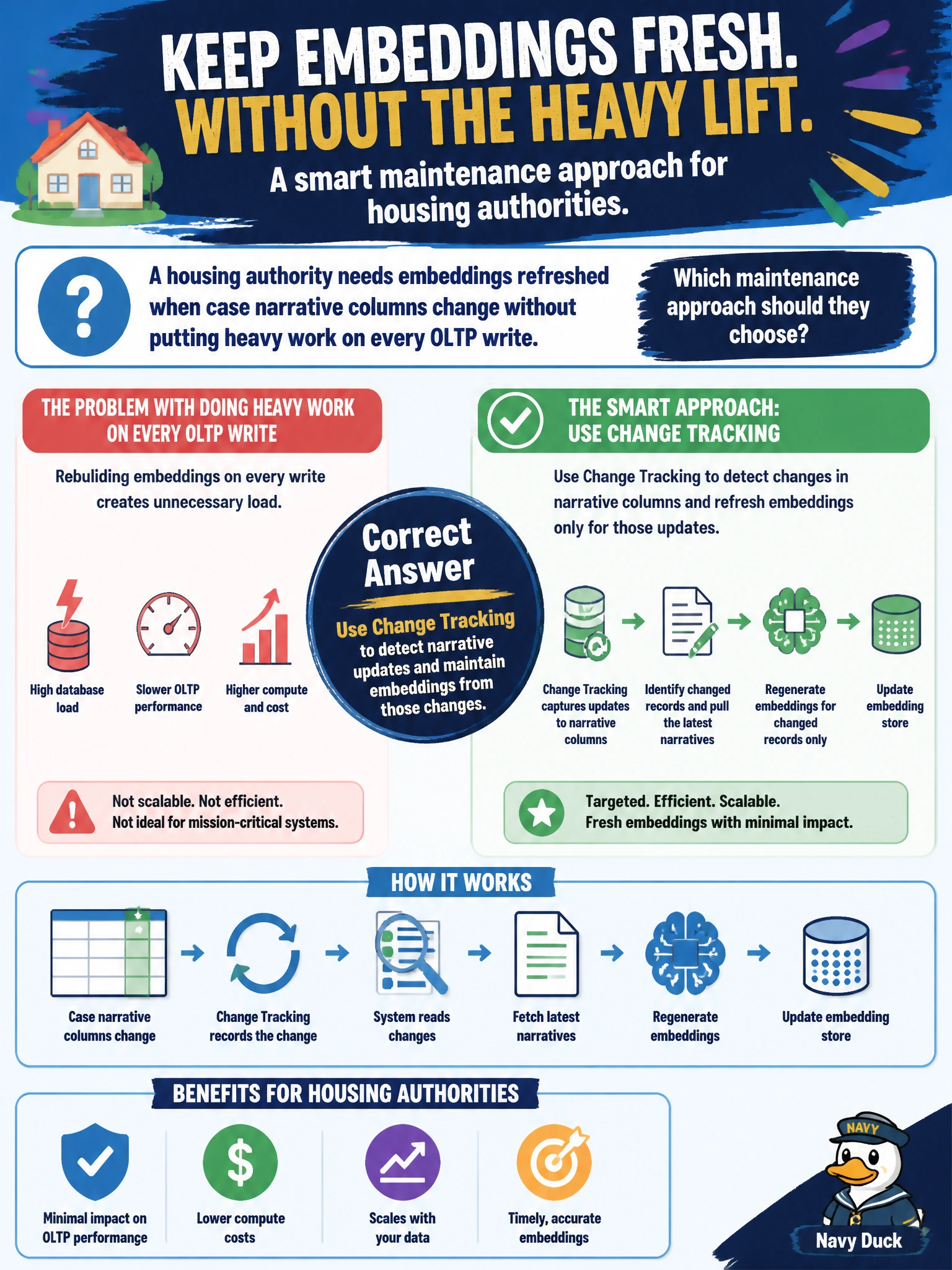
A housing authority needs embeddings refreshed when case narrative columns change without putting heavy work on every OLTP write. Which maintenance approach should they choose?
Select an answer to reveal the explanation.
Short Explanation
Think of Change Tracking as a sticky note on updated case narratives: you refresh embeddings from what actually changed. That way, you avoid redoing the whole filing cabinet on every click.
Full Explanation
Housing case narratives change over time, and embeddings need to reflect those changes without adding heavy recomputation to every OLTP write. Change Tracking detects which narrative columns were updated, allowing a maintenance job to refresh embeddings from those changes. This is the incremental vector-maintenance approach DP-800 associates with efficient upkeep: it protects write-path performance for case workers while bringing embeddings up to date. Disabling all narrative updates to prevent stale embeddings freezes casework quality and sacrifices accurate notes to protect vectors. Recomputing every embedding overnight with a full table scan and no change detection wastes compute on unchanged rows and can leave changed rows waiting until the next scan. Deleting embedding columns whenever any case row is touched discards retrieval state even for incidental updates and forces rebuilds instead of targeted refreshes. Exam caveat: size Change Tracking retention and cleanup for the housing authority’s sync schedule; expired tracking versions can cause updates to be missed and embeddings to become stale. Practical check: update one narrative in a non-production case row, confirm Change Tracking surfaces the change, run the maintenance job, and verify that the affected embedding refreshes while unrelated embeddings remain untouched.