
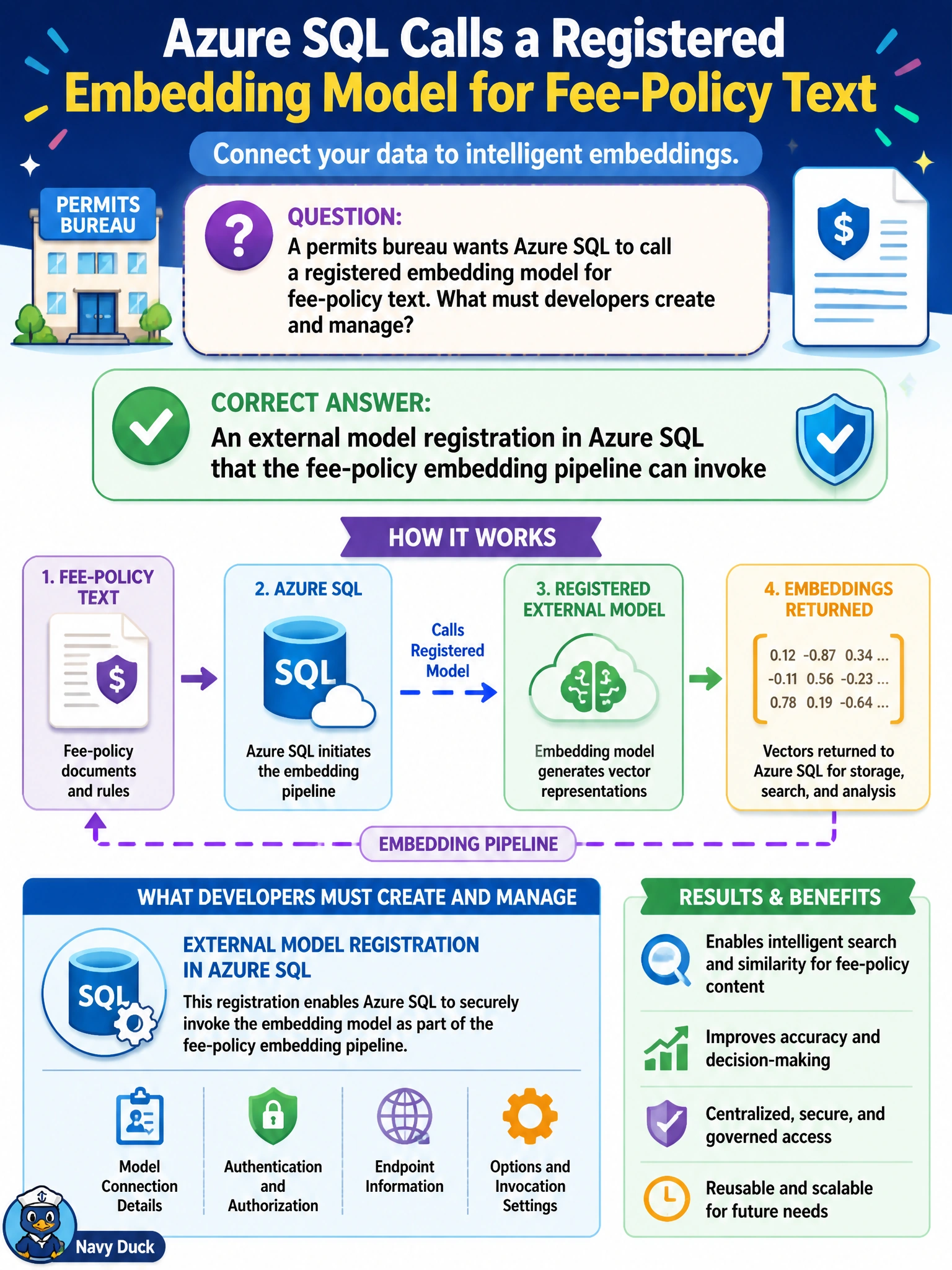
A permits bureau wants Azure SQL to call a registered embedding model for fee-policy text. What must developers create and manage?
Select an answer to reveal the explanation.
Short Explanation
Azure SQL won’t magically know your fee-policy embedder—register and manage the external model so the permits pipeline has a real doorbell to ring.
Full Explanation
Azure SQL can invoke an external embedding model for permits fee-policy text only after developers create and manage an external model registration that the fee-policy embedding pipeline can call. DP-800 emphasizes that SQL AI features are not ambient magic: the database needs a managed model object with reachable endpoint metadata so T-SQL embedding workflows have a contractual doorbell. Creating that registration is what ties municipal fee-policy text to a governed model rather than to ad-hoc tools outside the database. Keeping only a local PowerPoint of fee policies with no SQL model objects fails because slides are not invocable from Azure SQL and cannot participate in a database embedding pipeline. A desktop OCR tool disconnected from the permits database may extract text on a workstation, but it never becomes a registered SQL external model and therefore cannot be called consistently from fee-policy jobs. Hard-coding a list of random vectors into a CHECK constraint fabricates similarity signals, violates embedding semantics, and does not create a managed model registration at all. Exam caveat: registrations must be treated as operational assets—endpoint URLs, credentials, and model versions change, and stale registrations break embedding refresh even when fee-policy text is correct. Operational check: after registering the model, run a controlled T-SQL embedding call against a sample fee-policy paragraph, confirm the external model object resolves and returns a vector of the expected dimension, and document ownership for rotating endpoint secrets used by the permits bureau.