
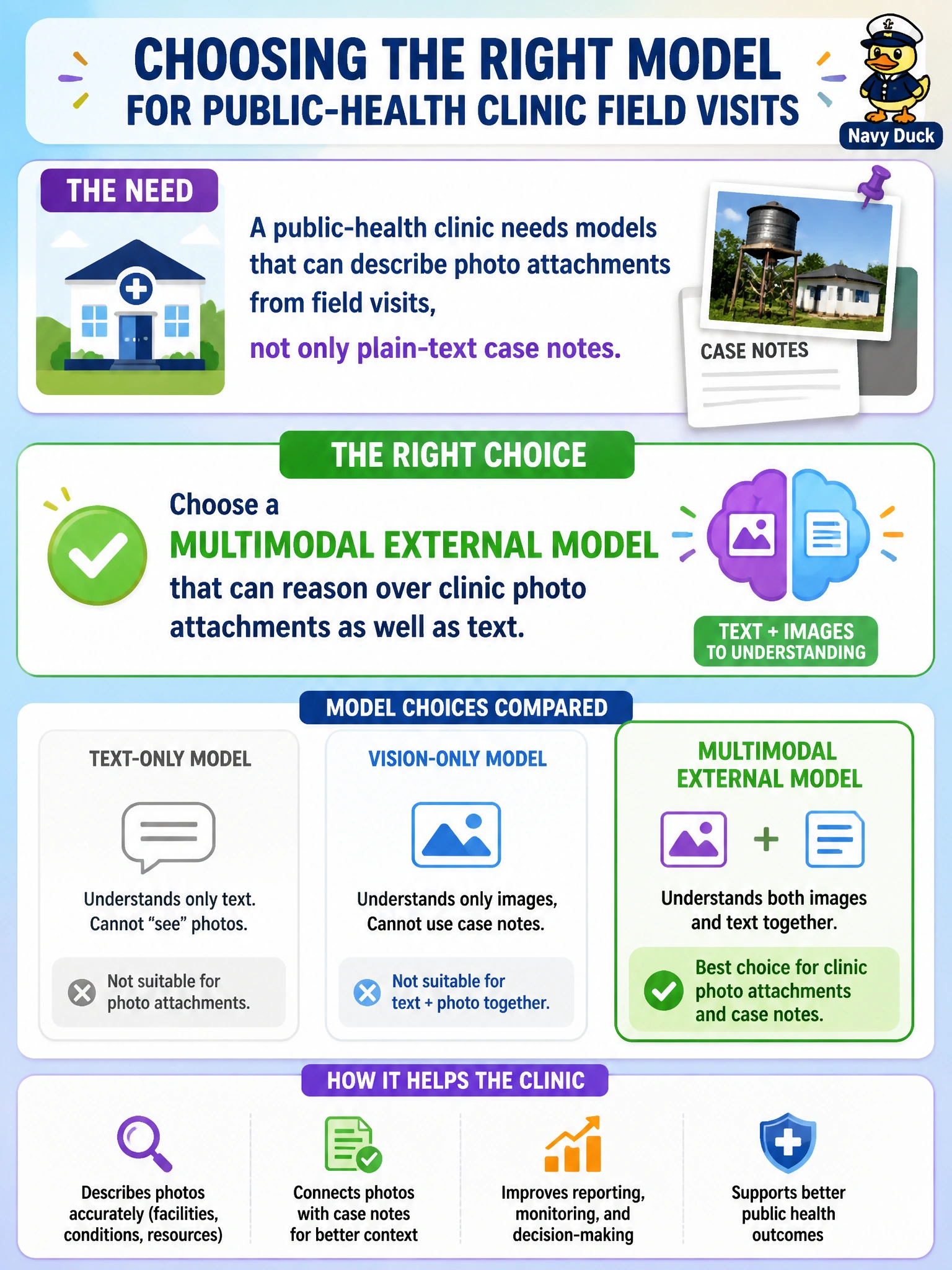
A public-health clinic needs models that can describe photo attachments from field visits, not only plain-text case notes. Which model choice fits?
Select an answer to reveal the explanation.
Short Explanation
Clinic photos need a model that can “see,” not a text-only stenographer—multimodal is the right lane when attachments matter.
Full Explanation
Public-health field visits often attach photos of sites, equipment, or conditions that case notes alone cannot capture, so the clinic needs a multimodal external model that can reason over those images together with text. DP-800 distinguishes text-only embedding paths from multimodal model choices when the municipal workload includes non-text evidence. Choosing a multimodal model fits clinic photo attachments because the same registered endpoint can contribute visual understanding into downstream search or summarization rather than discarding half the documentation. Using a text-only embedding model and discarding every photo attachment fails by concept: it preserves narrative but throws away the visual evidence that inspections and outbreak fieldwork depend on. Storing photos as VARBINARY without any model and calling that multimodal AI confuses persistence with intelligence—binary storage is not vision capability and does not produce embeddings or captions the clinic can search. Disabling attachments so the system never needs vision-capable models removes the operational requirement instead of meeting it and forces field staff into lossy workarounds. Exam caveat: multimodal endpoints often have different size, cost, and structured-output characteristics than text-only models, so registration and token budgeting must be revisited when photos become first-class inputs. Operational check: submit a controlled set of clinic notes with and without representative photo attachments, confirm the multimodal model returns usable image-aware outputs, and verify text-only fallbacks are not silently dropping attachment context in production health workflows.