
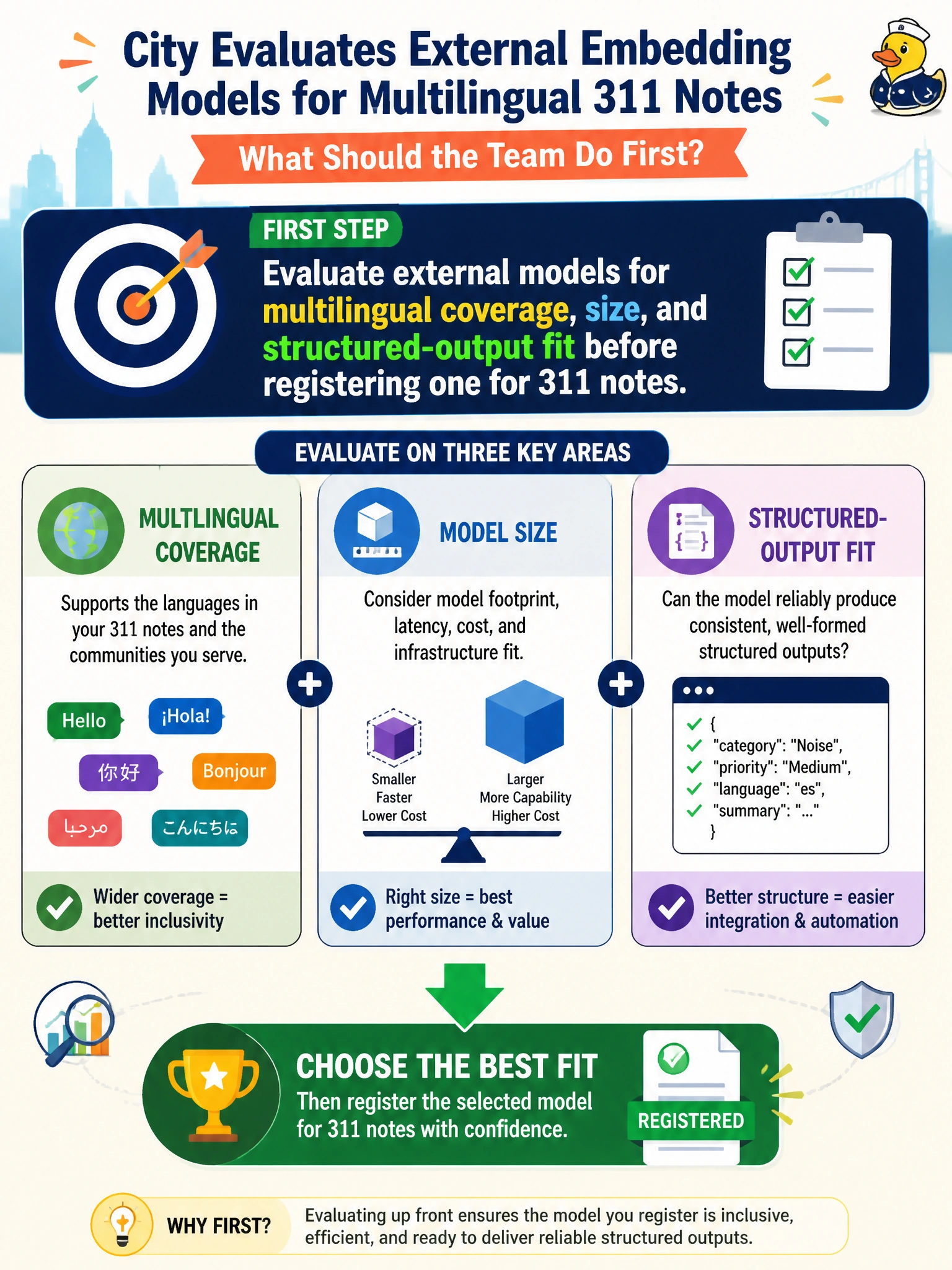
A city evaluates external embedding models for multilingual 311 notes and must weigh model size against structured-output needs. What should the team do first?
Select an answer to reveal the explanation.
Short Explanation
Picking an embedding model for multilingual 311 notes is like choosing a bilingual dispatcher—check language coverage, size, and structured-output fit before you put that model on the city’s payroll.
Full Explanation
Evaluating external embedding models before registration is the first control point for a city 311 pipeline that must handle multilingual resident notes while respecting model-size and structured-output constraints. DP-800 treats model selection as an explicit design step: coverage for the languages residents actually write in, operational cost and latency implied by model size, and whether the endpoint can return structured fields the SQL embedding workflow expects. Skipping evaluation and embedding every note with the first free endpoint found online is an availability choice, not a fitness choice—it risks poor multilingual quality, unstable dimensions, and endpoints that cannot produce the structured outputs municipal pipelines need. Requiring English-only notes so multilingual model size never matters rejects the civic requirement rather than solving it; the city must serve Spanish and other language input without converting language policy into a model shortcut. Replacing the SQL database with a spreadsheet before any embedding work begins abandons the Azure SQL external-model and vector patterns the exam is testing and destroys transactional integrity around request rows. Exam caveat: evaluation criteria should be written down and re-checked when the registered model version changes, because a newer endpoint can alter language packs, token limits, or output schema without a city noticing until retrieval quality drops. Operational check: for a sample of English and non-English 311 notes, compare candidate models on language recall, embedding dimension stability, structured-output parse success, and p95 latency, then register only the model that meets the documented municipal thresholds.