
Emergency management needs near-real-time incident table updates to fan out to operations dashboards. Which Azure SQL integration feature should they enable?
Select an answer to reveal the explanation.
Short Explanation
CES is the bullhorn for incident rows—when emergency tables change, events stream out so ops dashboards hear it now, not tomorrow’s backup.
Full Explanation
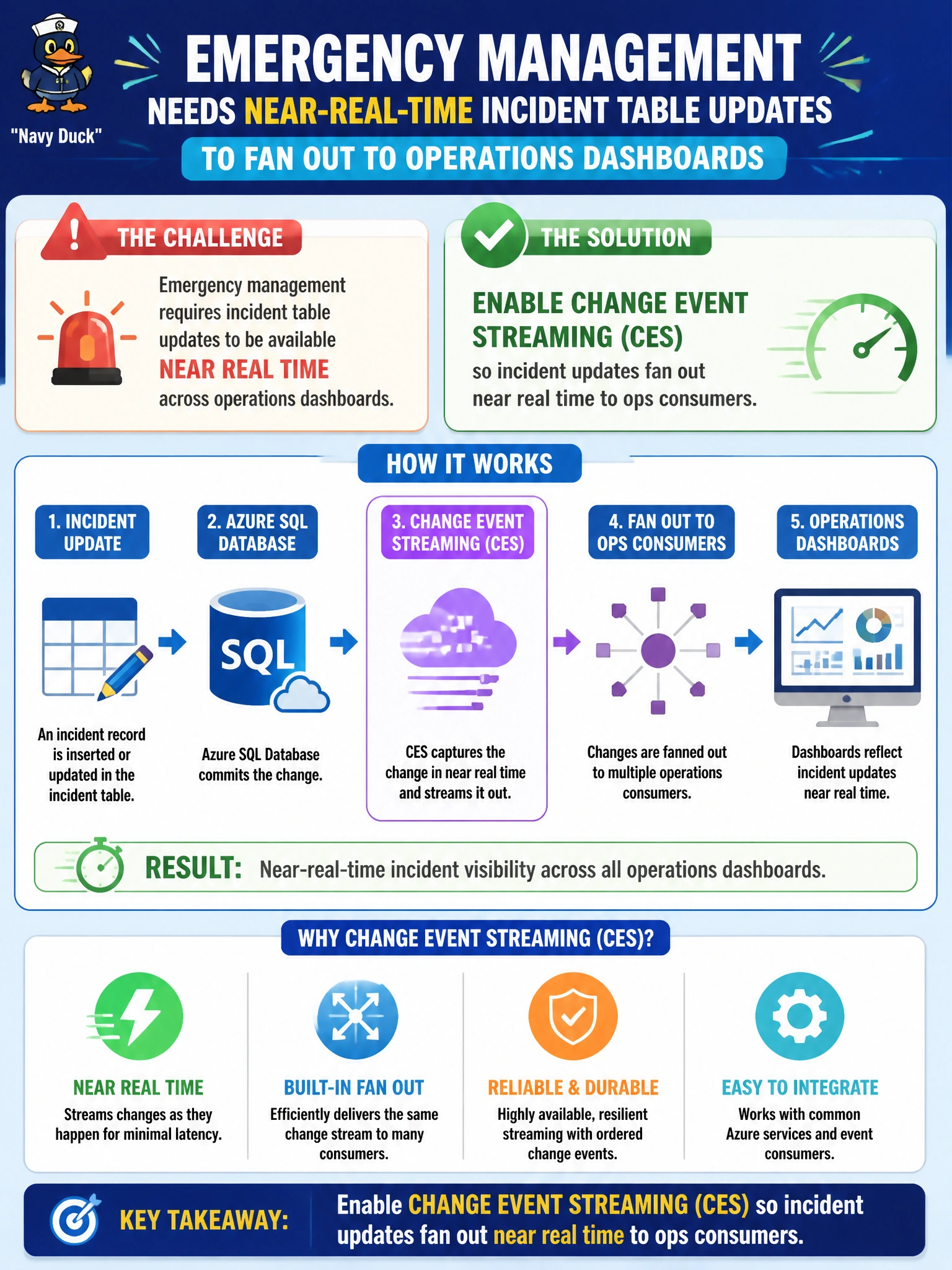
Emergency management needs near-real-time incident table updates to fan out to operations dashboards. They should enable change event streaming (CES) so incident updates fan out near real time to ops consumers. CES is aimed at streaming change events from Azure SQL to downstream listeners—matching municipal emergency scenarios where dashboards cannot wait for overnight batch refresh.
Waiting for nightly full database backups before refreshing any dashboard fails freshness: backups are recovery artifacts, not an event bus for incident rows. Emailing screenshots of the incident grid whenever a row changes fails scalability, structure, and automation for ops tooling. Turning off all change features and relying on quarterly table copies fails the near-real-time requirement by orders of magnitude.
Exam caveat: near-real-time fan-out points to change event streaming rather than backup-based refresh or manual screenshot workflows. Know the difference between recovery (backups) and integration (change events).
Operational check: enable CES for the emergency incident tables, subscribe an ops dashboard or intermediate consumer, update an incident row in test, and measure that the event arrives within the near-real-time window required by emergency management—not on a nightly backup schedule.