
Water utilities need meter reading changes to flow continuously into an Azure Function for downstream processing. Which SQL change technology fits best?
Select an answer to reveal the explanation.
Short Explanation
CDC is the continuously rolling tape of meter changes—turn it on so the Function hears every tick instead of waiting for a monthly CSV dump.
Full Explanation
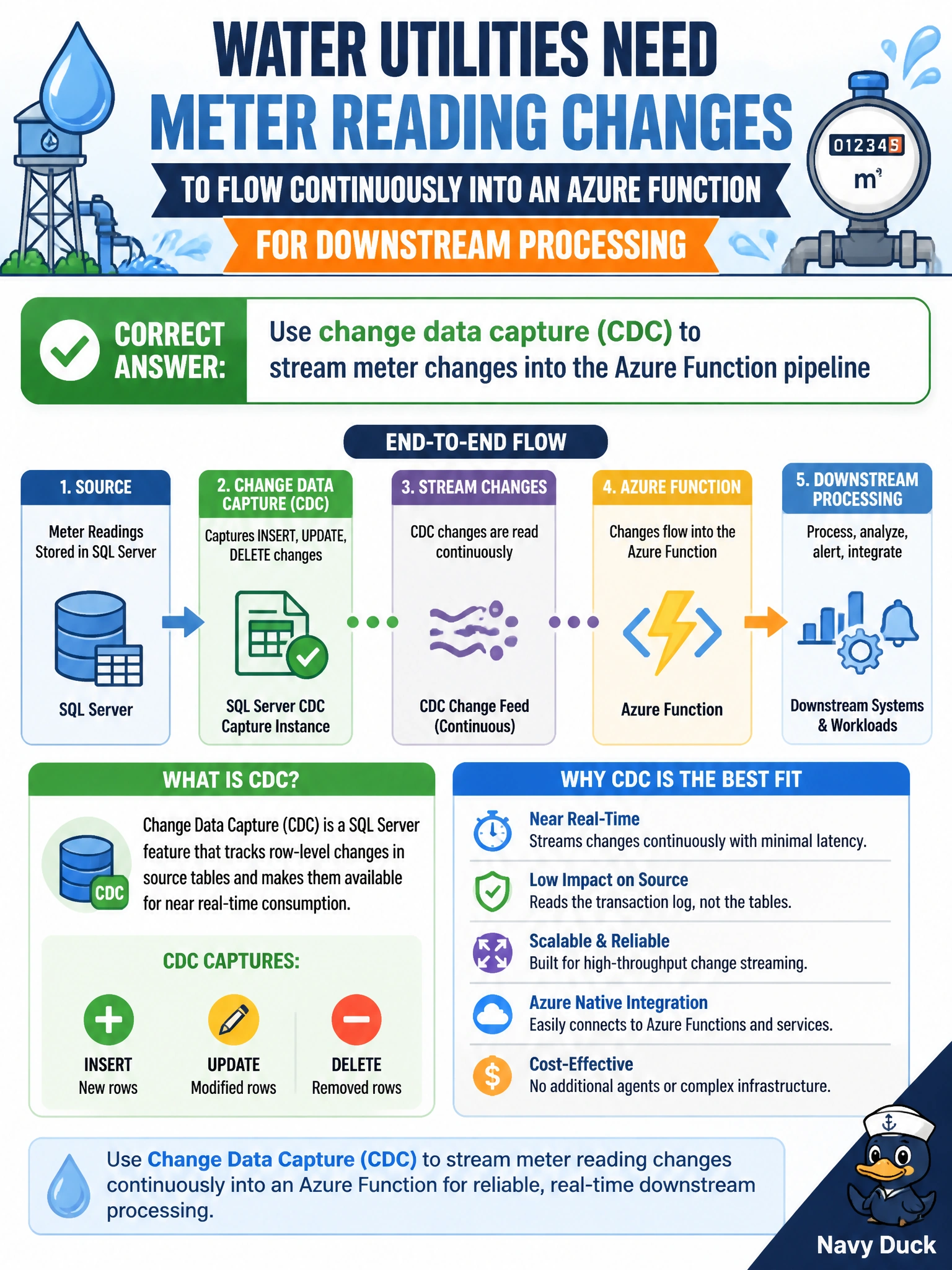
Water utilities need meter reading changes to flow continuously into an Azure Function for downstream processing. Change data capture (CDC) is the SQL change technology that fits best: it records insert/update/delete activity on meter tables so downstream processors can consume incremental changes rather than full extracts. For municipal meter telemetry, CDC supports near-continuous pipelines into Functions without redesigning the OLTP table as a message queue.
Exporting the entire meter table to CSV every month and ignoring interim updates fails latency and completeness—monthly full dumps miss continuous change. Disabling all change tracking features and polling with SELECT * every second from the Function fails efficiency and load: full-table polling is not CDC and can overwhelm Azure SQL. Manually retyping meter deltas into the Function from printed work orders fails automation and accuracy for utility-scale reading volumes.
Exam caveat: distinguish CDC (change log for downstream processing) from crude full-table polling or batch file drops. When the stem says continuously into an Azure Function, CDC (or closely related change technologies as framed by the item) beats monthly CSV and manual entry.
Operational check: enable CDC on the meter reading tables, connect the Azure Function pipeline to consume CDC changes, insert and update sample meter rows in test, and verify the Function processes those deltas without a full table export. Monitor CDC capture/cleanup jobs so water utility change feed health remains part of operations.