
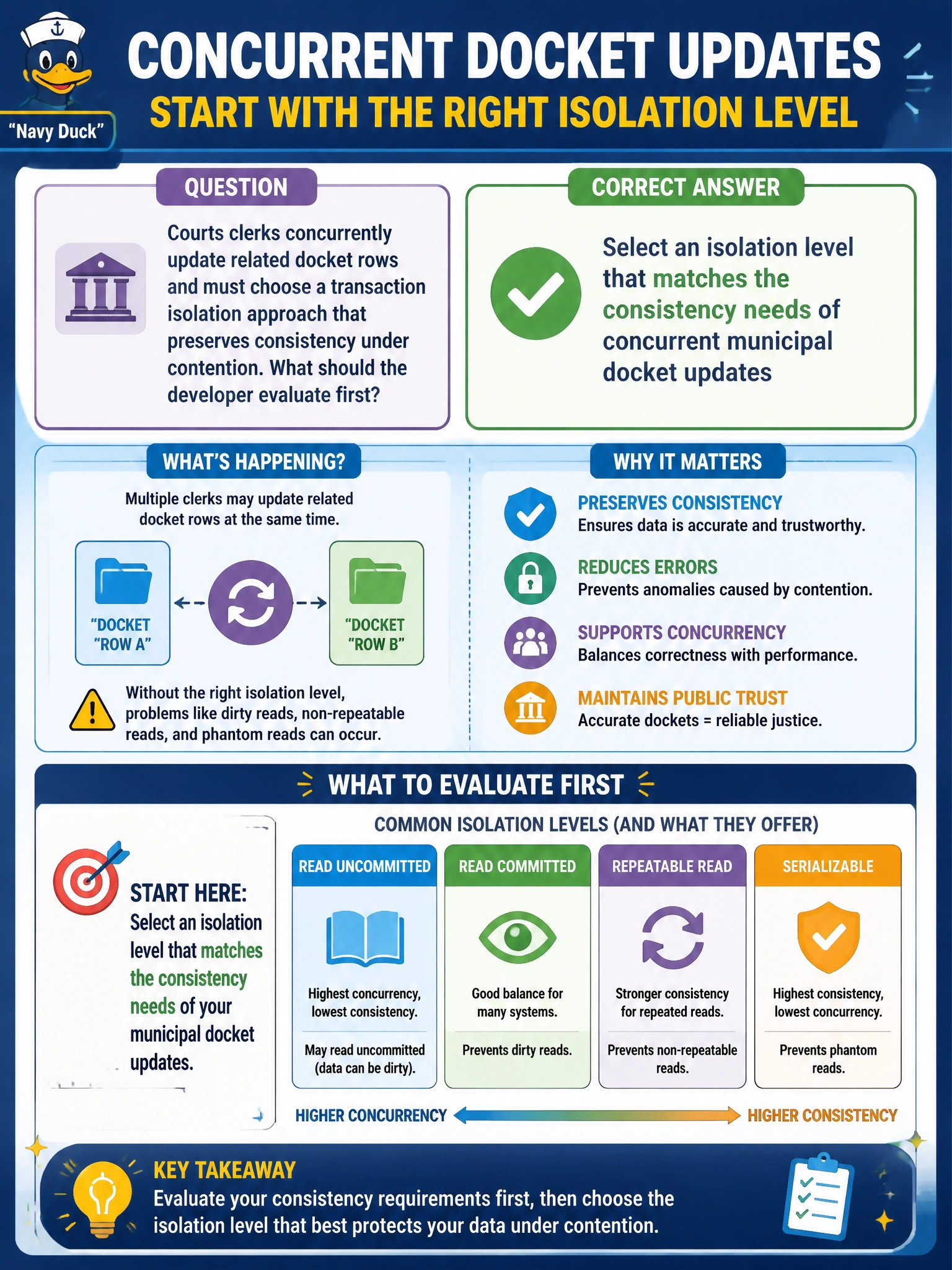
Courts clerks concurrently update related docket rows and must choose a transaction isolation approach that preserves consistency under contention. What should the developer evaluate first?
Select an answer to reveal the explanation.
Short Explanation
Isolation levels are the traffic lights for concurrent docket edits—pick the light timing that matches how consistent those courthouse updates must be.
Full Explanation
Selecting an isolation level that matches the consistency needs of concurrent municipal docket updates is what the developer should evaluate first when courts clerks concurrently update related docket rows. Isolation levels (read committed, repeatable read, serializable, snapshot/RCSI, and application-level patterns) trade lock duration and conflict behavior for consistency guarantees. Matching that tradeoff to docket integrity requirements—whether clerks can see intermediate states, whether lost updates are acceptable, whether blocking is tolerable—is the core transaction-design skill DP-800 targets here.
Disabling all transactions and relying on eventual screen refreshes only fails by concept: related docket updates can tear without atomic boundaries. Setting every session to an isolation choice without considering blocking or consistency tradeoffs treats isolation as a global default slogan rather than a workload decision and can create deadlocks or throughput collapse. Replacing isolation decisions with Dynamic Data Masking on docket numbers addresses display privacy, not concurrent write consistency.
Exam caveat: Read committed snapshot / row versioning often reduces reader-writer blocking in Azure SQL/SQL Server municipal OLTP, but writers can still conflict; serializable may be too strict for busy clerk queues. Know that isolation does not replace proper transaction scope around multi-row docket changes. Optimistic patterns may surface errors the application must retry.
Operational check: Map the docket use case (multi-statement update of related rows) to a candidate isolation level, load-test concurrent clerk sessions, and measure blocking, deadlocks, and inconsistency symptoms. Enable Query Store and wait stats during the test. Implement explicit transactions around related updates in procedures, choose SNAPSHOT/RCSI if readers must not block writers, and document retry logic for conflict aborts. Do not “fix” concurrency with masking or by removing transactions.