
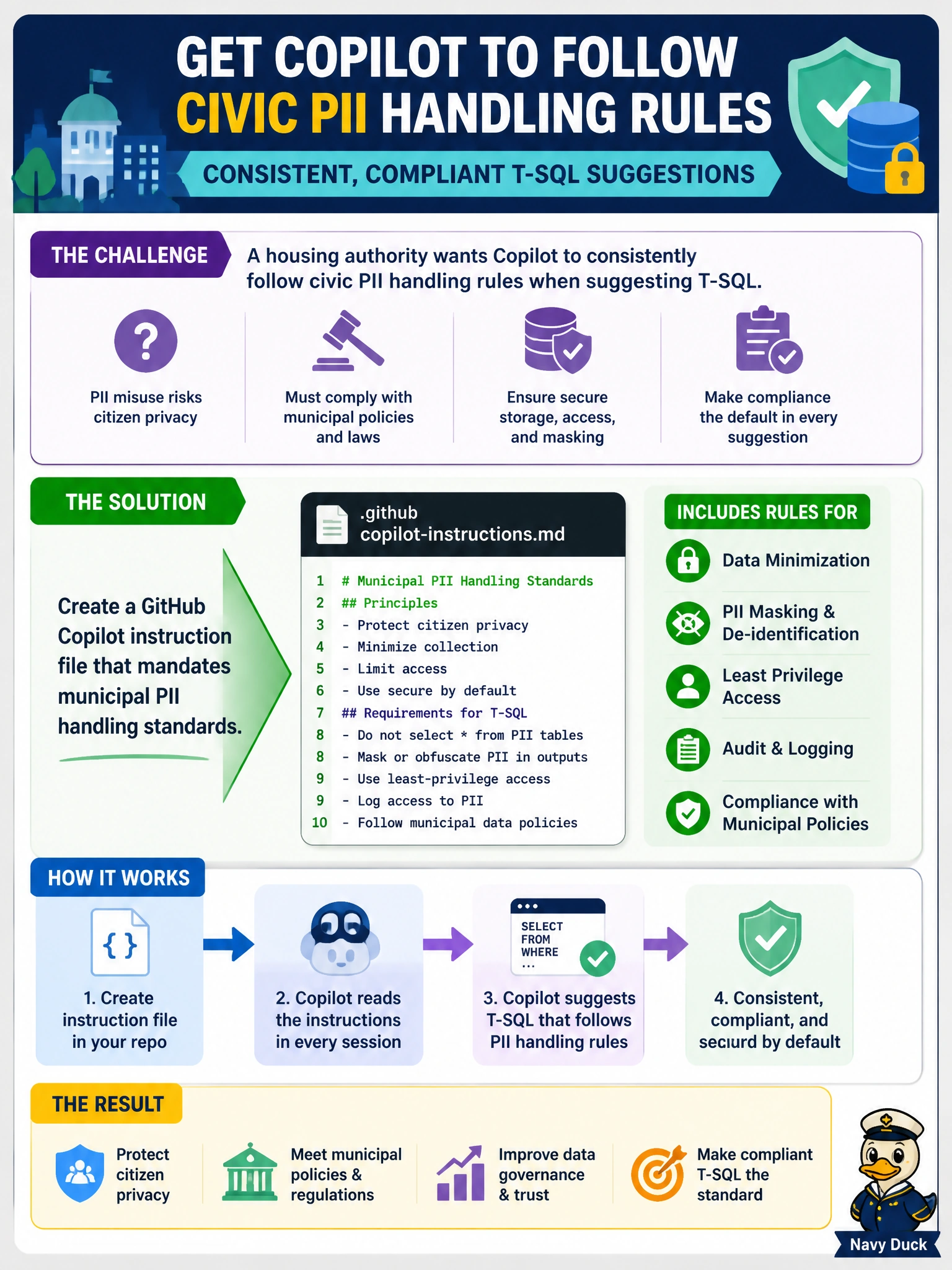
A housing authority wants Copilot to consistently follow civic PII handling rules when suggesting T-SQL. What should the team create?
Select an answer to reveal the explanation.
Short Explanation
An instruction file is like a sticky note on the shop manual that says “never paste resident SSNs”—Copilot reads those house rules before it suggests code.
Full Explanation
A GitHub Copilot instruction file that mandates municipal PII handling standards is what the housing authority should create so Copilot consistently follows civic PII rules when suggesting T-SQL. Instruction files encode project-specific norms—such as never selecting or logging resident SSNs unnecessarily—so suggestions align with housing policy before developers accept them.
An unrestricted db_owner login shared in chat fails by concept because shared privileged logins increase credential and audit risk; they do not teach Copilot PII standards. A public anonymous REST endpoint for every housing table fails because it expands data exposure rather than guiding safe code generation. A columnstore index instead of coding standards fails because indexes address performance/storage, not AI suggestion policy for PII handling.
Exam caveat: Instruction files are the DP-800-aligned mechanism for persistent Copilot project standards. Do not confuse security anti-patterns (shared db_owner, anonymous endpoints) or performance features (columnstore) with instruction-file governance.
Operational check: Commit the instruction file with the housing SQL project, include explicit PII do/don’t rules, have a developer request a sample query involving resident attributes, confirm suggestions omit prohibited PII patterns, and update the file via PR when policy changes.