
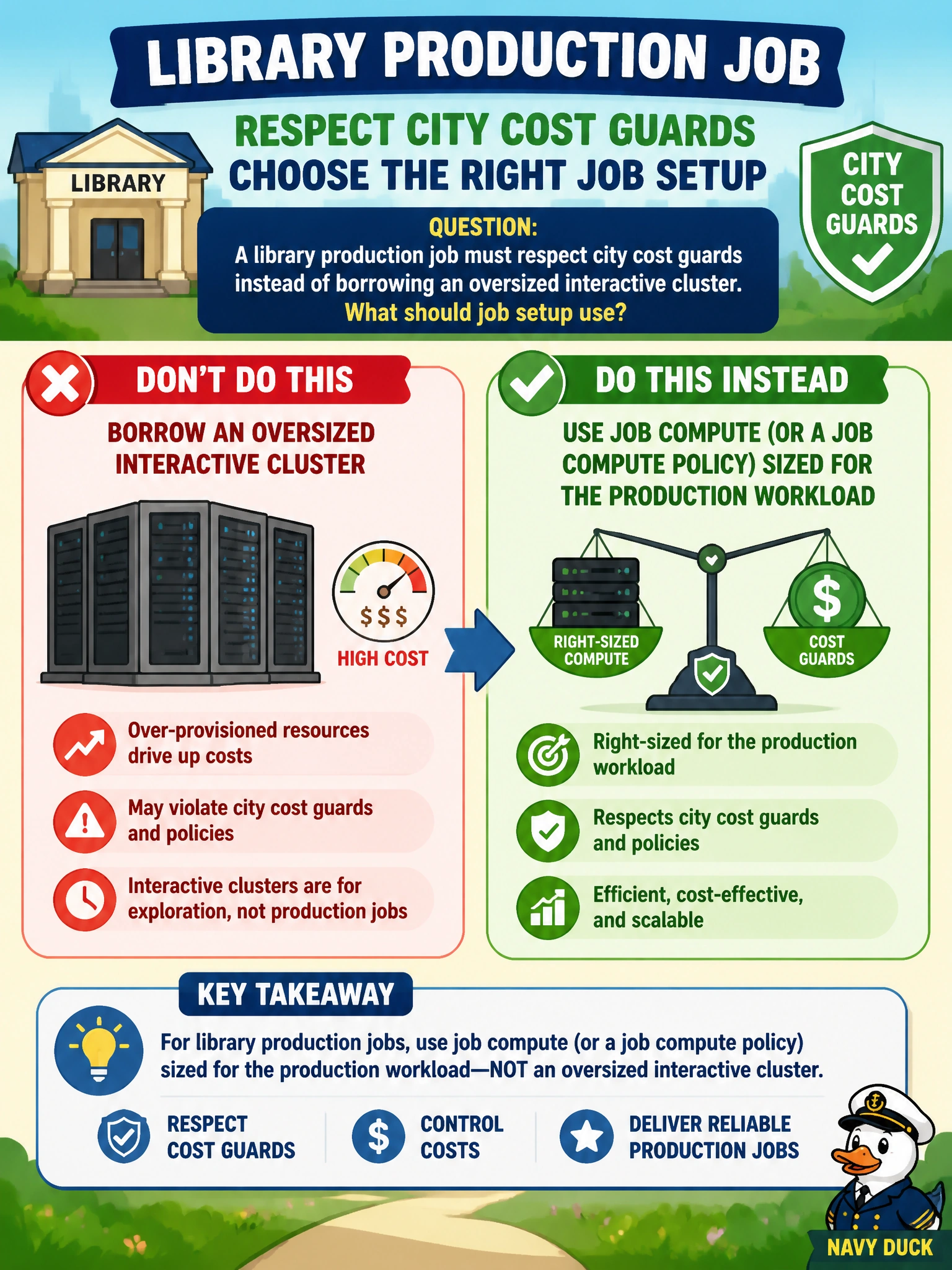
A library production job must respect city cost guards instead of borrowing an oversized interactive cluster. What should job setup use?
Select an answer to reveal the explanation.
Short Explanation
Production jobs need job compute, not a dedicated all-purpose cluster with auto-scaling for isolated nightly runs—it stays warm and bills at interactive rates so you'll blow past cost guards. You'll also get tripped up by assigning a personal compute resource to the job identity for nightly execution, since it lacks workspace governance and scalable compute. And don't pick a SQL warehouse with auto-scaling clusters to execute the nightly workflow reliably; that's a mismatch for a production job.
Full Explanation
A library production job that must respect city cost guards should use job compute (or a job compute policy) sized for the production workload rather than borrowing an oversized interactive all-purpose cluster. Job compute is ephemeral, policy-governable, and isolated from analyst notebooks, which aligns with municipal FinOps and least-privilege cluster use. Interactive clusters are convenient for development but expensive and contended when left large "just in case" and attached to production tasks. Using a dedicated all-purpose cluster with auto-scaling enabled for isolated production library runs on a nightly schedule fails by concept because even when dedicated and auto-scaled, all-purpose clusters stay warm and bill at interactive rates beyond job needs and violate cost guards compared to ephemeral job compute. Assigning a personal compute resource to the job identity for automated nightly library execution on schedule fails because personal resources lack workspace governance, scalable compute, and centralized secrets/auditing. Choosing a SQL warehouse endpoint with auto-scaling clusters enabled to execute the nightly production library workflow reliably fails because production jobs need job compute with explicit policy-compliant compute, not a warehouse designed for query concurrency even with auto-scaling. Exam caveat: job compute vs interactive/all-purpose is a recurring DP-style theme: production jobs → job compute/policies; exploration → interactive. Policies may cap node types and DBUs; "biggest cluster" is rarely the right exam answer for cost-aware municipal setups. Correct sizing still depends on data volume—undersizing causes SLA risk, oversizing burns budget. Operational check: open the Lakeflow Job compute settings and confirm job compute (or a constrained policy) is selected, that interactive clusters are not attached for production tasks, and that estimated cost aligns with the library's cost guardrails. Review recent run DBUs after cutover.
Prefer to study offline? Printable PDF study book + test engine ($7.50, unofficial). These questions stay free here.