
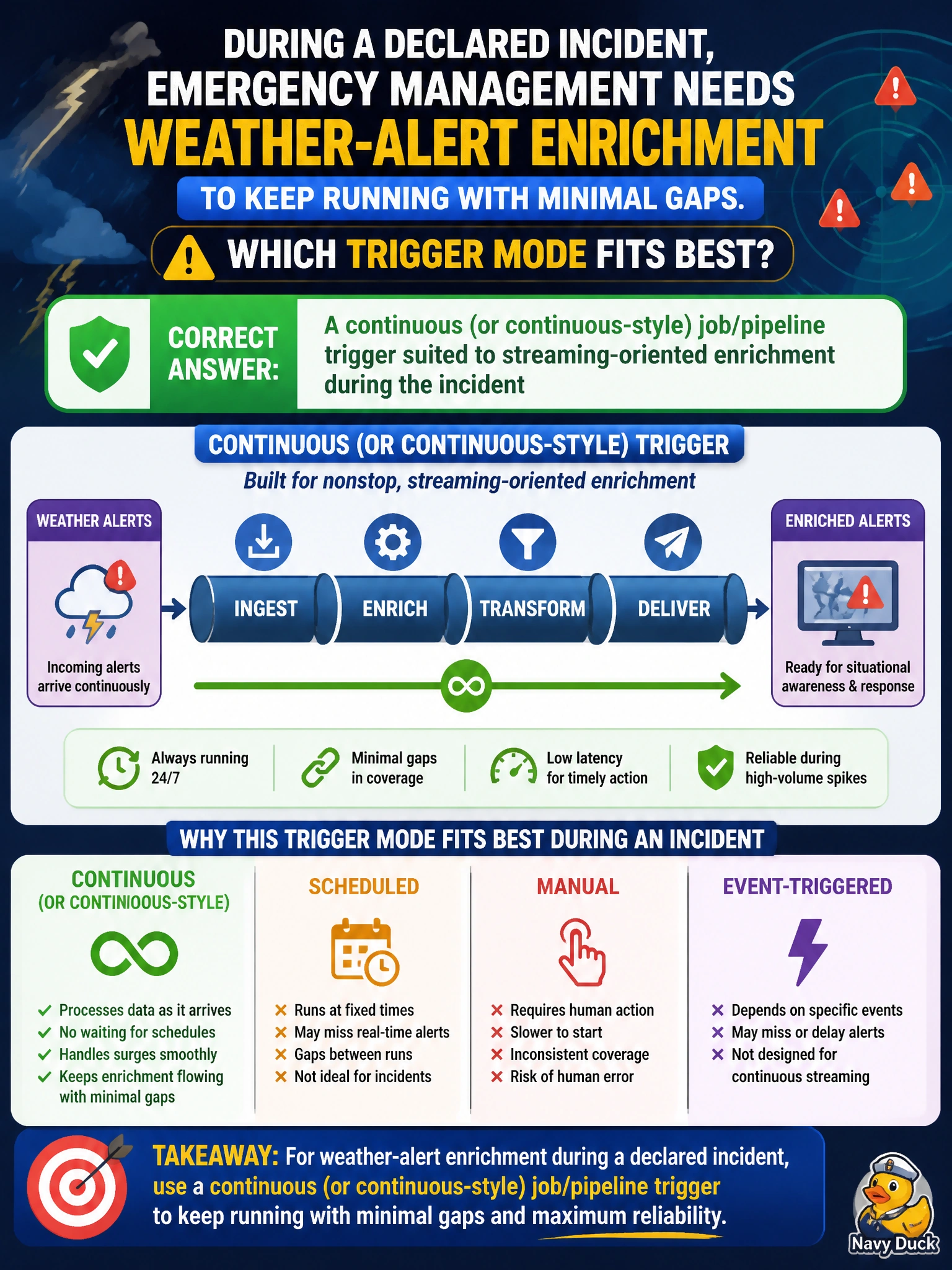
During a declared incident, emergency management needs weather-alert enrichment to keep running with minimal gaps. Which trigger mode fits best?
Select an answer to reveal the explanation.
Short Explanation
Declared incidents are live TV, not a short-interval batch schedule that holds alerts between fires—use a continuous-style trigger so weather enrichment stays on the air. Tumbling windows and file-arrival events still wait for the next window or landing, and that's too long during an active incident.
Full Explanation
During a declared incident, emergency management weather-alert enrichment that must keep running with minimal gaps fits a continuous (or continuous-style) job/pipeline trigger. Continuous mode keeps the enrichment workload active so new weather and alerting feeds are processed with low idle time, matching the operational reality of an ongoing incident rather than a short-interval schedule that still batches queued alerts between fires. Municipal emergency operations centers need enrichment to stay "on the air" while shelters, transit, and public messaging systems consume the outputs.
Using only a schedule trigger firing at short intervals to batch queued weather alerts fails because batching holds alerts until the next fire time, leaving gaps a live incident lasting hours or days cannot afford. A tumbling window trigger using short fixed intervals to aggregate alerts fails because fixed windows still aggregate and wait for window close, so alerts sit idle between windows and under stress that is too much gap. An event-based trigger launching the pipeline when new weather alert files arrive in cloud storage fails because it reacts to file landings rather than keeping enrichment continuously active, so alerts can gap between file drops or streaming feeds.
Exam caveat: match trigger to latency need—continuous for streaming-oriented or near-continuous enrichment; short-interval scheduled batching still queues between fires; file-arrival event triggers react to landings and can miss continuous streams. Continuous mode has cost implications; it is justified for declared incidents, not every low-priority civic batch.
Operational check: for an incident drill, enable continuous-style triggering for the weather enrichment job/pipeline, verify runs or micro-batches continue with minimal gaps, and confirm schedule-only, tumbling-window-only, or file-arrival-only modes are not left as the sole start mechanism. Pair with failure and duration alerts so gaps still page EOC staff.
Prefer to study offline? Printable PDF study book + test engine ($7.50, unofficial). These questions stay free here.