
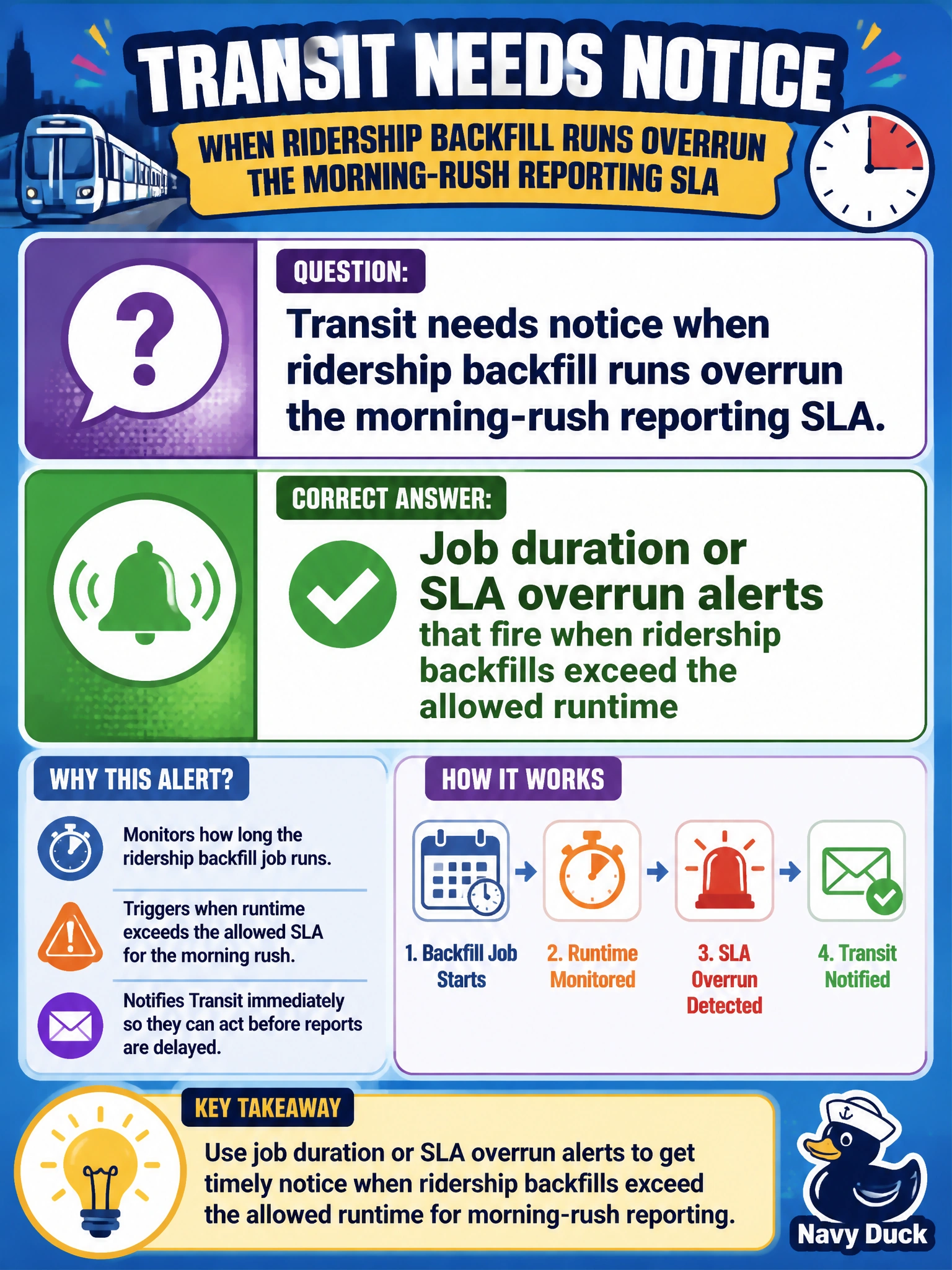
Transit needs notice when ridership backfill runs overrun the morning-rush reporting SLA. What alert should they use?
Select an answer to reveal the explanation.
Short Explanation
If the backfill bus is still idling when rush hour hits, you need a duration/SLA horn—not a queue duration alert that only fires when jobs sit queued too long. You'll miss the SLA if you only watch queue time, since your job can start on time but still run past rush hour.
Full Explanation
Transit ridership backfills that can overrun the morning-rush reporting SLA need duration or SLA-overrun alerts on the Lakeflow Job. Those alerts fire when runtime exceeds the allowed window, giving operations time to mitigate—cancel a runaway backfill, raise compute, or communicate delayed dashboards—before rush-hour reporting is blind. Municipal transit control centers care about wall-clock completion as much as eventual correctness; a backfill that "succeeds" at 10 a.m. can still miss the operational decision window.
Queue duration alerts for ridership backfills that fire when jobs wait queued beyond the allowed runtime fail by concept because they only track queue wait, so a backfill that starts promptly but runs long still overruns the morning-rush window without paging anyone. Mean duration alerts for ridership backfills that fire when mean runtime stays above the allowed runtime fail because they average across runs, so a single morning-rush overrun may not move the mean enough to alert in time, and backfills are exactly when overrun risk is highest. Table arrival SLA alerts for ridership tables that fire when new records land after the allowed runtime fail because arrival tells you when records appear, not whether the backfill job completed within the allowed runtime before rush hour.
Exam caveat: duration/SLA alerts complement queue-duration alerts; a job can clear the queue quickly and still breach SLA during execution. Do not confuse table-arrival SLA alerts with operational runtime SLAs—both matter, different signals. For long historical backfills, consider separate jobs or parameters so nightly incremental paths keep their tighter SLAs.
Operational check: set a duration threshold aligned to the morning-rush reporting cutoff, run a deliberately slow non-prod backfill, and confirm the overrun alert reaches ops. Verify queue-duration alerts are not the sole notification path on the production ridership job.
Prefer to study offline? Printable PDF study book + test engine ($7.50, unofficial). These questions stay free here.