
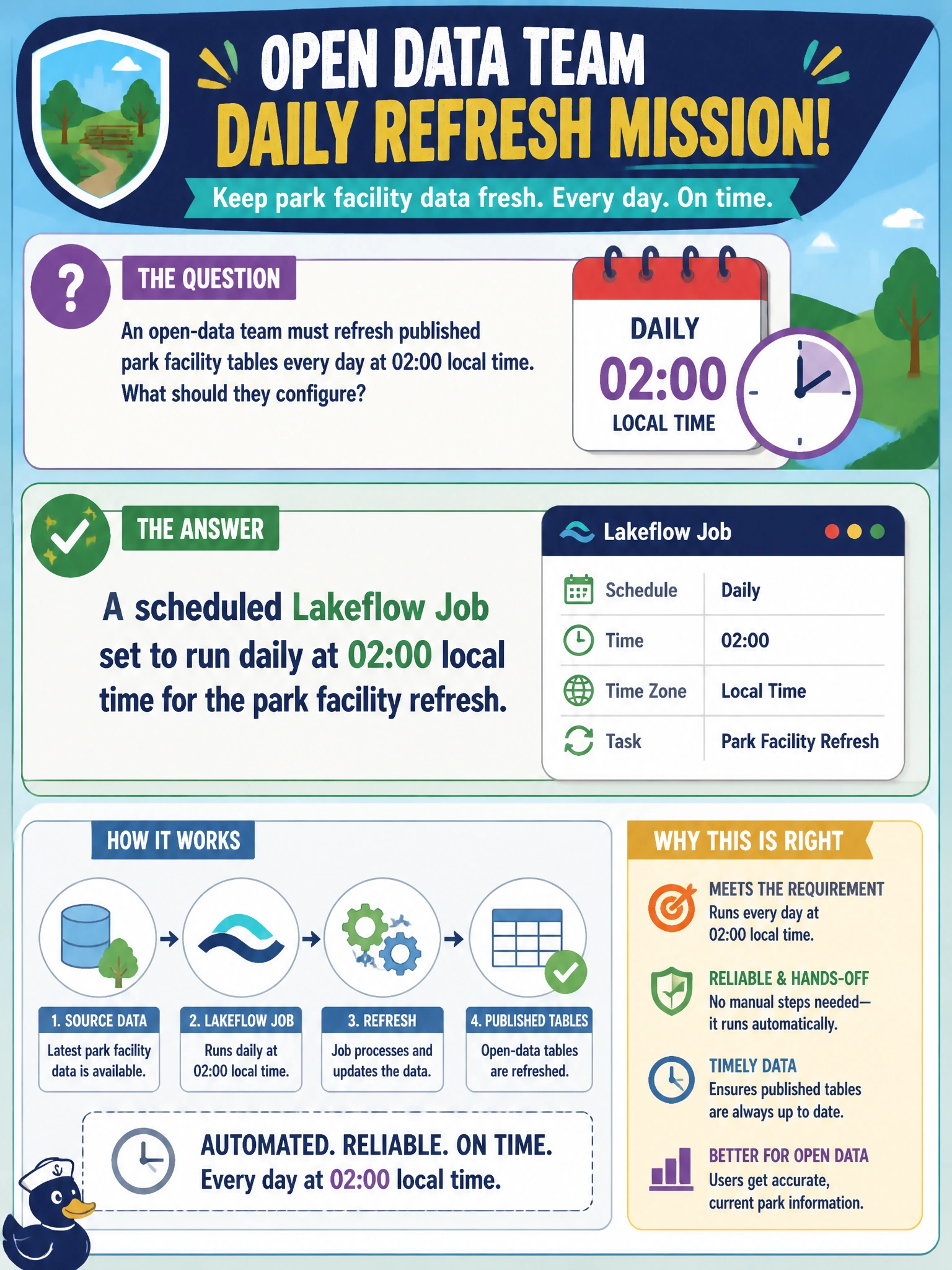
An open-data team must refresh published park facility tables every day at 02:00 local time. What should they configure?
Select an answer to reveal the explanation.
Short Explanation
Set a daily schedule for 02:00 local time so park data refreshes at a fixed, predictable moment every night. You'll only get that with a scheduled Job, since a Pipeline runs transform logic but doesn't orchestrate that refresh, Connect just ingests outside data, and Delta Sharing only shares what's already published.
Full Explanation
The open-data team's park facility tables must refresh every day at 02:00 local time to stay current for daytime usage. A scheduled Lakeflow Job configured with a daily cron or time-based trigger ensures consistent, automated execution at the specified hour, maintaining predictable SLA windows for downstream stakeholders and dashboards. Scheduling encodes intent—the job always runs at the designated time, regardless of user presence, network conditions, or other system load.
A scheduled Lakeflow Pipeline set to run daily at 02:00 local time for the park facility refresh fails because a Pipeline defines declarative transformation logic rather than orchestrating a scheduled Job; it does not execute a time-based refresh of the published park facility tables at 02:00. A scheduled Lakeflow Connect set to run daily at 02:00 local time for the park facility refresh fails because Connect provides managed ingestion from external applications and databases rather than running a refresh of published tables; it cannot execute the park facility refresh at the required time. A scheduled Delta Sharing set to run daily at 02:00 local time for the park facility refresh fails because Delta Sharing securely shares already-published data with recipients rather than scheduling compute; it does not run a refresh, so the published park facility tables would stay stale.
The 02:00 local time window is specifically chosen to avoid peak usage hours, preposition data for morning reports, and ensure overnight completion before business hours. Scheduling must respect timezone differences when the job runs on servers in different regions—use local time configuration, not UTC, to match the service's operating region.
Operational check: verify the job ran at or within a few minutes of 02:00 local time in the job run history; spot-check that published park facility tables carry today's date and the latest operating hours; alert if any scheduled run is missed or delayed by more than 15 minutes.
Prefer to study offline? Printable PDF study book + test engine ($7.50, unofficial). These questions stay free here.