
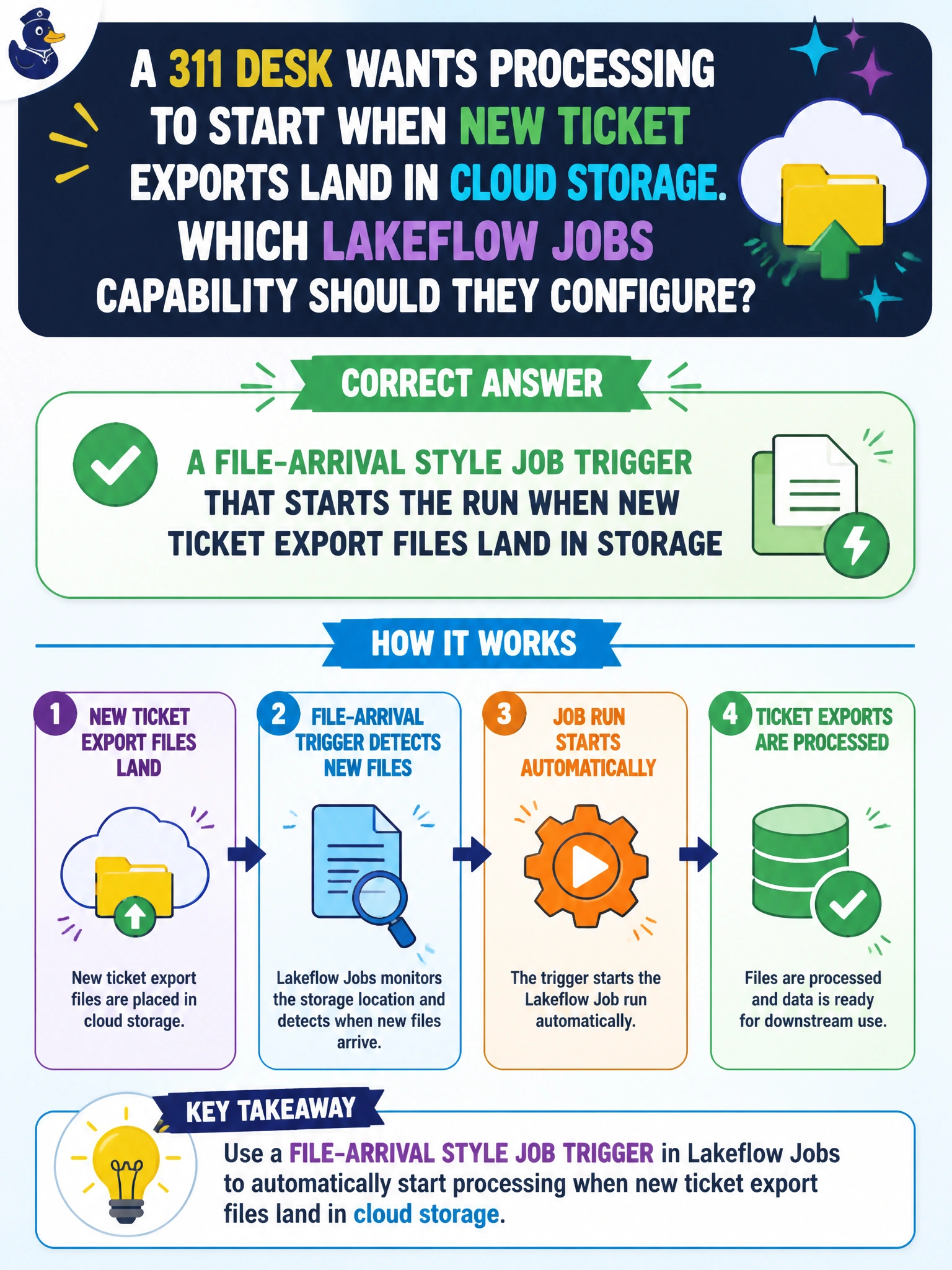
A 311 desk wants processing to start when new ticket exports land in cloud storage. Which Lakeflow Jobs capability should they configure?
Select an answer to reveal the explanation.
Short Explanation
When your ticket dump lands in storage, you'll want the job to wake up right away — that's a file-arrival trigger. It's not a scheduled-style trigger, since that one's tied to the clock and won't wake up for you just because files landed.
Full Explanation
When a 311 desk needs processing to start as soon as new ticket export files land in cloud storage, the right Lakeflow Jobs capability is a file-arrival (event-driven) style trigger. That trigger watches the landing location and starts the job when new export objects appear, so ticket enrichment, classification, and SLA clocks begin without waiting for the next calendar tick. For municipal service desks, reducing lag between export drop and processing directly affects response-time metrics citizens and council dashboards see.
A scheduled style job trigger that starts the run when new ticket export files land in storage mislabels the mechanism — scheduled-style triggers still react to the clock, not to the files, so they cannot start a run when exports land and tickets would still wait for the next timetable tick, which is exactly the lag the desk is trying to eliminate by asking for a trigger on file arrival instead of a calendar. A table-update style job trigger that starts the run when new ticket export files land in storage watches for table updates, not storage file arrival — it only fires after data is already committed as table changes, so nothing starts the run when the export files themselves first land in cloud storage. A continuous style job trigger that starts the run when new ticket export files land in storage misstates continuous behavior — it keeps compute running continuously rather than starting a run on each file arrival, which makes sense for a true streaming source, but it is heavier machinery than a desk that just needs a run to start promptly each time a batch of export files lands, which a file-arrival trigger handles without keeping compute running at all times.
Exam caveat: file-arrival triggers solve event-driven starts; they do not replace idempotent processing, quarantine for bad files, or schema validation. You may still combine file arrival with schedules for catch-up sweeps. Distinguish a continuous style job trigger that starts the run when new ticket export files land in storage from batch jobs that simply start when a file appears — keeping a run active continuously is not the same as starting a run on file arrival, and this stem asks for a job trigger on file landing.
Operational check: drop a sample ticket export into the watched storage path in a non-prod account and confirm the Lakeflow Job run starts automatically, processes the file, and leaves an auditable run record. Verify that deleting or ignoring the landing path is not part of the runbook, and that on-call paging supplements—not replaces—the trigger.
Prefer to study offline? Printable PDF study book + test engine ($7.50, unofficial). These questions stay free here.