
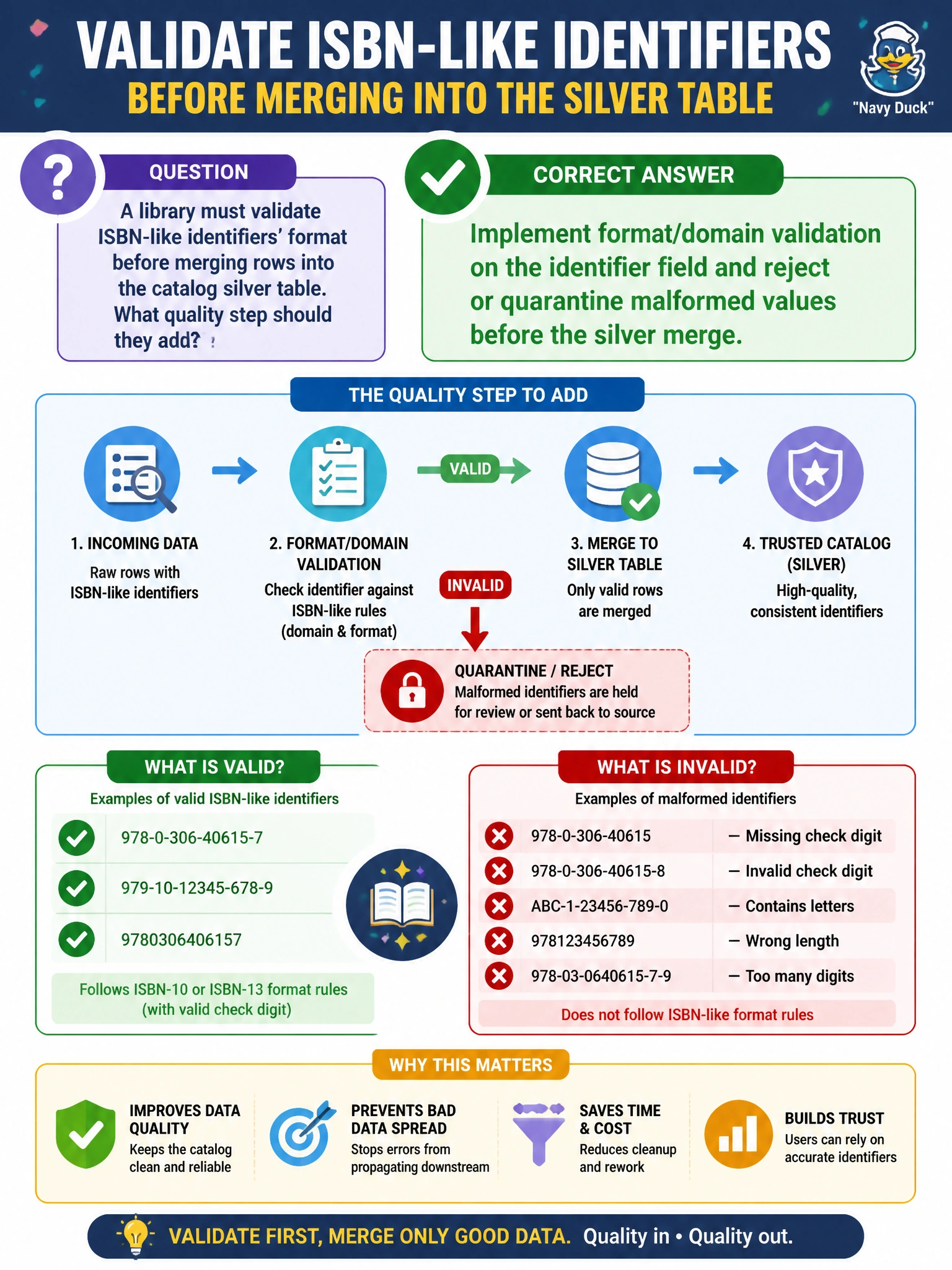
A library must validate ISBN-like identifiers' format before merging rows into the catalog silver table. What quality step should they add?
Select an answer to reveal the explanation.
Short Explanation
ISBN format checks are like verifying the barcode on a book before it hits the shelf—bad codes go back to the cart, not into the catalog. You'll still let malformed codes slip into silver if you're only checking for duplicates, out-of-range identifier values, or nulls because none of those confirm the barcode shape is valid.
Full Explanation
Domain and format validation for municipal identifiers belongs before curated merges. A library catalog silver table that accepts ISBN-like identifiers should enforce format/domain rules (length, check-digit pattern, allowed charset) and reject or quarantine malformed values so silver remains trustworthy for discovery, holds, and inventory joins. Running that check as a quality step prior to MERGE keeps bad identifiers out of the curated layer instead of discovering them only when patrons search or when downstream gold reports break. Enforcing uniqueness checks on the identifier field and rejecting or quarantining duplicate values before the silver merge fails because uniqueness does not guarantee a valid ISBN-like shape; malformed but unique strings still enter silver and spread bad keys into every dependent query. Implementing range validation on the identifier field and rejecting or quarantining out-of-range values before the silver merge fails because range checks numeric min-max bounds, not format/domain shape; malformed ISBN-like strings with illegal characters or bad check-digit patterns can still fall inside a range and enter silver. Implementing completeness validation on the identifier field and rejecting or quarantining null values before the silver merge fails because presence does not prove shape; non-null but malformed strings still enter silver and leave joins unreliable with polluted keys. Exam caveat: format validation proves shape, not that the ISBN exists in a bibliographic authority file; referential enrichment is a separate step if the city requires it. Operational check: submit rows with truncated, padded, and illegal-character identifiers, confirm they are rejected or quarantined before silver MERGE, verify well-formed identifiers merge cleanly, and sample silver for zero malformed identifier patterns after the load.
Prefer to study offline? Printable PDF study book + test engine ($7.50, unofficial). These questions stay free here.