
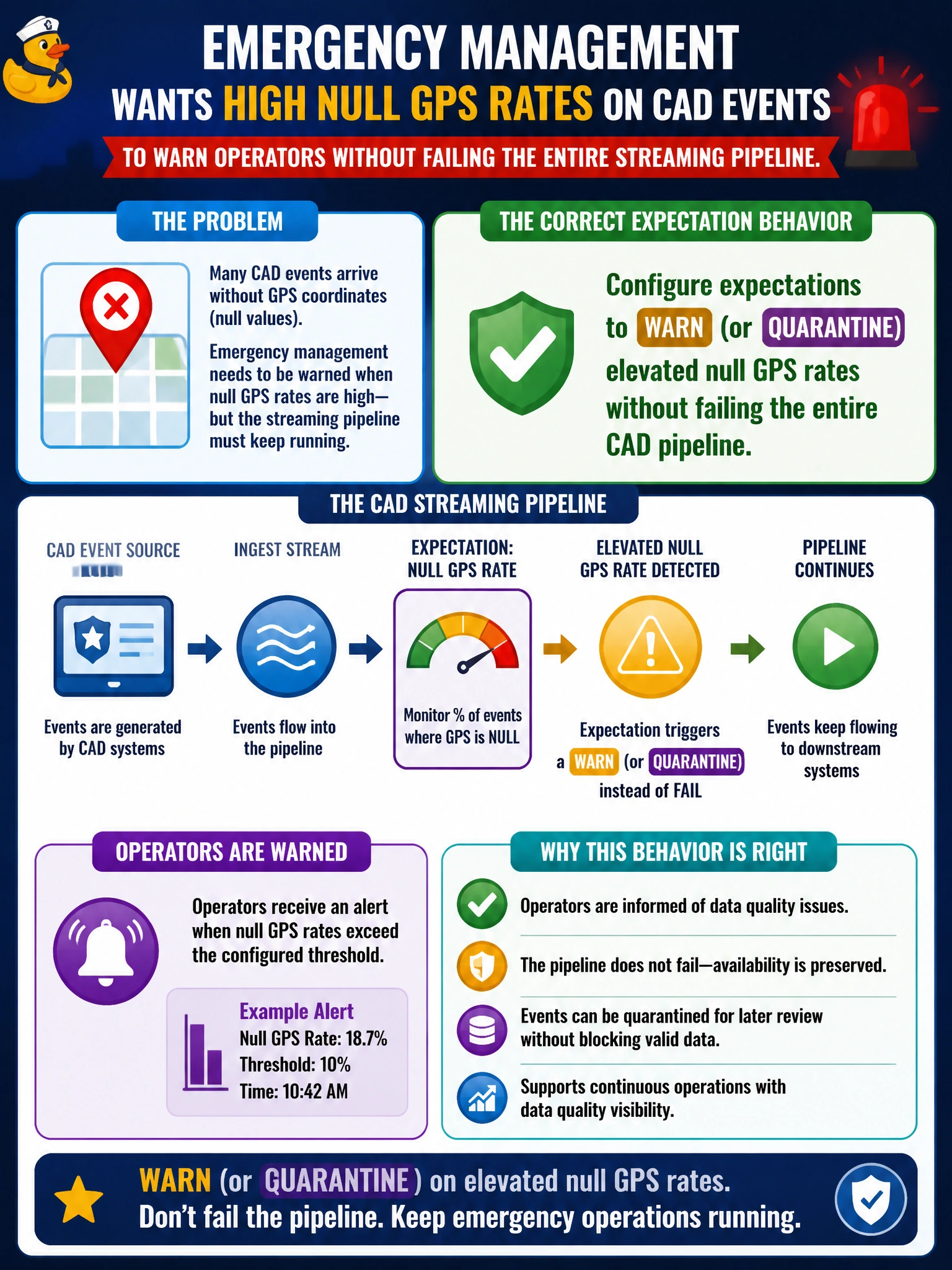
Emergency management wants high null GPS rates on CAD events to warn operators without failing the entire streaming pipeline. Which expectation behavior fits?
Select an answer to reveal the explanation.
Short Explanation
Null GPS is like a radio call with a fuzzy location—you'll flag it for dispatch without failing the CAD pipeline. You've got to watch elevated null GPS rates because a unit ID check won't catch the GPS gap.
Full Explanation
Expectation severity should match civic operational risk. Emergency management CAD streams often see elevated null GPS rates from devices, vendors, or coverage gaps. Configuring expectations to warn—or quarantine suspect rows—lets operators see the quality signal without failing the entire overnight landing job. The rest of the CAD events continue to bronze/silver so dispatch analytics remain available while the GPS null issue is investigated. That is the intended use of warn/quarantine severity: signal and isolate the elevated null GPS rate without swapping in null unit ID rates that leave the actual GPS gap unmonitored. Configuring expectations to warn (or quarantine) on elevated null unit ID rates without failing the entire CAD pipeline misses the asked-for signal: it monitors the wrong field, so operators get alerts about unit IDs while the elevated null GPS rate that threatens dispatch analytics goes unwarned. Configuring expectations to warn (or quarantine) on row-level null GPS violations without failing the entire CAD pipeline misses the aggregation: a per-row check flags each fuzzy location individually but never measures whether the overall null GPS rate is elevated, so operators don't get the high-rate warning emergency management asked for. Configuring expectations to warn (or quarantine) on elevated null GPS rates without failing the entire bronze ingestion job scopes the guarantee to the wrong pipeline: it watches the right GPS-rate signal but only promises the bronze ingestion job keeps running, leaving the CAD pipeline that emergency management needs to stay up without the required warn-without-fail protection. Exam caveat: warn versus quarantine versus which field you monitor is a policy choice—monitoring elevated null unit ID rates does not substitute for the GPS-rate signal, and life-safety alerts that require coordinates may still need harder gates later in the pipeline even if early ingest only warns. Operational check: simulate a burst of null-GPS CAD events, confirm the pipeline completes, verify warn/quarantine metrics for the elevated null GPS rate and any quarantine table populate, ensure non-null events still reach silver, and page operators from that GPS-rate signal rather than from a null unit ID rate that would miss the GPS outage.
Prefer to study offline? Printable PDF study book + test engine ($7.50, unofficial). These questions stay free here.