
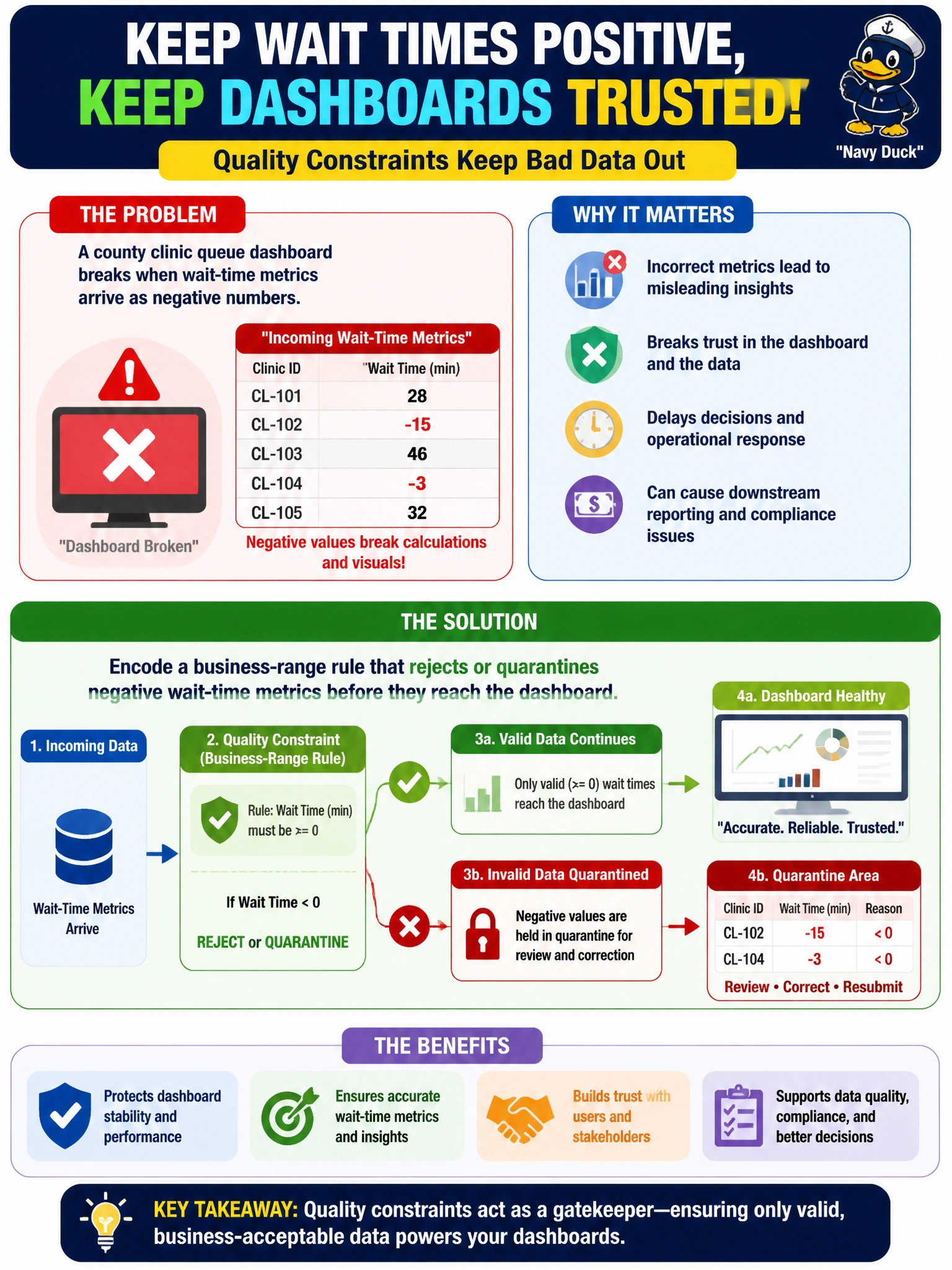
A county clinic queue dashboard breaks when wait-time metrics arrive as negative numbers. How should quality constraints treat those values?
Select an answer to reveal the explanation.
Short Explanation
Negative wait time is like a clock running backward at the clinic—your quality rule should toss that reading before the SLA board lights up red for nonsense. You'll still feed the dashboard garbage if you accept those negatives as valid integers or count them toward coverage, since they're still impossible values. You'll just mask the defect if you re-timestamp them, because the wait time's still negative.
Full Explanation
Business-range rules are first-class quality constraints for civic metrics. County clinic wait-time dashboards assume non-negative durations; negative values usually indicate clock skew, sign errors, bad joins, or unit mistakes. Encoding a range rule that rejects or quarantines negative wait times before dashboard publish protects SLA boards, while a strict data-type check that accepts negative wait-time metrics as valid integers ignores the business range and lets impossible values light the board red.
Enforcing a strict data-type check that accepts negative wait-time metrics as valid integers fails by design: it validates the type while explicitly approving an impossible business value, so negative integers flow through and corrupt the dashboard. Configuring a freshness monitor that re-timestamps negative wait-time metrics on arrival fails by design: it only updates arrival time while leaving the negative duration intact, so invalid wait times still reach the dashboard while the upstream defect stays hidden behind a fresh timestamp. Applying a completeness threshold that counts negative wait-time metrics toward required coverage fails by design: it treats invalid values as good coverage, so negative wait times still reach the dashboard instead of being rejected or quarantined.
Exam caveat: a range rule can be warn/quarantine/fail depending on how critical the dashboard is; finance-style SLA boards often quarantine or fail, while exploratory silver may warn first. Operational check: inject negative and absurdly large wait times into a test batch, confirm they never reach the clinic queue dashboard, verify zero-and-positive values still aggregate correctly, and open a remediation ticket for the source system producing the negatives.
Prefer to study offline? Printable PDF study book + test engine ($7.50, unofficial). These questions stay free here.