
A permits office must orchestrate extracts from on-prem SQL into ADLS before Databricks refine. Which tool should they select for that hybrid orchestration?
Select an answer to reveal the explanation.
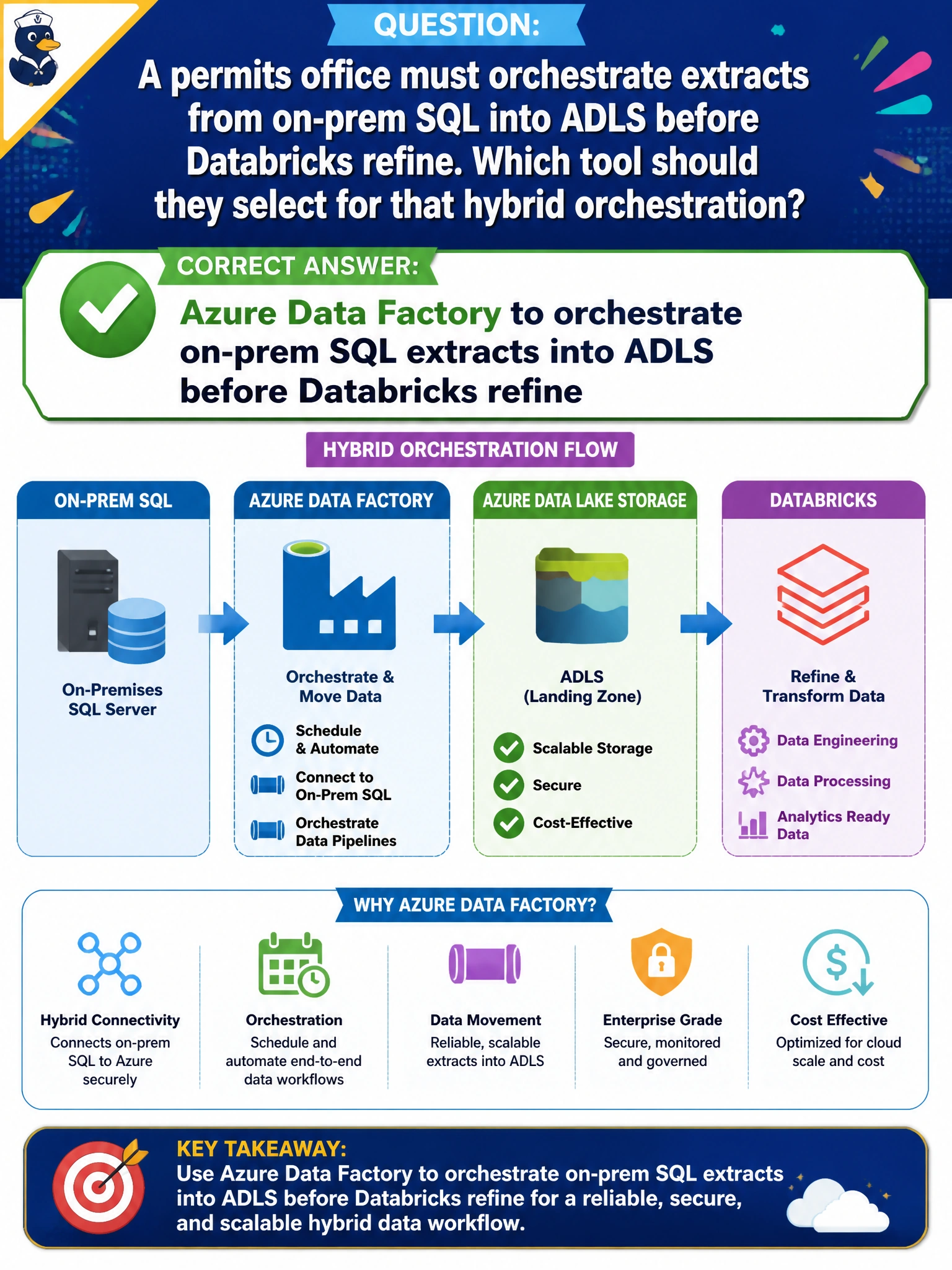
Short Explanation
ADF is the municipal shuttle that picks up on-prem SQL crates and drops them at the ADLS dock so Databricks can refine without everyone camping on the old server. You'll still need that shuttle since Logic Apps can't handle bulk hybrid copy, Auto Loader can't pull from on-prem SQL until files land, and SQL Server Agent jobs can't orchestrate to ADLS.
Full Explanation
Permits offices that extract from on-prem SQL into ADLS before Databricks refine need hybrid orchestration. Azure Data Factory is the appropriate tool for scheduling and moving on-prem SQL extracts into ADLS so Databricks can refine without every analyst hammering the operational SQL server. ADF fits the municipal pattern of controlled cloud landing followed by lakehouse transform and curated publish for permit analytics.
Azure Logic Apps is not the right fit for this hybrid orchestration; it is a lightweight workflow orchestration service rather than a purpose-built hybrid data movement orchestrator, and it lacks ADF’s native on-prem SQL connectivity, copy activity, and ADLS landing controls for permit extracts.
Databricks Auto Loader cannot orchestrate on-prem SQL extracts into ADLS; it is designed to detect files that have already landed in cloud storage and load them into Databricks, so it does not perform the on-premises-to-ADLS orchestration this question asks about.
SQL Server Agent jobs run inside the on-premises SQL Server instance and do not provide hybrid orchestration into ADLS; they lack ADF’s cloud landing, monitoring, retries, and permissions model for moving permit data into the lakehouse.
Exam caveat: ADF orchestrates hybrid movement into ADLS; Databricks then refines—do not treat SQL Server Agent jobs to orchestrate on-prem SQL extracts into ADLS as equivalent to a lakehouse pipeline, and do not confuse ADF orchestration with the transform engine itself. Operational check: create an ADF pipeline that extracts the permits SQL tables to ADLS on a schedule, confirm files land in the expected container and path, trigger or schedule Databricks refine against that landing, validate row counts against source extracts, and verify dashboards read refined lakehouse tables rather than live on-prem SQL.
Prefer to study offline? Printable PDF study book + test engine ($7.50, unofficial). These questions stay free here.