
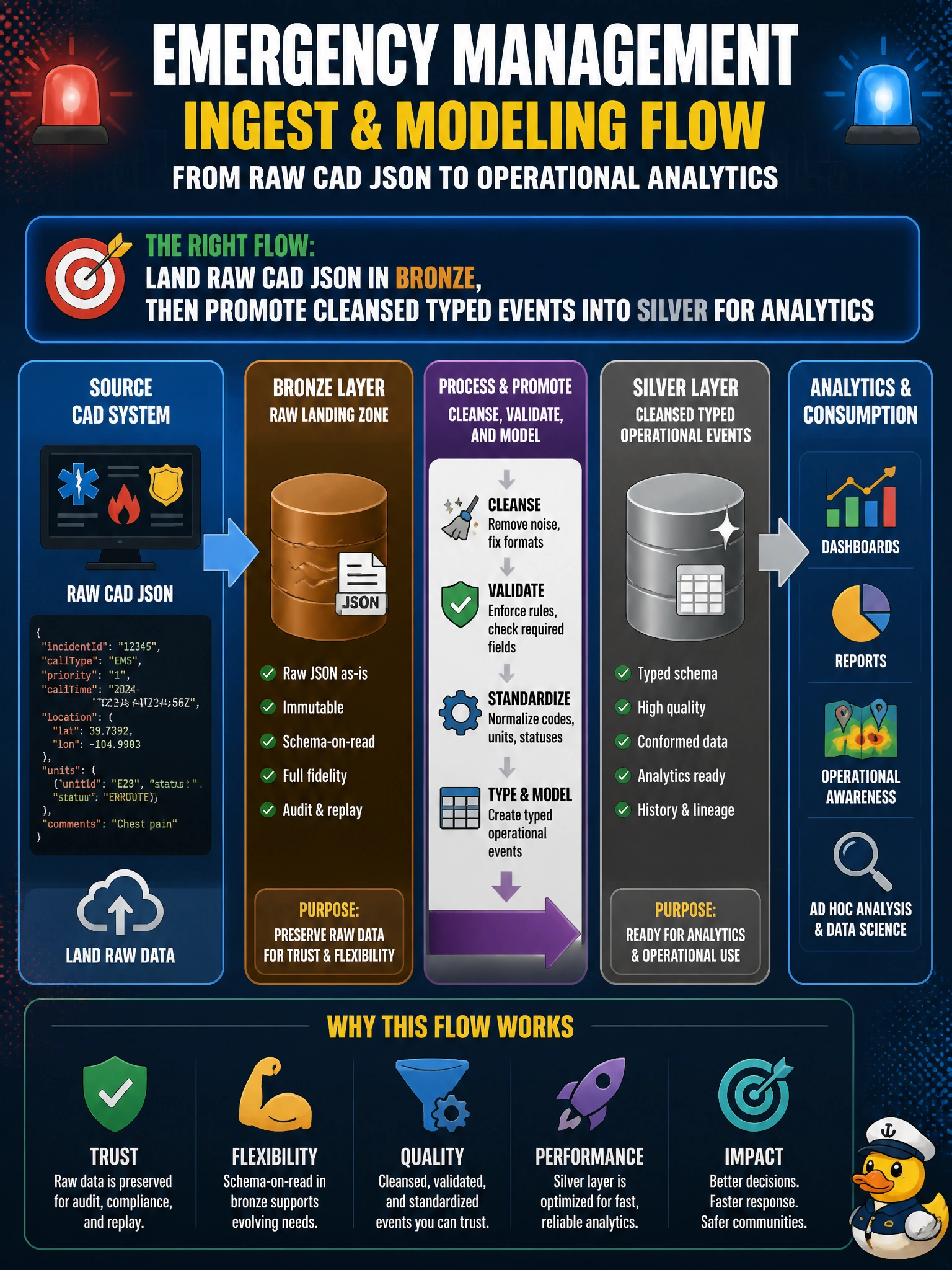
Emergency management must land raw CAD JSON then promote typed operational events for analytics. Which ingest and modeling flow fits?
Select an answer to reveal the explanation.
Short Explanation
Raw CAD JSON is the dispatch tape; silver is the typed incident log—land the tape first, then promote clean events so analytics are not guessing from messy payloads.
Full Explanation
Emergency-management CAD ingest should follow the medallion path: land raw CAD JSON in bronze as received, then promote cleansed, typed operational events into silver for analytics. Raw payloads preserve fidelity for replay and audit; silver gives dispatch analytics a typed incident log without forcing dashboards to parse messy JSON. That layered flow is the standard municipal operational modeling pattern.
Landing raw CAD JSON in silver and then promoting cleansed typed events into silver for analytics misplaces the raw landing, so silver mixes messy JSON with typed events with no bronze as-received copy for replay and audit. Landing raw CAD JSON in bronze and then promoting cleansed typed events into gold for analytics misplaces the typed operational layer, so gold holds row-level events instead of business aggregates with no silver incident log to build from. Landing raw CAD JSON in bronze and then promoting cleansed typed events into bronze for analytics collapses promotion in the raw layer, so bronze mixes typed records with as-received payloads with no silver incident log for validation and reuse.
Exam caveat: bronze is raw, silver is cleansed/typed, gold is business aggregates—do not skip layers because a dashboard wants fields quickly; promote deliberately. Operational check: land sample CAD JSON to a bronze path/table unchanged, build a silver promotion that parses and types key incident fields, validate row counts and null rates, and point analytics only at silver (or gold derived from it), never at production CAD.
Prefer to study offline? Printable PDF study book + test engine ($7.50, unofficial). These questions stay free here.