
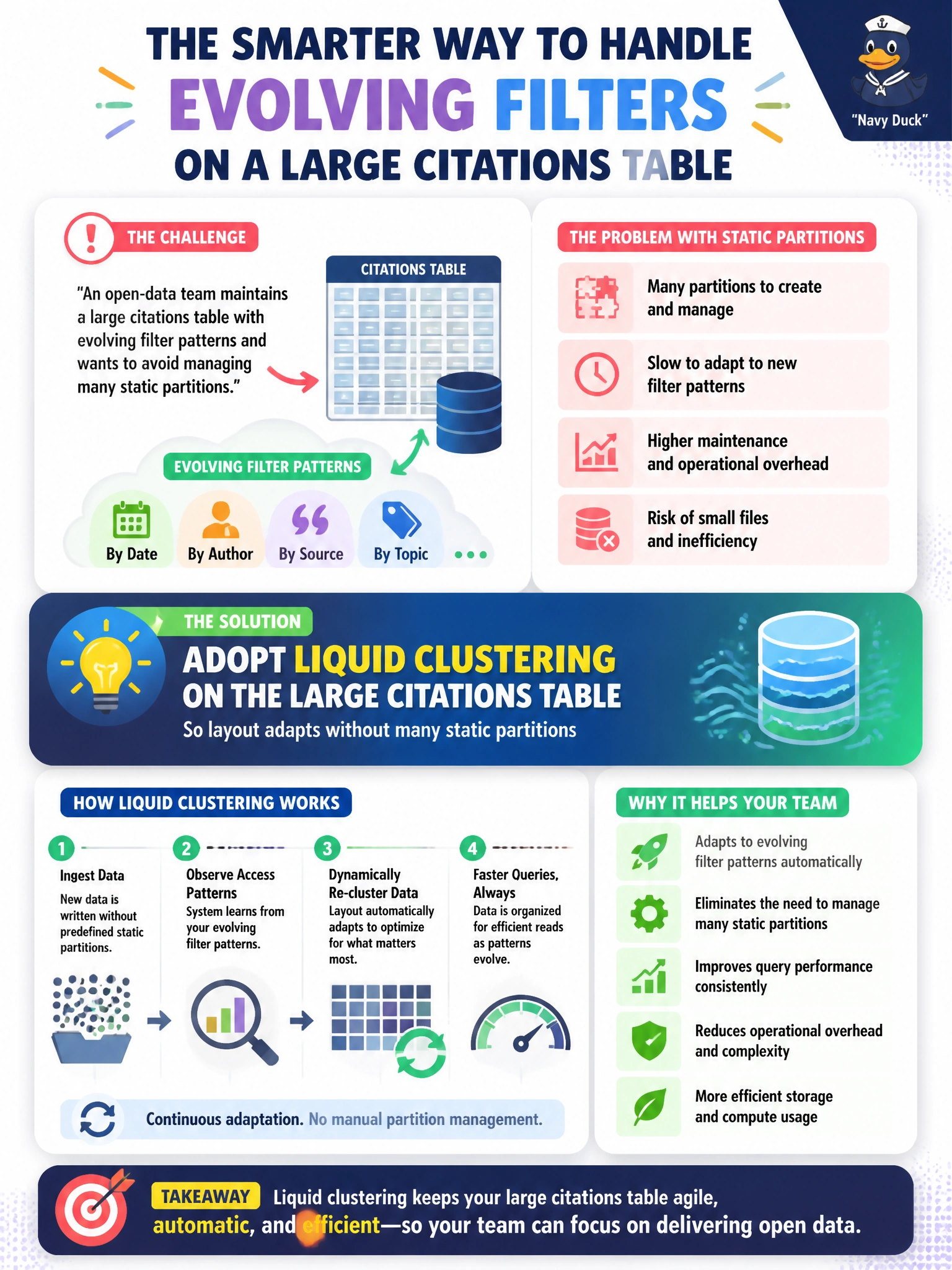
An open-data team maintains a large citations table with evolving filter patterns and wants to avoid managing many static partitions. What should they adopt?
Select an answer to reveal the explanation.
Short Explanation
Liquid clustering is the self-organizing filing room—citations settle into useful neighborhoods without you relying just on Auto OPTIMIZE with bin-packing to keep files compact. When filters evolve, that compact-only layout won't cluster for your new predicates, and you'll scan more than you need to.
Full Explanation
Open-data citations tables grow large and filter patterns evolve as portals and analysts change predicates. Liquid clustering lets Delta adapt data layout over time without relying only on Auto OPTIMIZE with bin-packing on the large citations table that compacts files but cannot cluster data when citation filters change. That adaptive layout strategy reduces partition explosion while still improving locality for common citation queries as access patterns shift. Auto OPTIMIZE with bin-packing on the large citations table keeps layout compact by combining small files but does not cluster data for new filter columns and forces broader scans when civic filters shift to author, venue, or date ranges. Scheduled OPTIMIZE with Z-order on the large citations table clusters data for author filters only and does not adapt the physical layout to the evolving, multi-column citation filters this portal needs. File-level data skipping on the large citations table helps queries skip files for evolving filters but does not reorganize file layout to keep pace with evolving filter patterns across the citations table. Exam caveat: liquid clustering is the adaptive clustering solution—Auto OPTIMIZE with bin-packing only compacts files, and that compact-only layout is the anti-pattern here when filters evolve. Operational check: enable liquid clustering on the large citations table for the high-cardinality filter columns that matter, run representative open-data queries before and after clustering maintenance, monitor file counts and scan bytes, and avoid relying only on Auto OPTIMIZE with bin-packing for compaction when portal facets keep changing.
Prefer to study offline? Printable PDF study book + test engine ($7.50, unofficial). These questions stay free here.