
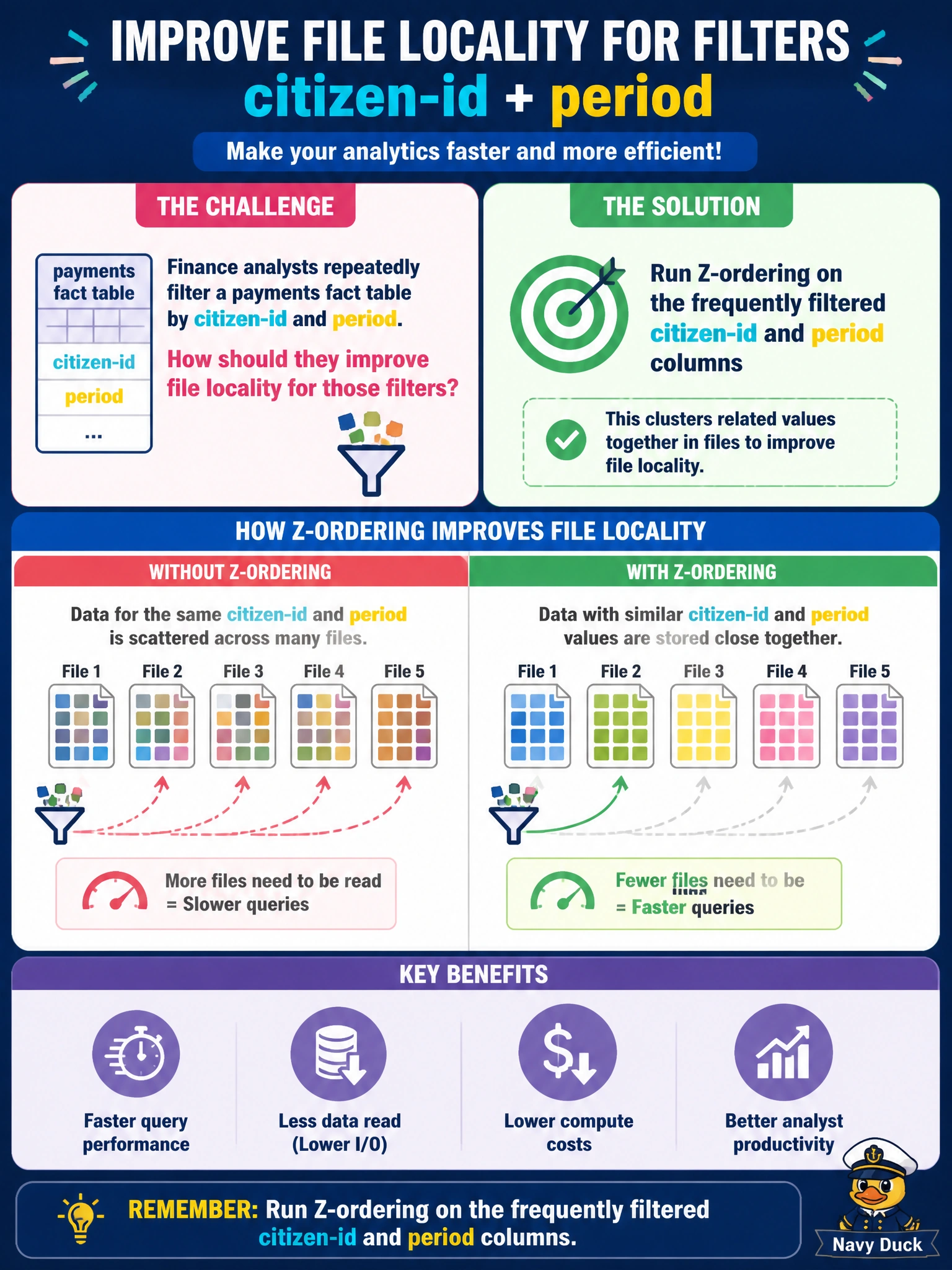
Finance analysts repeatedly filter a payments fact table by citizen-id and period. How should they improve file locality for those filters?
Select an answer to reveal the explanation.
Short Explanation
Z-ordering is co-locating payment slips by citizen and period so the clerk does not walk the whole warehouse for one account's month.
Full Explanation
Finance payment facts that are repeatedly filtered by citizen-id and period benefit from Z-ordering (multi-dimensional clustering of related values inside Delta data files). Z-ordering improves file locality so predicates on those columns skip more irrelevant files, cutting scan cost for municipal account-period lookups that dominate payment analytics and citizen service desks.
Partitioning the fact table by citizen-id and period columns for locality would create a massive number of tiny partitions because citizen-id is high-cardinality, causing small-file and listing overhead instead of efficient locality, whereas Z-ordering clusters those values inside files without partition explosion. Enabling bloom filters on the citizen-id and period columns can help skip files for those predicates but does not cluster or co-locate the values to improve file locality, so the analysts' filters still scan scattered data without the locality benefit of Z-ordering. Hash repartitioning on the citizen-id and period columns for improved locality shuffles rows by hash across files but does not sort and co-locate related citizen-id and period values together inside files, so it fails to improve file locality and skipping for the filters that dominate payment analytics.
Exam caveat: Z-ordering targets multi-column locality for selective filters; it is complementary to partitioning/clustering choices and should be applied to the columns that actually appear in WHERE clauses. Operational check: identify the top filter columns on the payments fact (citizen-id, period), run OPTIMIZE … ZORDER BY on those columns, compare bytes scanned for a typical citizen-period query before and after, and schedule Z-order maintenance after substantial loads; partitioning by citizen-id and period would cause partition explosion on high-cardinality citizen-id, so it is not a substitute for Z-ordering for those citizen-period predicates.
Prefer to study offline? Printable PDF study book + test engine ($7.50, unofficial). These questions stay free here.