
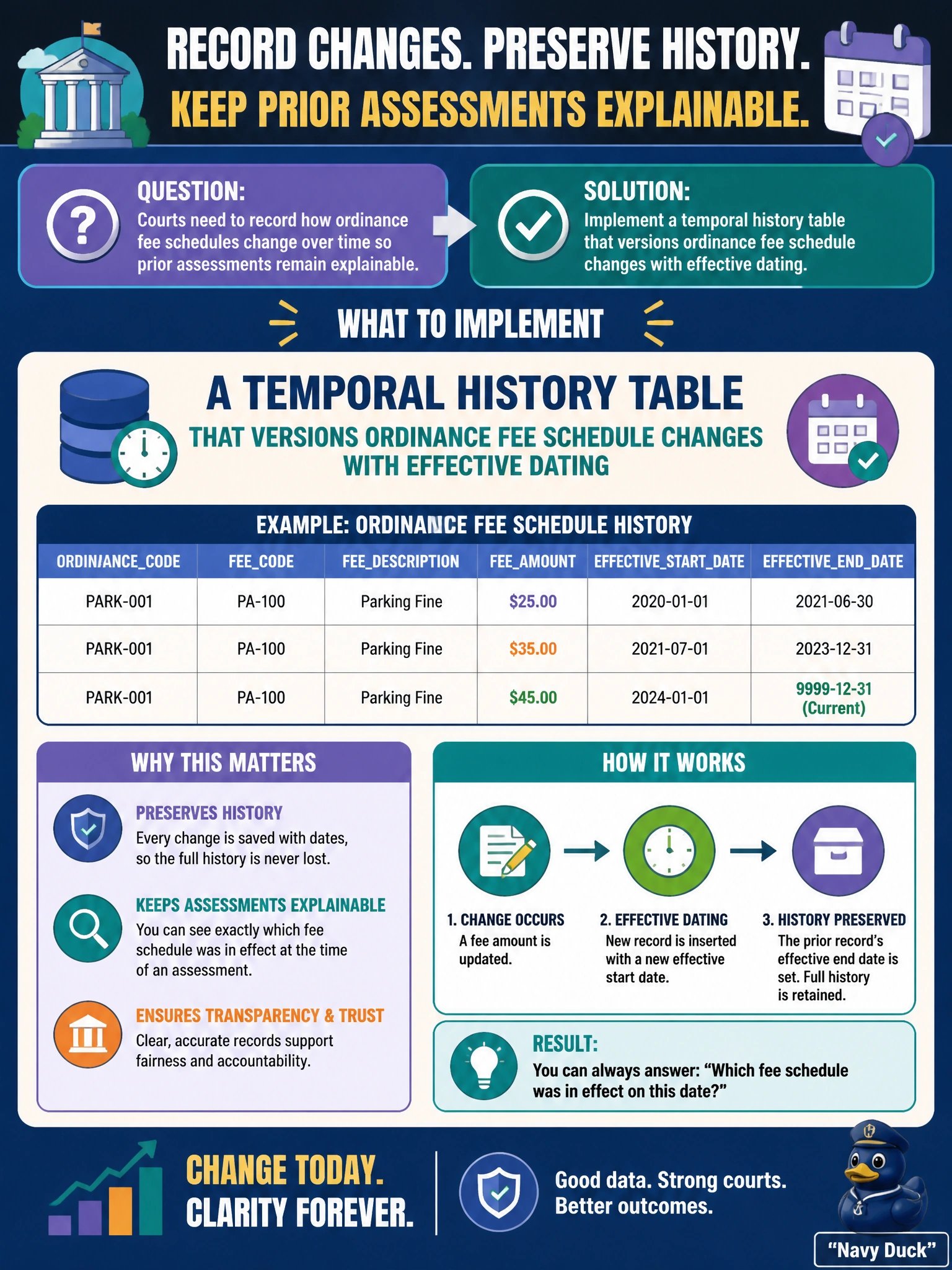
Courts need to record how ordinance fee schedules change over time so prior assessments remain explainable. What should they implement?
Select an answer to reveal the explanation.
Short Explanation
A temporal history table is the court's fee binder with dated tabs—when rates change, you add a new page since you'll lose history if you expect a Type 1 dimension to version changes with effective dating when it just overwrites. That way, you'll always pull the rate that was actually in force on the date of the citation.
Full Explanation
Courts that reassess ordinance fees need prior assessments to remain explainable when council changes rates. A temporal history (SCD-style) table that versions fee schedules with effective dating preserves which rate applied on which date, so an old citation or permit fee can be reconstructed from the lakehouse rather than from institutional memory. Effective-from/to columns (or equivalent version keys) keep municipal reference data auditable across ordinance amendments. A Type 1 dimension table that versions ordinance fee schedule changes with effective dating mislabels the approach because Type 1 overwrites to current values for efficient joins and keeps no effective-dated history, so it erases prior rates and breaks explainability for assessments already issued. A Git-versioned pipeline repository that versions ordinance fee schedule changes with commit history tracks commits, not queryable effective-dated fee data, so it leaves no lakehouse history of which rate applied on a given date and fails governance for analytics and appeals. A materialized reporting snapshot that versions ordinance fee schedule changes with nightly refresh still overwrites to current rates each refresh for dashboards and discards the temporal trail courts need. Exam caveat: temporal reference data is not optional decoration—effective dating is how municipal systems prove which fee applied at assessment time. Operational check: implement a history table (or SCD Type 2 dimension) for ordinance fee schedules, load a rate change with a new effective date without mutating prior rows, query an assessment date in the past and confirm the correct historical rate returns, and verify current-rate consumers still resolve the active version.
Prefer to study offline? Printable PDF study book + test engine ($7.50, unofficial). These questions stay free here.